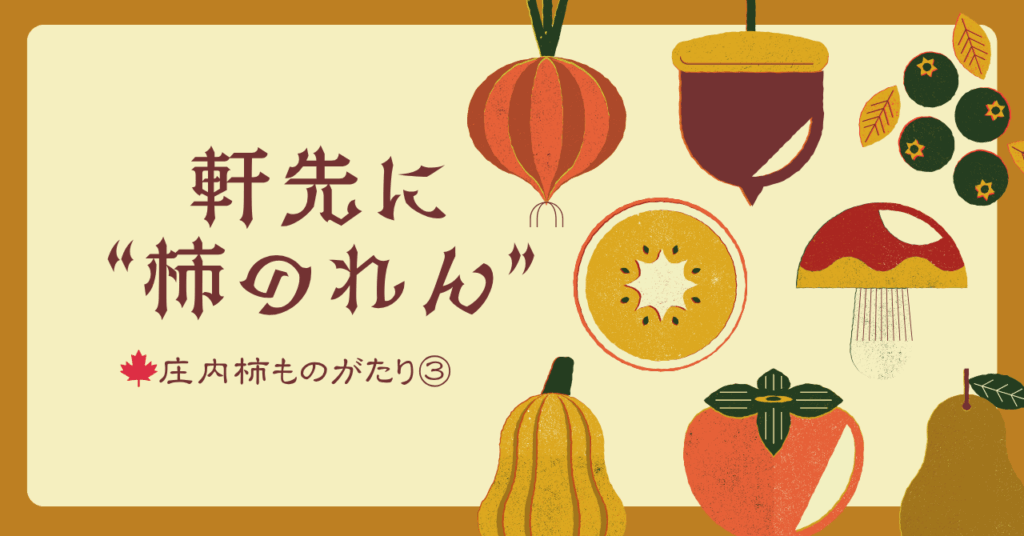
When the morning and evening chill suddenly sharpens, “persimmon curtains” start appearing all around towns in Shonai.
Orange persimmons hang under the eaves, swaying gently as they let the winter light shine through.
Whenever I see that scene, I think, “Winter’s really on its way.”
Hoshigaki—dried persimmons—are a winter wisdom born alongside Shonai’s cold.
The crisp, dry wind slowly draws moisture from the fruit, concentrating its sweetness as it goes.
Shonai winters are harsh, but it’s that very cold that creates that gentle, mellow sweetness.
The origins of dried persimmons—and why they took root in Shonai
The history of hoshigaki goes back a long way—people say that as far back as the Heian period, there was already a culture of “drying persimmons to preserve them.”
In those days, they were a preserved food for temples and the aristocracy, and in colder regions they were especially treasured as a rare source of sweetness.
In the Edo period, persimmon cultivation spread across Japan, and in cool, low-humidity areas like Shonai, people could make high-quality dried persimmons through natural air-drying alone.
They became popular as souvenirs for pilgrims visiting the Dewa Sanzan, and as year-end gifts as well—eventually taking root as “the taste of a Shonai winter.”
“Eating the sun in winter”— Hoshigaki is a Shonai seasonal tradition that fits those words perfectly. Up until the Showa era, nearly every home had a “persimmon curtain” under the eaves, and it was a late-autumn ritual: the whole family peeling persimmons together, then watching over them as they swayed in the wind.
The differences between hoshigaki, anpogaki, and dried fruit
These days, even when we say “drying persimmons,” there are many different styles. There’s the traditional sun-dried method, the modern low-temperature–dried “anpogaki,” and lately, dried fruit has become popular too. Each one has its own character and flavor.
Hoshigaki shaped by Shonai’s cold winds is known for keeping a “clean, pure fragrance” within its sweetness.
It finishes without over-drying, retaining just the right amount of moisture.
That’s a flavor you can only get from Shonai’s winter air.
The joy of making your own dried fruit at home
A few years ago, Sachiko started slicing Shonai persimmons to make homemade dried fruit.
At first, she tried it just out of curiosity, but drying concentrates the sweetness and aroma—and it pairs wonderfully with black tea and yogurt.
It’s easy to make.
Slice the persimmons thinly—about 5 mm—then hang them in a well-ventilated place for about two weeks.
Flip them partway through so they dry evenly.
The key is to stop when they’re about 80% dry.
Instead of drying them completely crisp, leave a little softness and you’ll get a texture similar to dried sweet potato.
Float a slice in black tea and it turns gently sweet and fragrant. Pair it with cheese or nuts and it becomes a perfect wine companion.
Mix it into granola or scones, and it transforms into a naturally sweet treat.
But… this year the cold came too early, and I missed my chance to make them.
It felt like autumn slipped by in the blink of an eye.
Still, maybe that’s the point—because there are seasons we “miss,” next year becomes something to look forward to.
Sachiko’s recommended ways to enjoy them
Hoshigaki isn’t just something to enjoy with tea—add a little twist, and it shows you all kinds of different sides.
① As a tea-time treat.
Enjoy round slices of hoshigaki with warm sencha or hojicha.
The balance of gentle bitterness and sweetness softens you right down.
② Pair it with cheese.
The saltiness of Camembert or blue cheese with the sweetness of hoshigaki—
it’s unbeatable with wine.
③ Hoshigaki butter toast.
Layer sliced hoshigaki on toast spread with butter.
The balance of toasty aroma and sweetness is spot-on.
④ Yogurt + chopped hoshigaki.
If you want to make up for the vitamin C that’s lost in drying,
add kiwi or mandarin oranges too—it becomes even more refreshing.
⑤ For baking.
Chop it finely and mix it into scones or pancakes,
and you can cut back on sugar while still getting natural sweetness.
With just a small extra step, “the old ways” connect with “life today.”
Try bringing a little of Shonai’s winter flavor into your everyday table.
What a guest taught me
The other day, a guest staying at Watausagi told me this:
“I love ‘not-fully-dried’ persimmons you can make in about two weeks, so every year I buy persimmons to take home just for that.”
I didn’t make it in time this year, but I’m thinking, “Next year, I’ll try making them too.”
I’m already looking forward to the next season.
I didn’t make it in time this year, but I’m thinking, “Next year, I’ll try making them too.”
I’m already looking forward to the next season.
That's all for today's article.
For the latest updates, follow our Instagram stories.
Please follow and stay tuned 🥰
Likes and shares mean a lot to me too ❤️