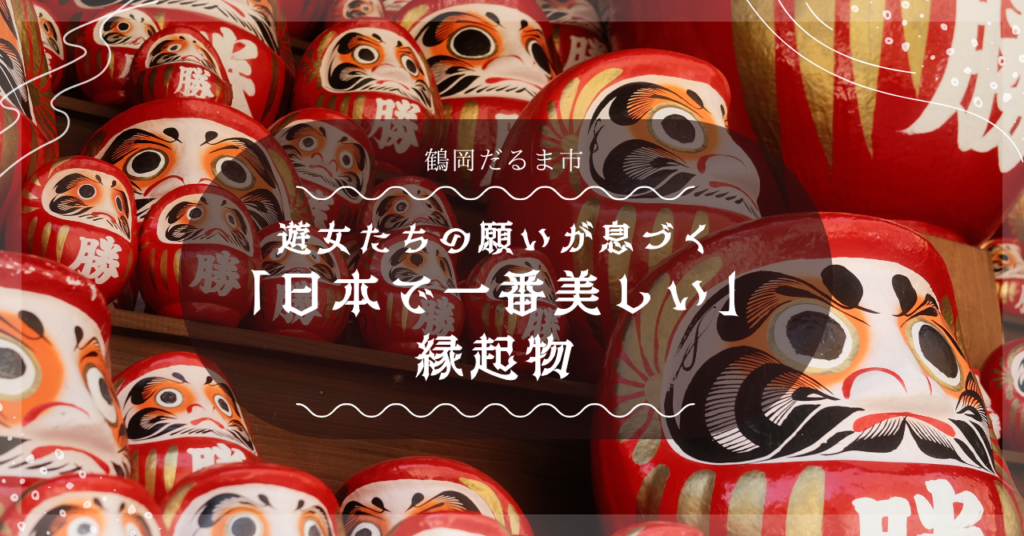
Tomorrow, December 17, a “Daruma Market” will be held at the Nanokamachi Kannon Hall in Tsuruoka. Locals also call it “Kannon-sama no Toshiyā (Otoshiyo),” and it’s the day when the year-end atmosphere finally starts to feel real.
Actually, I’ve never been there yet…
Tomorrow I’m going for the first time.
So today, as a bit of prep, I’m writing an article.
You might think a Daruma market is just a festival where red daruma dolls line up… but the more I researched it, the more fascinating it got—an unknown Tsuruoka (a “lost” Tsuruoka) started to come into view.
I have a feeling this might get a bit long, but I want to share it as vividly as I can.
One quick note before we begin. This article briefly mentions the former pleasure quarters that are said to have existed around Nanokamachi long ago. I’m not going to write about it in a sensational way. But if I avoid it entirely, I won’t be able to explain why Tsuruoka’s Daruma Market feels so uniquely special. It’s that kind of background. If it’s not your thing, feel free to skim past just that section.
Tsuruoka’s Daruma Market is where “four strands of history” cross on the same night.
What I found most fascinating was that the Daruma Market is…
-
the history of Tsuruoka as a castle town
-
the history of Nanokamachi—and its ties to the pleasure quarters
-
the history of daruma—“fall seven times, get up eight”
-
the history of kirizanshō (cut sanshō sweets)
These four threads all tie into a single knot—in the same place—on one day (really, one night): December 17.
I’d like to untangle them one by one.
1. Tsuruoka’s town history: year-end customs that set the whole town in motion
To begin with, Tsuruoka feels like a place that really cherishes the small events woven into everyday, old-fashioned life.
Among those events, the biggest one is the year’s turning point—New Year’s.
As the end of the year approaches, people straighten up the house, start preparing for the holidays, cleanse, and celebrate.
I think these are simple, visible rituals for telling your heart, “We made it this far.”
And because this is a land that’s about to enter a long season of snow, these kinds of practices—little “handwork” of the spirit—have kept going as customs and annual traditions.
What’s interesting is that in Tsuruoka, customs called “toshiyā” (year-end nights) — ways of marking the year’s turning point — don’t exist in just one form. There are several that still remain.
Like Daikoku-sama’s toshiyā, where people eat natto soup and grilled hatahata, and share omiki. A culture of welcoming the year’s end through household rituals is still very much alive here.
And one of those toshiyā traditions might be the Daruma Market at the Nanokamachi Kannon Hall. This isn’t just a “daruma clearance sale.”
It’s Kannon’s year-end night.
The Daruma Market feels less like an event invented to draw a crowd, and more like a year-end custom that becomes, not just something done at home, but a whole town’s bustle for one special night.
That’s why it’s been held on the same day, in the same place, year after year—and why it still continues.
Seeing it that way shifts how the Tsuruoka Daruma Market looks, just a little.
2. Nanokamachi as the stage: people gathered on the town’s “front,” while the “back” moved outside
The venue is the Nanokamachi Kannon Hall. In today’s address system it’s in the Honchō area, but the fact that the name “Nanokamachi” still survives is proof that this neighborhood was the town’s center for a very long time.
Back when Tsuruoka was a castle town,
Nanokamachi was where people gathered to shop and run errands.
There were stores, people walking, things getting done. And where people gather, conversation naturally multiplies.
So Nanokamachi has long been the kind of place that never runs out of stories.
Town news, rumors, fresh information—everything would pass through here first and then spread outward. It was, in a sense, the town’s “front stage.”
But the key point here is this: there was a time when that “front stage” also had a “back stage” living right alongside it.
In early modern Tsuruoka, it’s said that a licensed pleasure quarter (yūkaku / yūri) existed around Nanokamachi and Hachikenmachi. By today’s sensibilities you might think, “Right in the middle of town?” But back then it was natural for both commerce and entertainment to gather where the flow of people was.
Because it was the center, people came. Because people came, the town kept turning. That’s the kind of era this is talking about.
But that isn’t where the story ends.
As the town’s structure shifted from the Taishō into the Shōwa era, the pleasure quarters began to move in a direction that separated them from the town center.
Transportation patterns changed, urban reorganization progressed, and ideas about public morals and hygiene grew stronger. As a result, the quarters that had been near Nanokamachi and Hachikenmachi later relocated toward Futaba-chō. And so, over time, Nanokamachi was left with only the “front stage.”
The more I look into it, the more fascinating it gets.
When you keep that flow in mind, the location of the Daruma Market starts to mean something.
Held at the Nanokamachi Kannon Hall, it reads less like a tourism event and more like a long-loved year-end errand that happens right in the town’s center. In a place where people naturally gather, New Year preparations become a “market.” That’s why people come every year as a matter of course—along with the conversations and the buzz—and why it’s endured as part of the town’s calendar.
Even now, once a year, the Daruma Market still swells with people.
And these daruma dolls—somehow—have a history of being deeply loved by the courtesans who worked in those pleasure quarters.
3. The pleasure-quarter history: a hard-to-tell backdrop that thickens the “density” of wishes
As I mentioned briefly earlier, it’s said that a licensed pleasure quarter once existed around Nanokamachi. This isn’t something you can talk about lightly in today’s terms—because the people who lived there likely had very limited freedom and choice.
For women at that time, the reasons for entering a pleasure quarter can’t be explained by personal choice alone.
Bad harvests, poverty, family debt, a parent’s illness—circumstances like these could lead to a daughter being placed there under a fixed-term contract, as “nenki hōkō.”
A family borrows money from the quarter, and the daughter works for years to repay it. The advance could help the household, but it also became her “debt,” and it wasn’t something you could simply walk away from.
There are also stories of women being deceived, brought in through brokers, or drifting there after losing any place to go.
Details differed from person to person, but what many shared was this: a lot of them weren’t in a situation where they could freely choose.
But precisely because that background exists, it’s easy to imagine that daruma came to mean something beyond a simple good-luck charm.
Not every woman living in the pleasure quarters would have been satisfied with her work or her life.
Surely many carried a wish like this: someday I want to change my life. I want to change my situation. I want to change tomorrow. In an era when even stepping out into the public world wasn’t easy, Kannon’s year-end night—the Daruma Market—may have been a rare day when they could blend into the town’s bustle.
And the “symbol” they could take into their hands that night was the daruma.
Seen that way, the red daruma suddenly stops being just decoration.
4. The history of daruma: “fall seven times, get up eight” isn’t about grit—it’s the feeling of starting over
Daruma are said to be modeled after Bodhidharma and are often talked about in connection with the world of Zen. There are also various theories about why they’re red—because of the color of his robe, as protection from evil, as a charm against epidemics, and so on. But the essence of daruma for ordinary people is much simpler.
What makes daruma so powerful as a “tool for everyday life” is that you don’t need any complicated knowledge to get the meaning. You set it down and it catches your eye. You touch it and it wobbles. You knock it over—and it stands back up.
It falls, and it gets back up. That motion is right there in front of you. I think that alone gave people courage.
When you look at a daruma, even if something knocks the ground out from under you, you start to feel like you can stand back up again. And daruma doesn’t say a word. It just silently rights itself. That’s the strength of it.
As I mentioned in section 3, many of the women who lived in the pleasure quarters had circumstances that kept them from freely choosing their lives.
That’s exactly why the daruma’s motion—getting back up—may have resonated as something more than a simple good-luck charm.
Even if your life isn’t yours to shape the way you want, you don’t give in. Maybe that was the kind of courage they drew from a daruma.
Daruma are sold with blank eyes. Because “filling in the eyes” is basically the whole point of buying one.
That custom is like putting your wish into words and setting it down somewhere.
The act of painting in an eye is, in itself, a way of getting your mind in order. Before whether the wish comes true or not, you make visible what it is you truly want.
Doing that at the end of the year feels incredibly sensible.
The wishes of the courtesans likely weren’t vague ideals—they would have been directly tied to survival. Don’t get sick. Don’t get dragged into trouble. Don’t lose your regular patrons. Reduce your debt. Someday, get out of here. Being able to turn those wishes into something visible and keep it in your room—that’s what a daruma offered.
And the red color, in the sensibilities of that time, meant more than just “pretty”—it carried the sense of protection.
For example, red was treated as a color that wards off illness and misfortune, including things like smallpox, and red dolls and charms were kept close at hand. In a place with constant comings and goings, I imagine some people would have felt that meaning especially strongly.
And in Tsuruoka, the night you could get that daruma was Kannon’s year-end night—the Daruma Market. On a bustling night in the town center, in an atmosphere different from everyday life, you buy a daruma and paint in an eye as if to say, “Next year, I’ll do this.”
Daruma may have become less of a lucky charm and more of a “marker” you leave for your future self.
5. The history of kirizanshō: the Daruma Market’s “flavor signal”
And what you can’t separate from Tsuruoka’s Daruma Market is kirizanshō—that strip-shaped mochi sweet, where sweetness comes first and then the fragrance of sanshō pops with a little bite.
Kirizanshō is a sweet, but it somehow wears the face of “part of the ritual.” Probably because the aroma is so strong, it sticks in your memory. It’s like—when that scent shows up, your body understands before your brain does: “It’s year-end.”
So why kirizanshō at a Daruma Market?
I suspect the reason is pretty down-to-earth.
One reason is that it’s easy to take home. At a winter market, you can bring it back, share it, and it even works as a small gift. It slips neatly into the rhythm of year-end shopping.
Another is the power of the aroma. Sanshō has long been treated as something that can change the air through scent. Even without putting the word “warding off bad luck” front and center like we might today, you can feel it. The moment it hits your mouth, that bold fragrance rises and your mood flips. It’s small, but it works as a real “signal.”
And the Daruma Market is Kannon’s year-end night—a night to buy good-luck items.
If daruma is a “good-luck charm you can see and hold,” then kirizanshō is a “good-luck charm you eat.” One goes in your hand, the other in your mouth. When you have both, the year-end switch feels complete. That, to me, is the coolness of Tsuruoka’s Daruma Market.
That’s why kirizanshō can be “just a snack,” yet still wear the face of a year-end ritual.
Because with its taste and aroma, it presses the year-end switch in you.
That’s why Tsuruoka’s Daruma Market feels “beautiful.”
There’s the flow of people gathering in a castle town, the stage called Nanokamachi, the layered “I want to change things” feelings—spoken and unspoken—and the daruma that holds those feelings, and then kirizanshō that lands them back into everyday life.
All four of those rise up, every year, on December 17, in the same place.
So Tsuruoka’s Daruma Market isn’t just a festival stall scene. I think it’s an accumulation of the town’s memory.
What makes me feel it’s “the most beautiful in Japan” isn’t visual flashiness, but because people’s lives and feelings have remained—still visible—in a tangible form. And maybe that’s why there are moments when the red of those daruma looks strangely quiet.
Tomorrow, I’ll move on to the “experience” side: how do you enjoy it—and why is it so loved?
明日は実際に行って、時間帯、混雑、回り方、だるまの選び方、切山椒の食べ比べ(できたら)、写真の撮りどころまで、具体的にまとめます。
そして最後に、「なぜこんなにも愛されるのか」を、今日の予習と現地の体感をつないで言葉にしたいと思います。おたのしみに❣️
That's all for today's article.
For the latest updates, follow our Instagram stories.
Please follow and stay tuned.
Likes and shares are also very appreciated.
Related Articles
Enjoy the charm of central Tsuruoka city! Shonai Shrine and 10 recommended spots around it
Syogin Tact Tsuruoka|A Journey to *Experience* the World-Class Architecture Designed by SANAA