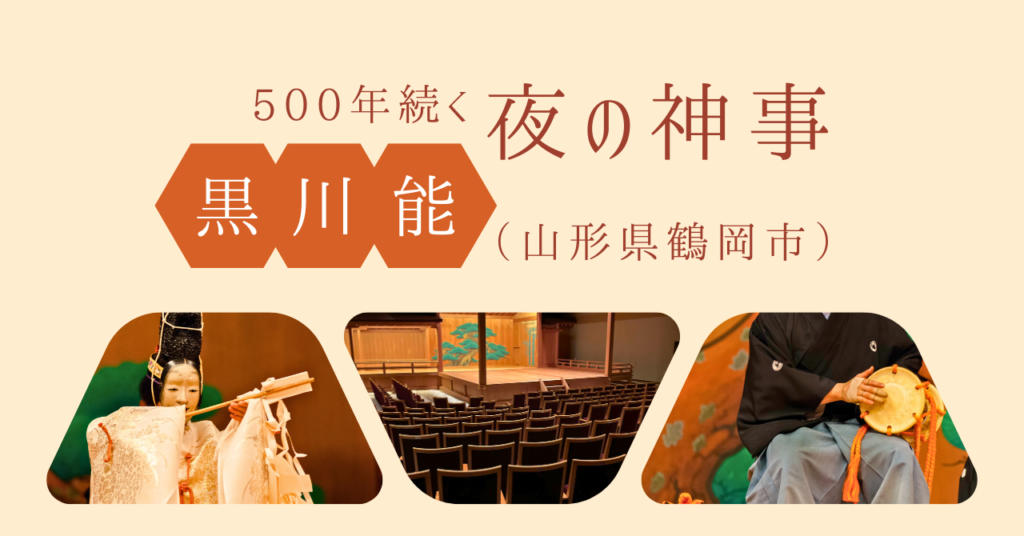
Kurokawa Noh is a form of Noh theater that has been passed down in the Kurokawa district of Tsuruoka City, Yamagata Prefecture, and is said to have continued for about 500 years. It is designated as an Important Intangible Folk Cultural Property of Japan.
Kurokawa Noh is distinct from the Noh performed in formal Noh theaters. It developed not as a performance meant to entertain an audience, but as an annual ritual dedicated and offered before the gods.
Understanding this difference first makes it easier to grasp the characteristics of Kurokawa Noh. It is not a stage created to entertain an audience. Instead, it is a dance performed in a fixed form, at a fixed time, by the people of the community, and dedicated to the gods. This is the essence of Kurokawa Noh, and the reason it is designated by the Japanese government as an Important Intangible Folk Cultural Property that should be preserved.
In this article, I would like to introduce Kurokawa Noh.
Chapter 1 | What Is Kurokawa Noh
Kurokawa Noh is preserved in the Kurokawa district of Tsuruoka City.
As the name suggests, it is a culture unique to this area.
It does not require a large stage or a big audience.
Unlike performing arts created for the stage, it should be understood as a form of folk performing art that has been passed down as part of everyday life in this community.
The people who carry on this tradition are not professional Noh performers, but members of the local community.
Not only the dancers, but also the musicians—such as those playing the flute and drums—have taken on their roles within the community itself.
That may be why the same forms and rhythms have been passed down continuously for more than 500 years.
Five hundred years ago, it is unlikely that most farmers could read or write.
So this is only a guess, but the movements of the dance and the rhythms of the music were probably handed down through oral tradition and by learning through observation and imitation.
If large numbers of unrelated people had been involved, it would not have been surprising if this culture had faded away instead.
The designation of an Important Intangible Folk Cultural Property by the Japanese government does not refer to physical cultural assets like buildings. Instead, it recognizes skills, rituals, and customs that have been passed down within local communities. In the case of Kurokawa Noh, the designation likely reflects not the quality of the performance itself, but the fact that the form of dedication has been preserved and that the tradition continues to function as part of the community’s cultural system.
In short, Kurokawa Noh is not a place to perform famous Noh masterpieces, but rather Noh as a community’s annual ritual. In the next chapter, we will explore why this annual ritual is performed before the gods.
Chapter 2 | Why Is It Performed Before the Gods? (The Purpose of Dedication and the Role of Form)
Kurokawa Noh is performed before the gods.
This is the most important point.
Kurokawa Noh has not been performed to be evaluated by an audience, but as an offering dedicated before the gods.
Dedication refers to the act of offering performances or offerings to the gods at places such as shrines.
Rather than expressing wishes through words, the emphasis is placed on conveying them through prescribed forms and rituals.
This is very close to the nature of what Kurokawa Noh has valued.
Winters in the Shonai region are marked by deep snow.
In the past, roads were easily blocked, making it difficult to access help or medical care.
People also used fire more often in winter, increasing the risk of fires.
Food became scarce, and concerns about health grew in the severe cold.
Getting through the winter must have been a far more urgent challenge than it is today.
In such an environment, once a year the community would stand before the gods and, through a fixed sequence of rituals, offer their wishes for the coming year. It is reasonable to imagine that Kurokawa Noh held this kind of role. In doing so, it may also have helped maintain order within the community. At the very least, it likely fostered a strong sense of unity among the people.
Then why “Noh”? It is difficult to identify a single definitive reason, but there is a structural explanation. In Noh, movements and sequences are fixed as formal patterns. Because of this, even when roles change, the same flow can be maintained. It is not a form that depends on a particular master performer. Instead, it works as a system where people take on roles, practice, imitate, and carry the performance through.
For a dedication performed before the gods, it is important that the event continues every year without interruption.
Verbal vows or declarations can easily lead to differences in interpretation. In contrast, a system based on established forms is easier to pass on to the next generation because “what needs to be done” is already defined. The long continuity of Kurokawa Noh may be partly due to how the premise of dedication and the nature of fixed forms fit well together.
Kurokawa Noh is not a tradition carried out by Shinto priests or shrine maidens, nor by intellectual elites such as samurai or court nobles. It is truly a culture of ordinary people living in the local community. People of this class in those days likely had little formal education and were often unable to read or write. It is therefore reasonable to imagine that Noh was a form of ritual that even such common people could perform before the gods.
Chapter 3 | Ōgi Festival (February 1–2): The Timing and Meaning of Kurokawa Noh
Kurokawa Noh is performed during the Ōgi Festival, held every year from February 1 to February 2. As part of this Shinto ritual conducted by Kasuga Shrine, the performances are dedicated through the night.
The Ōgi Festival is held in the middle of winter, when the cold is at its harshest and snowfall is at its heaviest.
Winters in Shonai are marked by deep snow and long nights.
At a time when daily life becomes more restricted, it is actually important for the community to share the same time together.
It may have been a night when the villagers gathered, staying up through the long winter night and enjoying it together once a year.

There are no flashy costumes or lavish meals.
People simply enjoy a moment outside of the ordinary.
While giving thanks to the gods.
That kind of night, and those two days, are what make up the Ōgi Festival and Kurokawa Noh.
Chapter 4 | The Tōya System: How the Tradition Continues Without a Noh Stage
One distinctive feature of how Kurokawa Noh is organized is the system known as tōya.
Each year, a selected household welcomes the deity and becomes the place where the Noh is performed.
Instead of a fixed Noh stage, an ordinary private home—normally used for daily life—is rearranged during the time of the Ōgi Festival and functions as the place of dedication.
Serving as the tōya naturally requires preparation and brings certain responsibilities.
Because many people come and go, there must be enough space for the Noh performance itself, space for the musicians, and seating arrangements for the audience so that many people can gather and enjoy the performance.
Homes in this region were built with this single night in mind—and for the role of tōya, which might come to a household several times in a lifetime.
It is common for houses here to have multiple tatami rooms connected in a continuous layout.
This can also be considered a distinctive characteristic of the region.
Owning a house capable of serving as the tōya may even have been a source of status within the community.
Chapter 5 | Kamiza, Shimoza, and the Tofu Festival: The People and Preparations That Sustain the Tradition
In the Kurokawa district, the people who carry on the Noh tradition are divided into Kamiza and Shimoza. This does not indicate a hierarchy. Rather, it is a structure that assigns roles in order to share responsibilities and ensure the dedication takes place.

If the continuation of a tradition depends on the skills of a particular individual, it becomes difficult to sustain once that person is gone. Kurokawa Noh has maintained its annual dedication by circulating roles within the community, allowing it to function as a system. The division into groups such as Kamiza and Shimoza is one example of the wisdom that enables the tradition to continue even as the people involved change over time.
Kurokawa Noh also cannot exist through the performers on stage alone. Preparations for the space, arranging the tools, and preparing food all require work carried out behind the scenes. The fact that the Ōgi Festival has also been called the “Tofu Festival,” and that handwork such as making freeze-dried tofu is done during the time of dedication, shows that the offering is organized as a form of collective work.
Freeze-dried tofu is a processed food made by using the cold of winter, and it requires both time and labor. The fact that such work is incorporated into the annual ritual shows that the dedication is not only about the performance itself, but also exists as a form of community work that includes preparation and organization.
The reason Kurokawa Noh has continued is not simply due to determination or spirit. There is the framework of the annual Ōgi Festival, the hosting system of the tōya, and the division of roles through Kamiza and Shimoza so that responsibility does not remain fixed to specific individuals. Even food preparation and demanding manual work are included. All of these have been carried out by the people of the region themselves, sustained through shared effort and enjoyment. That is why, even after 500 years, it continues as a living tradition.
Conclusion | The Shortcut to Understanding Kurokawa Noh Is to Look at the Structure of Dedication
Kurokawa Noh cannot be explained simply by the fact that an old form of Noh has survived. It is positioned as an annual ritual dedicated before the gods, performed within the framework of the Ōgi Festival. The venue is created through the tōya system, the roles of responsibility rotate through the divisions of Kamiza and Shimoza, and even the work outside the stage is carried out in ways that are practical and well-structured.
The value of Kurokawa Noh does not lie in a single performance alone, but in the fact that a system exists within the community that allows it to be carried out every year. The reason it is recognized as a cultural property cannot be separated from that structure.
Using this article as a starting point, when you watch Kurokawa Noh, try not to focus only on the beauty of the performance or its history. If you also enjoy the background—such as the reasons why it has been able to continue for 500 years—you may find the event even more fascinating.
It may have sounded a bit analytical, but in this small town where depopulation is becoming a serious issue, I believe that in order to preserve cultural traditions with such a long history, it is important not only to see what appears on the surface but also to understand the background behind them. That is why I wanted to share what I know, as much as I can.
If you would like to learn more, please visit the official website.
Since the dates are fixed every year, I highly recommend experiencing it at least once.
That's all for today's article.
For the latest updates, follow our Instagram stories.
Please follow us and stay tuned.
I'm happy to like and share .
📖 やまがたいいとこ の関連記事
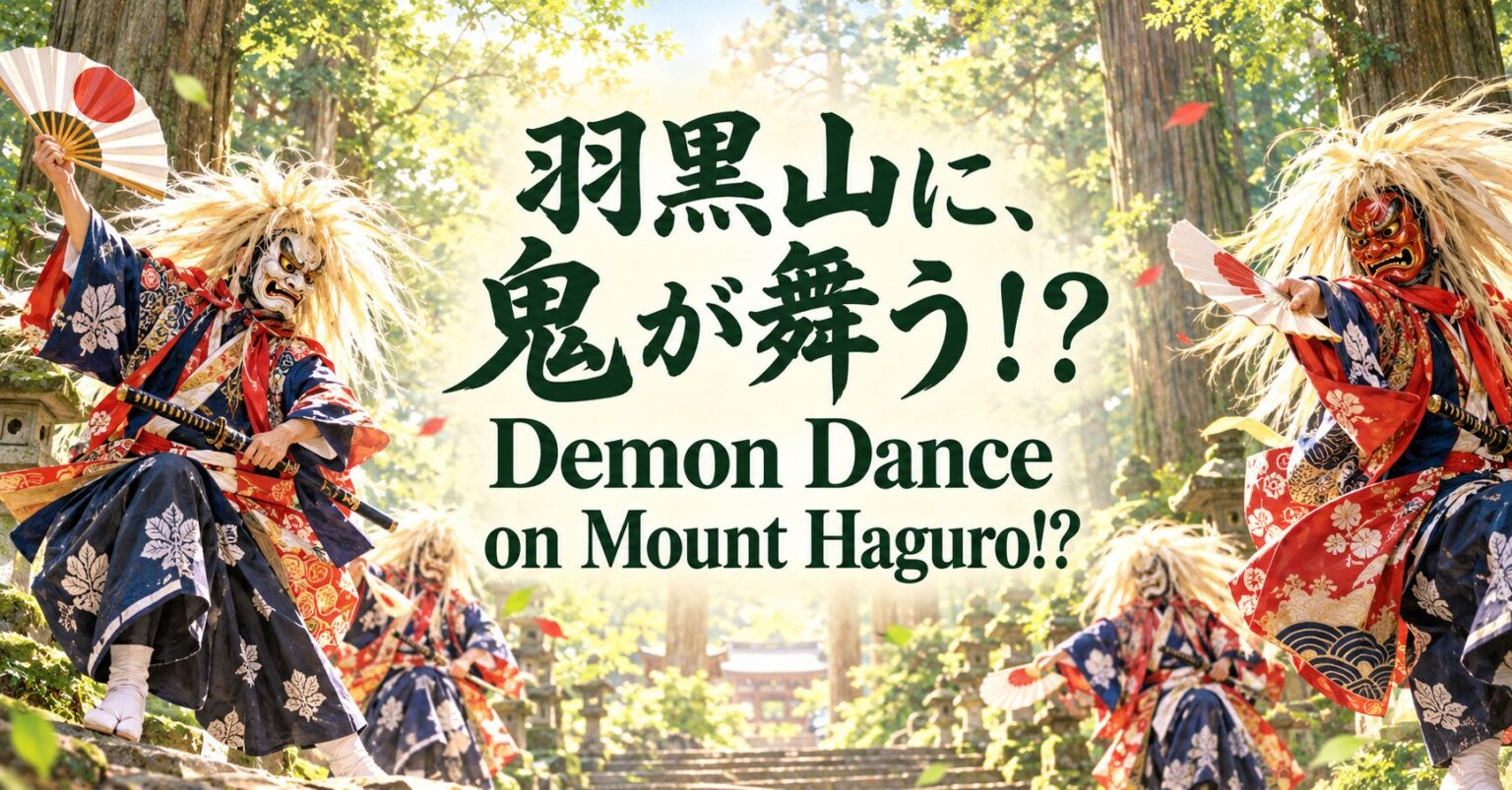
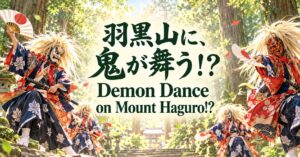 Demons Dancing on Mount Haguro!?
 Why a dragon god at a Buddhist temple? The mystery of Zenpoji (Tsuruoka) and its sea-guarding dragon faith
 Michelin-Starred Sakata: A Two-Star Tour Built on the Wealth of the Kitamae Ships
- STAY WITH US -
Your Base for Exploring Tsuruoka
A small guesthouse in central Tsuruoka, Yamagata. The perfect base for your trip to Dewa Sanzan and Shonai.
Book Now →