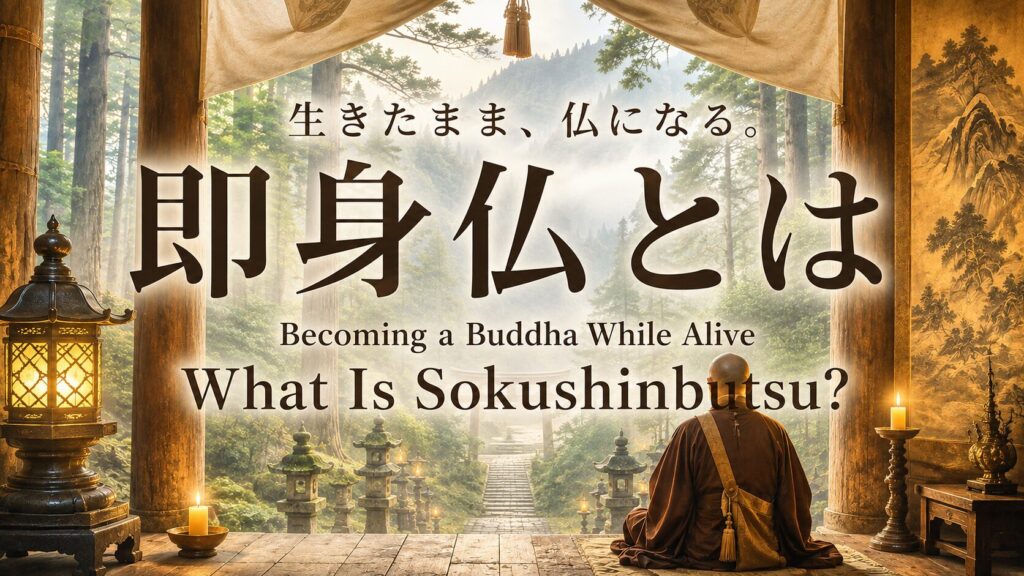
Have you ever heard the word sokushinbutsu (即身仏)?
Monks who sought to become Buddhas while still alive and who, through severe ascetic practice and fasting, mummified their own bodies — their remains are enshrined as sokushinbutsu in temples across the Tohoku region to this day.
Found nowhere else in the world and surviving only in Japan's Tohoku region, this tradition is deeply tied to the Shugendo of Dewa Sanzan.
Here we introduce what sokushinbutsu is, its history and the thinking behind it, and where you can see them today.
Note: Sokushinbutsu are enshrined human remains. Within their faith they are revered as Buddhas, but anyone who feels uneasy is under no obligation to view them.
→ About Dewa Sanzan and Shugendo (Article No.15)
What Is Sokushinbutsu? In a Word
A sokushinbutsu is a monk who pushed his own body to the extreme in order to become a Buddha while still alive, finally entering nyujo — a state of deep meditation, not the taking of one's life but the entering of profound stillness — after which the body naturally mummified.
The essential understanding is not "a mummy made by dying," but "becoming a mummy oneself as part of the practice of becoming a Buddha."
Buddhism holds the idea of sokushin jobutsu — becoming a Buddha in this very body. Sokushinbutsu has been regarded as the ultimate practice of that idea.
Sokushinbutsu (即身仏)
Sokushin = "this very body"; butsu = "Buddha, an enlightened one." The remains of a monk who mummified his own body as the final stage of practice aimed at becoming a Buddha while alive. They are still enshrined in temples in Japan (mainly Yamagata Prefecture) and are objects of veneration.
The History of Sokushinbutsu — Why It Survived in Tohoku
A Deep Connection to Shugendo
The culture of sokushinbutsu cannot be separated from the Shugendo thought centered on Dewa Sanzan.
In Shugendo, practitioners seek supernatural power (genriki) through extreme training in the mountains. Sokushinbutsu has been understood as its ultimate form — a practice that uses the body itself as the vessel of training, spending it to the very end.
Sokushinbutsu are concentrated in the Shonai region (around Tsuruoka and Sakata) because this area, strongly shaped by the Shugendo of Dewa Sanzan, is where such extreme practice took particular root.
The Process of Becoming a Sokushinbutsu (According to Tradition)
The training to become a sokushinbutsu is said to have been a gradual process spanning several years.
That said, there are various theories about the details, and accounts differ between sources. The following is what is broadly handed down, but not every sokushinbutsu necessarily followed the same path.
- Over several years, reducing body fat on an extremely sparse diet of nuts, roots, and the like.
- Drinking lacquer (urushi) tea to preserve the body internally (said to protect it from insects).
- In the final stage, entering a stone chamber or wooden coffin and entering a meditative state (nyujo).
- Leaving only a small air hole and a bell; when the bell no longer rang, he was judged to have entered nyujo.
- Exhumed years later; if the body had mummified, enshrined as a sokushinbutsu.
Note: The process above is based on tradition and texts, and not all details are confirmed as historical fact. The drinking of urushi tea in particular remains under ongoing research and debate.
Why Are They Concentrated in the Edo Period?
Most confirmed sokushinbutsu date from the Edo period (17th–19th centuries).
In 1879 (Meiji era) the government prohibited the practice, and it has not been carried out since. All surviving sokushinbutsu are monks who entered nyujo before the ban.
Sokushinbutsu Today — Where You Can See Them
About 20 sokushinbutsu survive in Japan today, most of them concentrated in the Shonai region of Yamagata Prefecture.
If you are traveling around Dewa Sanzan and Tsuruoka, these are spots well worth visiting.
| Temple | Sokushinbutsu | Location | Access |
|---|---|---|---|
| Dainichibo Temple (大日坊) | Shinnyokai Shonin | Oami, Tsuruoka | ~15 min by car from Mt. Haguro |
| Churenji Temple (注連寺) | Tetsumonkai Shonin | Oami, Tsuruoka | ~15 min by car from Mt. Haguro |
| Komyoji Temple (光明寺) | Chukai Shonin | Kitazawa, Sakata | ~30 min by car from Tsuruoka |
| Nangakuji Temple (南岳寺) | Tetsuryukai Shonin | Oyama, Tsuruoka | ~20 min by car from central Tsuruoka |
Dainichibo and Churenji draw the most visitors and offer detailed explanations. Many people visit them together with a Dewa Sanzan pilgrimage.
Please note that an admission fee applies. Check each temple's official information in advance.
How to Approach Sokushinbutsu
How you feel when facing a sokushinbutsu differs from person to person.
Some feel "afraid." Some feel "this is sacred." Some wonder, "Why would anyone do this?"
From the standpoint of faith, a sokushinbutsu already exists as a "Buddha" and is an object of worship. Seen that way, paying respects at the temple is no different from praying before an ordinary Buddhist altar or statue.
Even when visiting out of tourist or cultural interest, it is important to approach with quiet respect.
Final Thoughts — What Still Flows Through This Land of Prayer
That so many sokushinbutsu remain in Yamagata's Shonai region means that many monks once practiced here and longed to become Buddhas — and most of them were not special people from afar, but people who lived and prayed in this very land.
To think that people who believed so deeply, and disciplined themselves day after day, truly lived here in Shonai is somehow deeply moving.
And that diligent, wholehearted character feels, somehow, like it still flows quietly through this land today — in the warmth of Shonai's people, in their everyday spirit of giving way to one another, in a gentleness that may be the most beautiful thing about a people who have prayed, striven, and cared for one another since long ago.
Standing at its threshold, sokushinbutsu may feel a little daunting. But at its heart is a heart that cares for others. Together with a Dewa Sanzan pilgrimage, do come and touch the prayer of this land.
→ A model itinerary for Dewa Sanzan (Article No.6)
→ Shugendo: the mountain practice at the centre of this history [Article No.15]
Guesthouse Watausagi is ideally located — close to the sea, the mountains, and the city center alike. Use it as your base to explore all that Tsuruoka and the Shonai region have to offer.
We also share the charms of our home region — Yamagata, Tsuruoka, and the Shonai area.
I'm always sharing updates and local tips on Instagram Stories. Follow us on Instagram and stay in the loop! 😊
And a like or a share is always, always appreciated 💕
📖 やまがたいいとこ の関連記事
 Demons Dancing on Mount Haguro!?
 Why a dragon god at a Buddhist temple? The mystery of Zenpoji (Tsuruoka) and its sea-guarding dragon faith
 Michelin-Starred Sakata: A Two-Star Tour Built on the Wealth of the Kitamae Ships
- STAY WITH US -
Your Base for Exploring Tsuruoka
A small guesthouse in central Tsuruoka, Yamagata. The perfect base for your trip to Dewa Sanzan and Shonai.
Book Now →