
The three sacred mountains are spread across a fairly wide area in Yamagata Prefecture, and each one requires its own approach.
In this guide, I'll walk you through how to reach the region from major cities, how to access each mountain,
and how to put together an efficient itinerary — including the honest answer to the question everyone asks: 'Do I really need a car?'
→ New to Dewa Sanzan? Start here: What Is Dewa Sanzan?(Article No.1)
→ Deciding when to visit: Dewa Sanzan Season Guide(Article No.2)
Understanding the Layout: Where Are the Three Mountains?
All three mountains are located in Tsuruoka City (鶴岡市), Yamagata Prefecture, in the Tohoku region of Japan.
Mt. Haguro (Hagurosan) is the most accessible — it sits closest to Tsuruoka city center and is the only mountain reachable by regular bus. Mt. Gassan and Mt. Yudono are further into the mountains, roughly 45 minutes to 1 hour from Haguro by car.
Your practical base for exploring all three mountains is Tsuruoka — and specifically, Tsuruoka Station, which is where most transport connections begin.
Guesthouse Watausagi is located almost exactly between all three mountains, making it an ideal base for exploring Dewa Sanzan in any direction.
→ Google→ View the location of all three mountains on Google Maps
Getting to Tsuruoka: Your Gateway to Dewa Sanzan
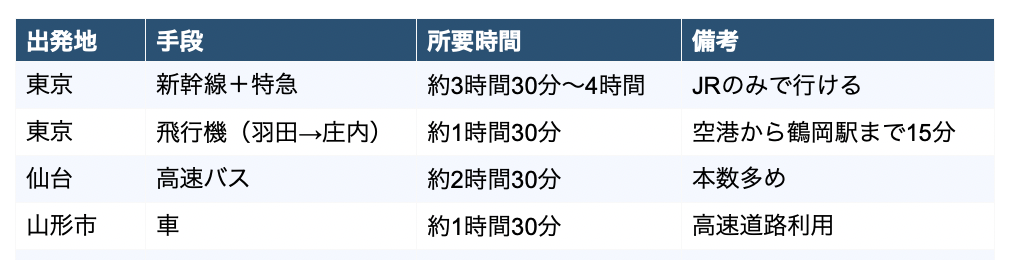
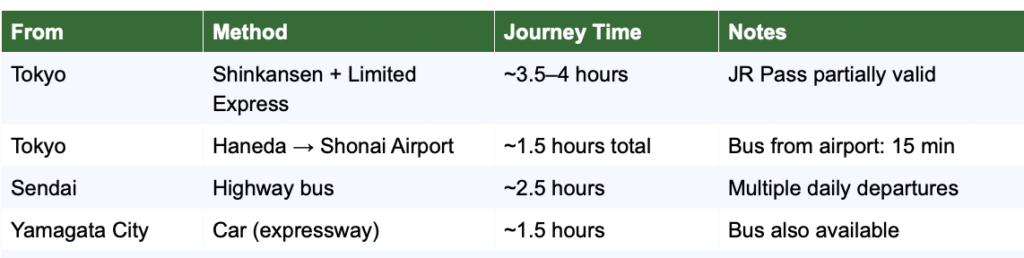
Before you can visit any of the three mountains, you need to get to Tsuruoka. Here's how to reach it from major starting points:
From Tokyo
Option 1 — Bullet train + limited express: Take the Yamagata Shinkansen from Tokyo to Shinjo (approx. 2.5 hours), then transfer to the Limited Express Inaho to Tsuruoka (approx. 1 hour). Total: around 3.5–4 hours.
Option 2 — By air: Fly from Haneda Airport to Shonai Airport (approx. 55 minutes). A connecting bus runs from Shonai Airport to Tsuruoka Station in about 15 minutes. This is often the fastest door-to-door option.
Note: The JR Pass covers the Shinkansen portion, but the Limited Express Inaho requires a separate reservation. Check your pass coverage before booking.
From Sendai or Yamagata City
From Sendai: Highway bus to Tsuruoka, approximately 2.5 hours. Several departures daily.
From Yamagata City: By car via the Yamagata Expressway, approximately 1.5 hours. Bus connections are also available.
Getting to Mt. Haguro (Hagurosan)
3Mt. Haguro is the easiest of the three mountains to reach and the only one with regular public bus service. It's the natural starting point for any Dewa Sanzan visit.
Driving
From central Tsuruoka, Mt. Haguro is approximately 30 minutes by car. The road is well-signposted and easy to navigate.
There are two main parking areas: one at the Zuishinmon Gate (the bottom of the stone staircase, for those who want to walk the famous 2,446 steps), and one near the summit (for those who prefer to drive directly to the top).
→ mt haguro Zuishinmon Gate Parking — Google Maps(Googlemap)
By Bus
Buses run from Tsuruoka Station to Mt. Haguro's summit, operated by Shonai Kotsu. Journey time is approximately 1 hour.
Bus frequency varies significantly by season — more departures in summer, fewer in winter. Always check the timetable before you go, especially if you're planning a winter or early spring visit.
→ Shonai Kotsu Bus Timetable (external link)
Stone Steps or Drive to the Top?
Mt. Haguro offers a choice: walk the 2,446 ancient stone steps through the cedar forest, or drive directly to the summit. Both are valid options, but they offer very different experiences.
For a detailed comparison of both routes and how to decide which is right for you:
→ Mt. Haguro Stone Steps vs Driving Which Way Should You Visit Haguro?(ArticleNo.8)
Getting to Mt. Gassan (Gassan)
Mt. Gassan requires a proper mountain hike to reach the summit shrine. It's open from early July to mid-October. Planning ahead is essential.
Driving
From central Tsuruoka, the trailheads are approximately 1 hour by car. There are two main access points: Both trailheads have parking areas. Arrive early in peak season (late July–August) as lots fill up quickly on weekends.
- Usuzawa-guchi (姥沢口): Has a ropeway/chairlift to reduce hiking time. Best for first-timers and those with limited time.
- 8th Station (八合目): Higher starting elevation, so less hiking required. Allows you to reach the summit in about 1.5 hours one-way.
By Public Transport
Limited seasonal bus services run from Tsuruoka Station to the Gassan trailheads during summer, but frequency is very low.
For most travelers, a rental car is the practical choice for Mt. Gassan.
Hiking Time Estimates


Mt. Gassan can be done as a day trip, but I recommend staying the night before in Tsuruoka and departing early morning. Mountain weather deteriorates in the afternoon — the earlier you start, the better your chances of clear skies at the summit.
→ Full Mt. Gassan Hiking Guide: What to Wear, What to Expect (Article No.9)
Getting to Mt. Yudono (Yudonosan)
Mt. Yudono is the most sacred and most mysterious of the three mountains. Getting there involves a short shuttle bus from the car park to the shrine entrance — and then an experience unlike anything else in Japan.
Driving
From central Tsuruoka, approximately 1 hour by car. Once you reach the Yudono parking area, a shuttle bus runs to the entrance of the sacred grounds
(approximately 500 yen round trip, subject to change). Walking is also possible but takes longer.
From Mt. Haguro
Mt. Haguro and Mt. Yudono make a natural combination for a two-mountain day or a 1-night, 2-day trip.
The drive between the two is approximately 45 minutes. A typical plan: visit Haguro in the morning, drive to Yudono in the afternoon.
By Public Transport
Reaching Mt. Yudono by public transport alone is genuinely difficult. There is no regular bus service directly to the shrine. A rental car is strongly recommended.
Rental car agencies are available near Tsuruoka Station. Booking in advance (especially in summer) is essential.
3Sample Itineraries: Putting It All Together
Now that we’ve covered the access information, let’s walk through a practical plan for how to actually get around.
Day Trip: Mt. Haguro Only
- 9:00 AM — Bus from Tsuruoka Station
- 10:00 AM — Arrive at Zuishinmon Gate, begin stone staircase
- 12:00 PM — Summit: Sanjin Gosaiden shrine, lunch
- 2:00 PM — Begin descent / depart by bus & 3:30 PM — Back at Tsuruoka Station
Haguro alone is a deeply rewarding day. Don't underestimate it — the cedar forest, the pagoda, and the summit shrine are genuinely stunning.
1泊21 Night, 2 Days: Haguro + Yudono
- 1Day 1 morning: Mt. Haguro — stone steps, pagoda, summit shrine
- 1Day 1 afternoon: Return to Tsuruoka, rest, dinner & night: Stay at Guesthouse Watausagi (perfectly positioned for next morning)
- 2Day 2 morning: Drive to Mt. Yudono — sacred grounds, purification ceremony
- 2Day 2 afternoon: Back to Tsuruoka, explore the city, or depart
Guesthouse Watausagi is located right in the middle of the three mountains, making it easy to travel to Mt. Yudono the next morning!
2 Nights, 3 Days: All Three Mountains
- 1Day 1: Mt. Haguro — stone steps, Five-Storied Pagoda, Sanjin Gosaiden
- 2Day 2: Mt. Gassan — early departure, full day hike, summit shrine (stay hydrated and dress in layers)
- Day 3: Mt. Yudono — sacred grounds — then travel home
One honest tip: Mt. Gassan is physically demanding. On Day 1, take it easy in the afternoon and get to bed early. Your legs will thank you on Day 2.
→ Detailed 2-night, 3-day itinerary: Dewa Sanzan Model Course (Article No.6)
Do I Really Need a Car? The Honest Answer
This is the question I get asked most. Here's the straightforward answer:
- Mt. Haguro: Yes, you can visit by bus.
- Mt. Gassan: Very difficult without a car.
- Mt. Yudono: Not realistically accessible by public transport.
3If you want to visit all three mountains, a rental car is the clear recommendation. Pick it up at Tsuruoka Station, and you'll have complete flexibility.
If driving isn't an option, guided tour buses do operate seasonally from Tsuruoka, and taxi tours are also available. These can be a good solution for travelers who prefer not to self-drive.
And if a car is truly out of the question — Mt. Haguro alone is absolutely worth the trip. The stone staircase, the ancient cedar forest, and the summit shrine make for one of the most memorable experiences in all of Tohoku. Start there, and you won't be disappointed.
Wrap-up
Getting around Dewa Sanzan is straightforward once you understand the layout.
Use Tsuruoka as your base, rent a car if you can, and plan your mountain days around the opening seasons.
If you have any questions about the logistics of your specific trip, feel free to reach out — I'm happy to help.
→ When to visit: Dewa Sanzan Season Guide(ArticleNo.2)
→ Full itinerary ideas: Dewa Sanzan 2-Day Model Course(ArticleNo.6)
Guest House Watausagi is a popular inn for guests who like temples, shrines, and power spots.
This guesthouse is located right between Mt. Hagurosan, Mt. Gassan, and Mt. Yudonosan,
Guesthouse Watausagi sits right in the heart of Dewa Sanzan territory — perfectly positioned between Hagurosan, Gassan, and Yudonosan. Guests come from across Japan and around the world to explore these sacred mountains. Make Watausagi your base and discover the spiritual world of Dewa Sanzan! 😊😊
We also share the charms of our home region — Yamagata, Tsuruoka, and the Shonai area.
I'm always sharing updates and local tips on Instagram Stories. Follow us on Instagram and stay in the loop! 😊😊
いいね・シェアもうれしいです💕
🏔️ 出羽三山入門シリーズ
 【NO.1】Deep in the mountains of Yamagata Prefecture lies one of Japan's most extraordinary spiritual destinations.
 【No.2】When Should You Visit the Dewa Sanzan? A Local’s Guide to Seasonal Highlights and Travel Tips 🌿
📖 やまがたいいとこ の関連記事
 Demons Dancing on Mount Haguro!?
 Why a dragon god at a Buddhist temple? The mystery of Zenpoji (Tsuruoka) and its sea-guarding dragon faith
 Michelin-Starred Sakata: A Two-Star Tour Built on the Wealth of the Kitamae Ships
- STAY WITH US -
Your Base for Exploring Tsuruoka
A small guesthouse in central Tsuruoka, Yamagata. The perfect base for your trip to Dewa Sanzan and Shonai.
Book Now →