
Unlike most Japanese shrines that are open year-round,
the three sacred mountains of Dewa Sanzan each follow their own seasonal calendar😊
and if you don't plan accordingly, you might arrive to find one or two mountains completely closed.
I've lived here for years, and in this guide I'll walk you through exactly when to visit, what each season offers, and what to watch out for. Let's make sure your trip goes perfectly. 😊
First Things First: The Opening Season Calendar
Before planning anything else, here's the most important information you need to know:
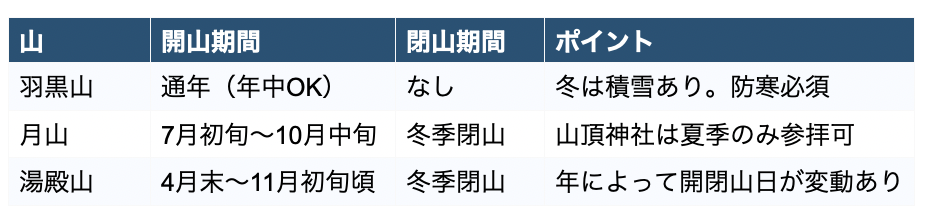
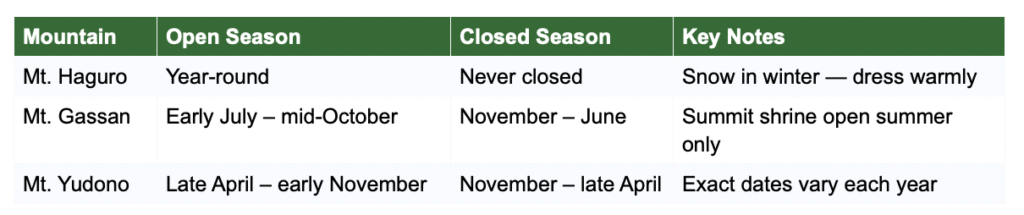
The key takeaway: if you want to visit all three mountains, your window is July through October — only about four months of the year.
Outside that window, you're looking at partial visits. Not a bad thing — but worth knowing in advance!
Spring (April – June): Snow Melts, Fresh Green, First Openings
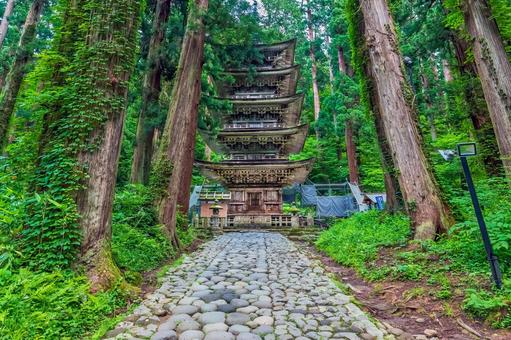
Mt. Haguro in Spring
Spring at Haguro is quietly beautiful.
5As the snow melts in April and May, fresh green shoots appear between the ancient cedar trunks, and the stone staircase becomes wonderfully atmospheric.😊
The Opening Ceremony (Kaisan-sai) takes place in May, when yamabushi mountain ascetics blow sacred conch shells through the cedar forest. If your timing lines up, it's absolutely worth experiencing.
Mt. Gassan in Spring — Not Yet Open for Hiking
Here's something that surprises many visitors: Mt. Gassan's trails remain buried under deep snow until July. The summit shrine is completely inaccessible in spring.
As the snow melts in April and May, fresh green shoots appear between the ancient cedar trunks, and the stone staircase becomes wonderfully atmospheric.
— just don't expect to reach the shrine.
Mt. Yudono in Spring
Mt. Yudono typically opens in late April, though the exact date varies each year depending on snow conditions. Always check the official website before planning a spring visit.
The first days after opening are wonderfully quiet — few visitors, fresh mountain air, and a sense of the sacred site waking up from its winter sleep.
Spring: What to Watch Out For
- 4 to 5Snow and ice remain on trails through April and May — wear waterproof shoes with grip
- Temperatures drop sharply at night — layers are essential
- Mt. Gassan summit is NOT accessible until July
Summer (July – August): All Three Mountains Open — Peak Season
Mt. Haguro in Summer
The ancient cedar canopy keeps Haguro's stone staircase surprisingly cool even in summer, making it a pleasant climb even on hot days.
My personal tip: visit early morning. Before 8 AM, you'll have the stairs almost to yourself, the light filters beautifully through the trees, and the air feels completely different from midday.😊
8and the air feels completely different from midday. 😊
Mt. Gassan in Summer — The Best Time to Go
July and August are without question the best months for Mt. Gassan. This is when everything comes together: snowfields you can actually walk across in July, rare alpine wildflowers blooming along the trail, and the summit shrine finally open for worship.
The landscape is genuinely extraordinary — think lunar terrain meets Japanese mountain pilgrimage, with wildflowers everywhere and mist rolling through. It's unlike anything else in Japan.
One important note: the summit can be near freezing even in August. A warm layer (fleece or light down jacket) is non-negotiable, regardless of how hot it is at the base. If possible, avoid Obon week (around August 13–16) — this is Japan's major holiday period when the trails become very crowded. July or September are much calmer.
Mt. Yudono in Summer
Summer at Yudono is lush and green, with the forested approach to the shrine creating a beautifully immersive atmosphere.
Many visitors combine all three mountains into a 2-night, 3-day trip in summer — and it's absolutely the right season for that.
Summer: What to Watch Out For
- Mt. Gassan summit temperatures can drop below 5°C (41°F) even in August — always carry a warm layer
- Strong UV at altitude — sunscreen, sunglasses, and a hat are essential
- Insects are active in July-August — bring repellent
- Obon (mid-August): expect significant crowds and busy parking lots. Arrive very early or plan for September instead
Autumn (September – October): Foliage and Quiet — My Personal Favourite
I'll be honest with you: autumn is my favourite season at Dewa Sanzan.😊
The summer crowds have thinned out, the air turns crisp, and the mountains begin to show their most dramatic colours. Everything just feels right.
Mt. Haguro in Autumn
10By early October, the cedar forest comes alive with colour — the deep green of the ancient trees contrasted against the reds and golds of the surrounding deciduous forest. It's stunning to walk through.
Morning mist often settles over the stone steps in autumn, creating an almost otherworldly atmosphere. If you're a photographer, this is your season. Bring your camera.
Mt. Gassan in Autumn — Don't Miss the Window
9September is a wonderful time for Mt. Gassan — the crowds of summer have gone, the trail conditions are excellent, and the high-altitude views are crystal clear on good days.
10But be aware: Mt. Gassan closes in mid-October. If you're planning a September or October visit, check the exact closing date for that year and don't leave it to the last minute.
Mt. Yudono in Autumn
Mt. Yudono closes in early November. The autumn colours along the approach path are beautiful,
and there's something poignant about visiting a sacred site just before it closes for winter — locals often make a final pilgrimage before the gates shut.
Autumn: What to Watch Out For
- Closing dates for Gassan and Yudono vary each year — always check official sources before booking
- Peak foliage weekends (early October) bring heavy traffic — weekday visits are far more peaceful
- Temperatures drop fast after sunset — a proper jacket is essential, even if the day starts warm
Winter (November – March): Only Haguro Remains
With Gassan and Yudono closed for winter, Mt. Haguro becomes the sole destination — and honestly, it's magnificent in a completely different way.
Deep snow buries the stone steps. The ancient cedars stand silent under white. The entire mountain feels like a different world from its summer self.
On New Year's Eve, the Matsurei Festival transforms Haguro into one of Japan's most dramatic fire ceremonies, with yamabushi carrying enormous burning torches through the winter darkness.😊
→ Read more: The Winter Magic of Mt. Haguro [Article No.32]
→ Read more: Haguro's Matsurei Festival — Fire, Snow and Mountain Priests on New Year's Eve [Article No.30]
Winter: What to Watch Out For
- Snow completely covers the stone steps — snowboots and microspikes are strongly recommended
- Roads can be icy — rental cars must have winter tyres (confirm when booking)
- Wind chill at the summit makes it feel much colder than the forecast — layer up seriously
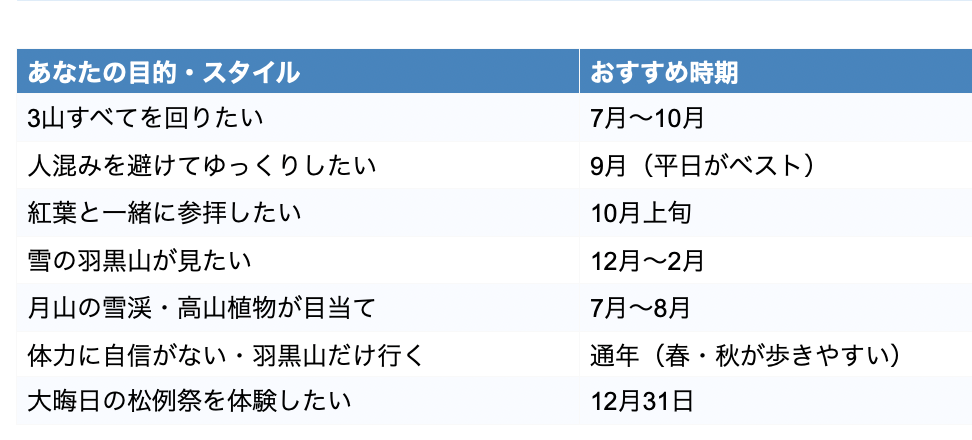
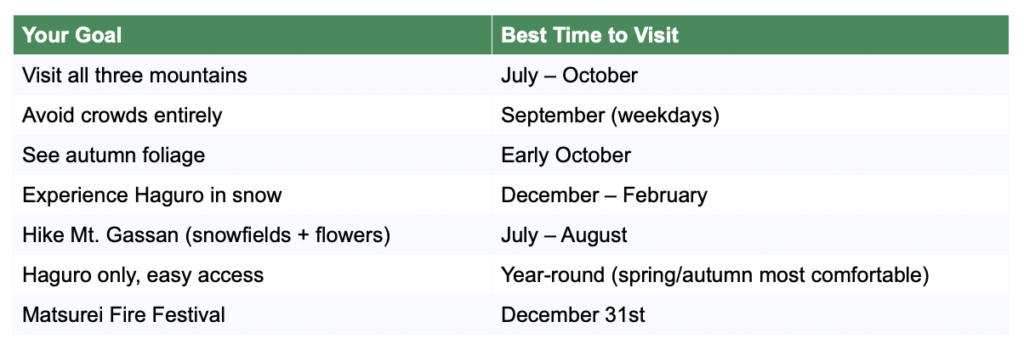
So When Should YOU Go? A Quick Reference Guide
Here's the bottom line, matched to different types of travellers:
Wrap-up
Dewa Sanzan rewards visitors in every season — but the experience changes dramatically depending on when you come.
Knowing the calendar in advance is the difference between a good trip and an unforgettable one.
Plan around your priorities, check the official mountain websites for the latest opening dates, and don't be afraid to visit in the shoulder seasons — September especially is a hidden gem.
→ Access guide: How to Get to Dewa Sanzan [Article No.3]
→ Full overview: What Is Dewa Sanzan? [Article No.1]
Guest House Watausagi is a popular inn for guests who like temples, shrines, and power spots.
This guesthouse is located right between Mt. Hagurosan, Mt. Gassan, and Mt. Yudonosan,
Guesthouse Watausagi sits right in the heart of Dewa Sanzan territory — perfectly positioned between Hagurosan, Gassan, and Yudonosan. Guests come from across Japan and around the world to explore these sacred mountains. Make Watausagi your base and discover the spiritual world of Dewa Sanzan! 😊😊
We also share the charms of our home region — Yamagata, Tsuruoka, and the Shonai area.
I'm always sharing updates and local tips on Instagram Stories. Follow us on Instagram and stay in the loop! 😊😊
いいね・シェアもうれしいです💕
🏔️ 出羽三山入門シリーズ
 【NO.1】Deep in the mountains of Yamagata Prefecture lies one of Japan's most extraordinary spiritual destinations.
 【NO.3】Getting to Dewa Sanzan takes a little planning — but once you understand the logistics, it's very manageable.
📖 やまがたいいとこ の関連記事
 Demons Dancing on Mount Haguro!?
 Why a dragon god at a Buddhist temple? The mystery of Zenpoji (Tsuruoka) and its sea-guarding dragon faith
 Michelin-Starred Sakata: A Two-Star Tour Built on the Wealth of the Kitamae Ships
- STAY WITH US -
Your Base for Exploring Tsuruoka
A small guesthouse in central Tsuruoka, Yamagata. The perfect base for your trip to Dewa Sanzan and Shonai.
Book Now →