
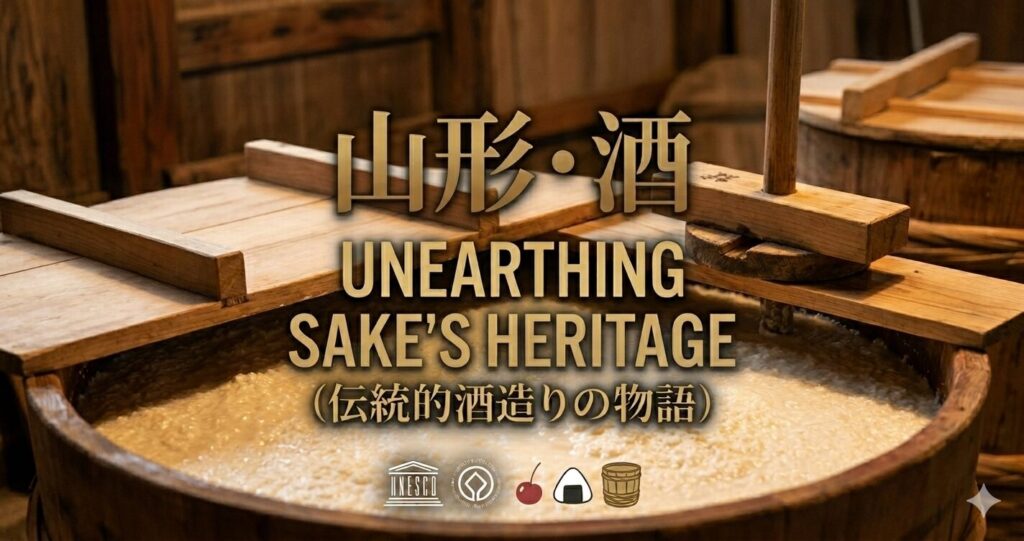
What is the most complex thing you have ever tasted?
Wine? Whisky? A craft beer, maybe?
If you have ever had sake, you might pause for a moment and answer: “It could be sake.”
On December 5, 2024, the craft behind that very drink was inscribed on UNESCO’s list of Intangible Cultural Heritage.
“Traditional sake-making.” The decision, made at the intergovernmental committee in Paraguay, was unanimous.
Since the inscription, travelers around the world have begun journeying to the “home of sake.” And Tsuruoka, in Yamagata, is one of the very best places to go.
Today, I’d like to take the time to tell you why.
What It Means That “Traditional Sake-Making” Became UNESCO Intangible Heritage
UNESCO Intangible Cultural Heritage is an international framework that recognizes “formless cultural treasures humankind should carry forward.” Unlike World Heritage, which covers buildings and landscapes, it exists to protect living cultural practices themselves — skills, knowledge, customs and rituals.
The newly inscribed “traditional sake-making” is the brewing craft that master brewers (toji) and their teams have built over centuries using koji mold. Its basic form is said to have taken shape more than 500 years ago, evolving in step with the climate and terroir of each region and living on today in sake, shochu, awamori and mirin.
The unanimous decision on December 5, 2024 made it Japan’s 23rd Intangible Cultural Heritage element — and only the second tied to food culture, after washoku in 2013.
“Traditional Sake-Making” — UNESCO Inscription at a Glance
Date decided: December 5, 2024 (JST), unanimous
Where: Asunción, Paraguay (19th session of the committee)
Scope: traditional brewing of sake, shochu, awamori, mirin and more
Number: Japan’s 23rd element; 2nd tied to food culture, after washoku
Core craft: koji-based fermentation (basic form established 500+ years ago)
How Rice, Water and Koji Alone Create Such Complex Flavor
The ingredients of sake are simple: rice, water and koji mold.
So how does something so complex, so delicate — a liquid that changes its expression cup by cup — come from so little?
The answer lies in a fermentation technique found nowhere else in the world: multiple parallel fermentation.
Koji — A Microbe Unique to Japan
Koji is a microbe that grows on steamed rice. It converts the rice’s starch into sugar; yeast then turns that sugar into alcohol. Both conversions happen at the same time, in the same tank — that is what “multiple parallel fermentation” means.
Beer and wine carry out only one of these steps. Sake alone accomplishes both transformations in a single vessel.
Koji is Japan’s national fungus. Miso, soy sauce, vinegar, sake — much of Japanese food culture rests on this tiny organism.
The Toji — The Master Brewer
But koji, rice and water alone don’t mean anyone can make sake.
Inside the brewery, reading temperature, humidity and the pace of fermentation with all five senses, tending the koji by hand — the craftsperson with that skill is the toji, the master brewer.
A technique still called flawless today was systematized by earlier generations through experience and intuition alone — in an age when microbes weren’t even known to exist. That is what UNESCO has now recognized anew for the world.
Brewed in the cold of winter, then left to wait for spring. As the word kanzukuri (“cold brewing”) suggests, sake is born at nature’s temperature, over nature’s own time.
Tsuruoka’s Rare Distinction: A Double UNESCO Connection
Here I want to explain why Tsuruoka holds special meaning as a destination.
Tsuruoka is already a UNESCO Creative City of Gastronomy — designated in 2014, the first city in Japan to receive the title, and one it still holds today.
And now “traditional sake-making” has been inscribed as UNESCO Intangible Cultural Heritage.
UNESCO Creative City of Gastronomy × UNESCO Intangible Heritage (traditional sake-making). Few places in Japan sit where these two overlap.
As a Creative City of Gastronomy, Tsuruoka is known for its diversity of heirloom crops, its living regional cuisine, and the deep bond between food and farming. To that, add a brewing culture the world has recognized. This isn’t a marketing line — it’s the sheer depth of a culture this land has built over centuries.
The abundant rice of the Shonai Plain, and pure water flowing down from Mt. Chokai and Mt. Gassan. Sake’s two great ingredients are here in generous supply.
Tsuruoka × UNESCO — Why the Double Tie Is Rare
UNESCO Creative City of Gastronomy: designated 2014 (first in Japan)
UNESCO Intangible Heritage: traditional sake-making, inscribed 2024
→ Few places in Japan are both a City of Gastronomy and a home of living sake culture
→ For international travelers, the “UNESCO” name is a powerful reason to make the trip
Why Travelers Worldwide Are Now Moving to Seek Out Sake
Since the 2010s, sake has been quietly booming around the world.
In Europe, a mature wine culture went looking for “the next fermented drink.” In the U.S., riding the wave of Japanese cuisine, sake bars multiplied fast. In Taiwan, Korea and Southeast Asia, interest in high-quality sake is spreading among younger drinkers.
What they share is a fascination with terroir — the character of a place. Like wine, sake takes on a completely different personality from brewery to brewery and region to region. The rice variety, the hardness of the water, the temperature of the brewery, the toji’s lineage — all of it lives in a single cup.
“I want to drink this sake where it was born.” That desire is what sends travelers toward the source.
The UNESCO inscription gave that current a decisive push. To taste “a culture the world has recognized” for themselves, travelers move. With sake, the journey always leads to a brewery, to rice, to water. Tsuruoka, in Yamagata, has all three.
More and more guests from overseas tell us they want to learn about sake or visit a local brewery. Day by day, we see how a single cup of local sake grows into a deep curiosity about Tsuruoka itself.
Drink This Land’s Sake, on This Land
The Shonai region is dotted with breweries, each with its own character.
Snowmelt from the foot of Mt. Gassan; Yamagata sake rice such as Dewa Sansan and Dewa no Sato grown on the Shonai Plain. From these, each brewery brews with its own technique and philosophy. Some handle everything from growing the rice to brewing the sake — and that one cup holds the whole story, from paddy to brewery.
“This sake is made from rice grown in that field over there.” A cup enjoyed while hearing that is an experience no high-end restaurant can offer.
Some breweries welcome tours and tastings. Please check with each brewery directly before visiting.
▼ Tips for Enjoying Shonai Sake
Choose local sake made with Yamagata rice such as Dewa Sansan or Dewa no Sato
Pair it with Shonai regional dishes at an izakaya or restaurant in Tsuruoka
Brewery tours usually require a reservation (always check with each brewery)
April–May is when the new sake brewed over winter comes together, along with limited spring releases — light, easy-drinking flavors begin to fill the shelves 🌸
A Base for a Journey Through “Sake and Food the World Recognized”
Visit a brewery, raise a cup over regional cooking, and the next morning go breathe the air of the Dewa Sanzan mountains.
That is a Tsuruoka trip with Watausagi as your base.
Stay in a UNESCO Creative City of Gastronomy and taste the sake of a UNESCO Intangible Heritage craft — Watausagi is here as a place where you can have both at once.
“I stayed one night and ended up wanting to stay much longer,” guests often tell me. I think that is the quiet power of this town.
Sake and food, mountains and water — on this land UNESCO has recognized twice, I hope you’ll find your own cup. Tsuruoka will be here, waiting, whenever you come.
One Cup of Sake Becomes the Doorway to a Journey
UNESCO chose “traditional sake-making” as Intangible Heritage because it is not merely a manufacturing technique, but a living culture that nature, people and microbes have raised together over hundreds of years.
One of the places where that culture is rooted is Tsuruoka, in Yamagata.
A journey can begin with a single cup of sake. You visit the brewery that made it, gaze at the field where the rice grew, look up at the mountains the water flowed from — and before you know it, you’re already thinking, “I want to come back.”
In Tsuruoka, that cup is waiting.
📖 やまがたいいとこ の関連記事
- STAY WITH US -
Your Base for Exploring Tsuruoka
A small guesthouse in central Tsuruoka, Yamagata. The perfect base for your trip to Dewa Sanzan and Shonai.
Book Now →