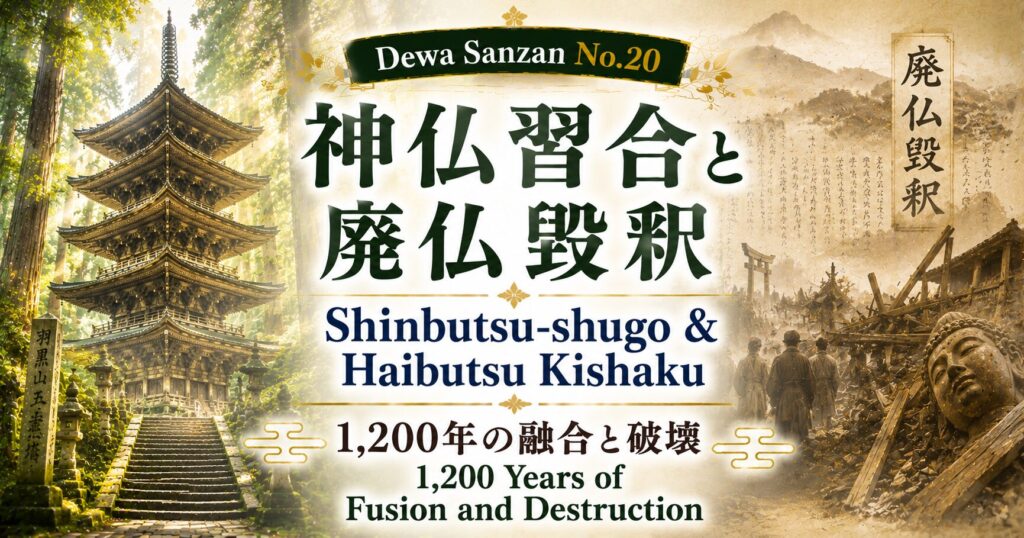
Walking the stone staircase at Mt. Haguro, you pass a five-storied Buddhist pagoda standing in the precinct of a Shinto shrine. The question this raises — why is a Buddhist structure here? — opens into one of the most fascinating and turbulent episodes in Japanese religious history.
The answer requires understanding two concepts that most guidebooks don't fully explain:
- Shinbutsu-shugo (神仏習合): the 1,200-year Japanese tradition of fusing Buddhism and Shinto into a single integrated religious practice
- Haibutsu Kishaku (廃仏毀釈): the violent, government-mandated separation of Buddhism and Shinto that began in 1868, which included the widespread destruction of Buddhist objects at Shinto sites
Together, these two events form the deepest layer of Dewa Sanzan's history — and explain almost everything about why the mountain looks and feels the way it does. 😊
→ Dewa Sanzan overview [Article No.1]
→ Shugendo: the mountain practice at the centre of this history [Article No.15]
→ The Sanjin Gosaiden: how the separation affected Haguro's summit shrine [Article No.17]
Two Key Terms
Shinbutsu-shugo (神仏習合)(shin-butsu-shu-go)
The Japanese religious phenomenon in which Shinto deities (kami) and Buddhist figures were understood as different manifestations of the same sacred realities — or as deeply interrelated beings within a single cosmic order. Active from roughly the 6th century CE until 1868, a period of approximately 1,200 years.
Haibutsu Kishaku (廃仏毀釈)(hai-butsu-ki-sha-ku)
Literally: 'abolish Buddhism, destroy Shakyamuni (the Buddha).' The movement, triggered by the Meiji government's 1868 Shinbutsu Bunri-rei (edict separating Buddhism and Shinto), during which Buddhist statues, buildings, and texts were removed or destroyed from shrine precincts across Japan. Intensity varied by region but was severe in some areas.
These two terms trace the great arc of this history — a long age of fusion, brought to an end by a violent age of separation.
Dewa Sanzan stood right on the front line of that history.
The Era of Fusion: Shinbutsu-shugo (6th Century — 1868)
When Buddhism Arrived in Japan
Buddhism reached Japan from the Korean peninsula in the 6th century CE (traditionally dated 538 or 552 CE). Japan already had an indigenous religious tradition — what we now call Shinto — characterised by reverence for kami (divine presences) in natural phenomena: mountains, rivers, trees, rocks, the sun, the sea.
In most historical encounters between established religious traditions, the arriving religion either displaces the existing one or the two maintain distinct, competing identities. In Japan, something different happened: the two traditions merged.
This merger was not a formal theological agreement. It developed organically, over centuries, through the practical activities of priests, monks, and ordinary worshippers who found ways to incorporate both traditions into their religious lives. The result — shinbutsu-shugo — was not Buddhism plus Shinto. It was a genuinely new synthesis.
How Did the Fusion Work?
The central intellectual mechanism was a doctrine called honji suijaku (本地垂迹) — 'original ground, manifest traces.' This doctrine held that the Shinto kami were local manifestations of universal Buddhist figures: a kami encountered in Japan was understood as the local appearance (suijaku, 'trace') of a bodhisattva or Buddha whose 'original form' (honji) was the Buddhist figure.
This meant that worshipping the kami of Mt. Haguro was, in a sense, worshipping the underlying Buddhist figure of which that kami was a manifestation. The two acts of worship were understood as reaching toward the same sacred reality from different directions.
In practice, this produced a religious landscape in which:
- Shinto shrines had Buddhist temples built within or beside their precincts (jinguji, 神宮寺)
- Buddhist monks participated in Shinto rituals at shrines
- The same practitioner might worship kami and Buddha in the same visit
- Mountain ascetic practice (Shugendo) developed as a syncretic tradition drawing from both
The Five-Storied Pagoda at Mt. Haguro — a Buddhist tower within a Shinto sacred complex — is a direct product of this era. In the shinbutsu-shugo worldview, there was nothing contradictory about its presence.
Dewa Sanzan in the Era of Fusion
During the long period of shinbutsu-shugo, Dewa Sanzan was one of Japan's foremost syncretic sacred sites. The mountain complex combined Shinto deities, Buddhist practice, and the mountain asceticism of Shugendo in an integrated whole.
Mt. Haguro's precinct included Buddhist temple buildings alongside Shinto structures. Yamabushi mountain priests — who embodied the Shugendo synthesis of Buddhist and Shinto practice — were the primary human actors maintaining the tradition. The three mountains together (Haguro, Gassan, Yudono) were understood through both Shinto and Buddhist interpretive frameworks simultaneously.
This was not confusion or syncretism as a compromise. It was a mature, sophisticated religious culture with its own internal coherence, developed over more than a millennium.
The Era of Separation: Haibutsu Kishaku (1868 Onward)
The Meiji Restoration and the Shinbutsu Bunri-rei
The Meiji Restoration of 1868 transformed Japan's political structure with extraordinary speed. The new imperial government sought to establish Shinto as a state ideology — a framework that could unite Japan under the emperor's divine authority and provide ideological coherence for the new nation.
This required dismantling shinbutsu-shugo. On April 5, 1868 — less than three months after the formal start of the Meiji period — the Dajokan (the new government's ruling council) issued the Shinbutsu Bunri-rei: the Edict Separating Buddhism and Shinto.
The edict ordered that Buddhist elements be removed from Shinto shrines: the Buddhist priests who served at shrine-temple complexes were to become either Shinto priests or purely Buddhist monks; Buddhist statues, texts, and ritual objects were to be removed from shrine precincts; the practice of using Buddhist terminology to describe Shinto deities was to cease.
Haibutsu Kishaku: The Destruction Begins
What followed was not merely administrative compliance. In many domains across Japan, the separation edict triggered a wave of active destruction — sometimes government-directed, sometimes spontaneous mob violence — against Buddhist properties that had been integrated with Shinto sites.
Buddhist statues were smashed. Temple buildings were torn down. Libraries of Buddhist sutras were burned. In some domains, the destruction was so thorough that entire Buddhist traditions that had existed for centuries were effectively erased within a year.
The scale and intensity varied significantly by region and domain. Some areas experienced only minor disruption. Others saw catastrophic destruction of irreplaceable cultural heritage.
What Happened at Dewa Sanzan
Dewa Sanzan was significantly affected. The mountain complex, which had operated for centuries as an integrated Shinto-Buddhist-Shugendo sacred site, was required to reorganise itself as a purely Shinto institution.
- Many Buddhist structures and statues at Mt. Haguro were removed or destroyed
- The jinguji (shrine-temple complex) structure was dismantled
- Yamabushi, whose practice was inherently syncretic, were required to choose between Shinto and Buddhist identity — and Shugendo itself was formally banned in 1872
- The religious landscape of the mountain was reorganised under Shinto administrative structures
The Sanjin Gosaiden at the summit of Haguro, which houses the deities of all three mountains, was shaped partly by this reorganisation: with Mt. Gassan and Mt. Yudono's Buddhist elements stripped away and their winter closure making separate mountain worship impossible, the combined enshrinement at Haguro's year-round accessible summit became the solution.
The Five-Storied Pagoda: The Survivor
The most historically significant object to survive the Haibutsu Kishaku at Dewa Sanzan — and perhaps the most symbolically resonant — is the Five-Storied Pagoda at Mt. Haguro.
A Buddhist tower standing within a Shinto shrine complex was precisely the kind of structure the separation edict targeted. By rights, it should have been dismantled. It was not.
The reasons are not fully documented. Accounts suggest that advocacy by some parties slowed the process; that the sheer scale and established importance of the structure made destruction politically difficult; that the transition period allowed some structures to survive where others did not.
What is certain is that the pagoda survived — and that it now stands as a National Treasure of Japan, the oldest pagoda in the Tohoku region, and the most visible physical evidence of the 1,200 years of shinbutsu-shugo that preceded the Meiji separation.
When you pass the Five-Storied Pagoda on the stone staircase, you are looking at something that was almost destroyed, that survived by a combination of chance and advocacy, and that now embodies the full complexity of Japanese religious history in a single structure.
→ The Five-Storied Pagoda — full story [Article No.21]
The Sanjin Gosaiden: A Form Born from the Upheaval
In fact, the present form of the Sanjin Gosaiden is also closely tied to haibutsu kishaku.
As Dewa Sanzan's faith was reorganised as pure Shinto, and with Mt. Gassan and Mt. Yudono closed through the winter, a single place was needed where all three mountains' deities could be worshipped year-round.
The solution was the Sanjin Gosaiden — all three mountains' deities enshrined together at the year-round summit of Mt. Haguro, in the form we see today.
“A great historical upheaval gave birth to a new form” — the Sanjin Gosaiden is a striking example of exactly that.
→ The Sanjin Gosaiden: how the separation affected Haguro's summit shrine [Article No.17]
What Remains Today: The Traces of Fusion
More than 150 years after the Meiji separation, Dewa Sanzan is officially classified as a Shinto sacred site. The three mountains are shrines; the priests are Shinto priests; the worship follows Shinto forms.
But the traces of shinbutsu-shugo are everywhere for those who know what to look for:
- The Five-Storied Pagoda stands in the Haguro precinct — a Buddhist tower in a Shinto shrine
- Yamabushi continue to practise at Dewa Sanzan — their tradition, though reformed after 1868, reconnected with its Shugendo roots in the postwar period
- The Pilgrimage of Rebirth concept — present, past, future — reflects Buddhist cosmological ideas about rebirth
- The term 'Gongen' (権現), which appears in Dewa Sanzan historical records, is specifically a shinbutsu-shugo term for a kami understood as a manifestation of a Buddhist figure
- The architectural style of the Sanjin Gosaiden shows the influence of Buddhist temple architecture
Dewa Sanzan is not simply a Shinto site. It is a Shinto site that contains the living evidence of 1,200 years of something more complex — a synthesis that the Meiji government tried to end and that history has not entirely been able to erase.
Why This Matters for Your Visit
Understanding shinbutsu-shugo and haibutsu kishaku matters for your visit because it answers the questions that the mountain itself raises.
Why is there a Buddhist pagoda in a Shinto precinct? Because the mountain operated under shinbutsu-shugo for 1,200 years, and this structure survived the attempt to erase that history.
Why are three mountains' deities in one shrine? Because the Meiji separation disrupted the existing sacred infrastructure and required a new institutional solution.
Why do yamabushi still walk here, blowing conch shells? Because a practice that was officially banned in 1872 was revived in the postwar period and has continued since.
The mountain does not explain its own history. But if you carry this history with you as you walk the staircase, the layers become visible — and what seemed like a simply beautiful ancient forest reveals itself as one of the most historically complex religious landscapes in the world. 😊
Wrap-up
Shinbutsu-shugo was not confusion or theological sloppiness. It was a sophisticated synthesis, developed over centuries, that reflected a distinctively Japanese understanding of how different sacred traditions relate to each other.
Haibutsu Kishaku was not simply reform. It was a traumatic destruction of irreplaceable cultural heritage, driven by political calculation rather than religious insight.
Dewa Sanzan carries both: the synthesis in its mountains, its pagoda, its pilgrimage structure; the rupture in its administrative form, its missing buildings, its reorganised shrines.
Walking through it with this in mind is a different walk from walking through it without. 😊
Guesthouse Watausagi is a favourite with travellers who love shrines, temples and power spots. It sits right between Mt. Haguro, Mt. Gassan and Mt. Yudono — the three Dewa Sanzan peaks — and welcomes guests from all over Japan and the world who care about their nature, history and faith. We'd love you to use us as your base for the pilgrimage 😊
We also share the charms of our home region — Yamagata, Tsuruoka, and the Shonai area.
I'm always sharing updates and local tips on Instagram Stories. Follow us on Instagram and stay in the loop! 😊
And a like or a share is always, always appreciated 💕
📖 やまがたいいとこ の関連記事
 Demons Dancing on Mount Haguro!?
 Why a dragon god at a Buddhist temple? The mystery of Zenpoji (Tsuruoka) and its sea-guarding dragon faith
 Michelin-Starred Sakata: A Two-Star Tour Built on the Wealth of the Kitamae Ships
- STAY WITH US -
Your Base for Exploring Tsuruoka
A small guesthouse in central Tsuruoka, Yamagata. The perfect base for your trip to Dewa Sanzan and Shonai.
Book Now →