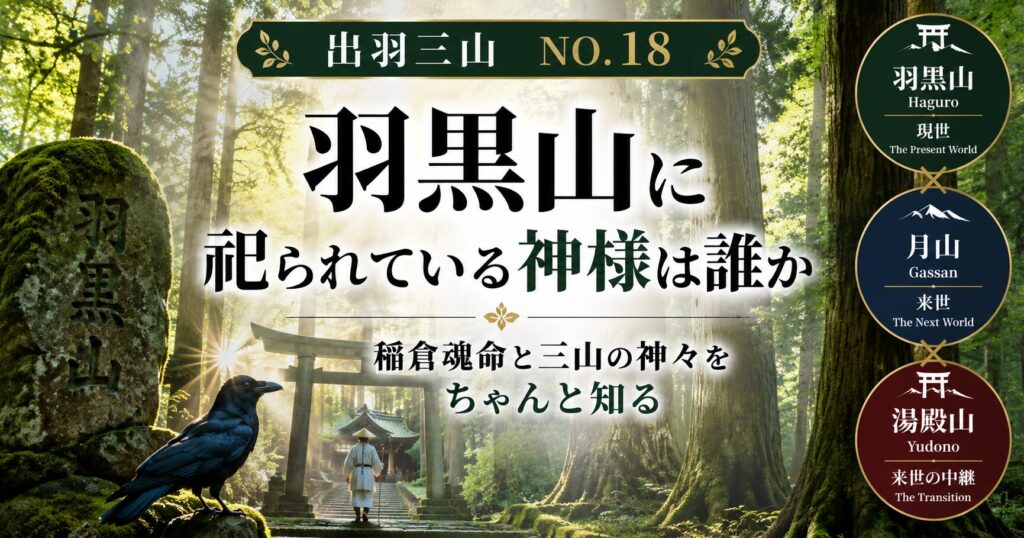
When you bow your head at the Sanjin Gosaiden — the grand shrine at the summit of Mt. Haguro — who exactly are you bowing to?
It's a question worth answering properly. The three deities enshrined in this building represent some of Japan's oldest and most widely worshipped divine figures: the god of food and harvest, the god of the moon, and a trio of mountain, medicine, and relationship deities that together cover a remarkably wide range of human concerns.
This guide introduces each deity, explains their significance in Japanese religious tradition, and describes how to worship at the Sanjin Gosaiden in a way that feels respectful and intentional — whether or not you come with religious belief. 😊
→ About the Sanjin Gosaiden: why three mountains in one shrine [Article No.17]
→ Dewa Sanzan overview [Article No.1]
The Three Deities: At a Glance
| Mountain | Deity | Main blessings |
|---|---|---|
| Mt. Haguro | Ukanomitama-no-Mikoto | Harvest, food, agriculture, business prosperity |
| Mt. Gassan | Tsukuyomi-no-Mikoto | Relationships, time, agriculture, fishing, safe travel |
| Mt. Yudono | Oyamatsumi, Okuninushi, Sukunahikona | Medicine, hot springs, healing, relationships, agriculture |
At the Sanjin Gosaiden, you can pay your respects to all three mountains' deities at once. Knowing each deity's character and blessings before you bring your palms together adds real depth to the visit.
The Deity of Mt. Haguro: Ukanomitama-no-Mikoto
The principal deity of Mt. Haguro is Ukanomitama-no-Mikoto — one of the most widely venerated deities in Japan, whose domain is food, grain, and the harvest.
The name itself is telling: 'Uka' refers to food or provisions; 'no Mikoto' is an honorific used for deities of high rank. This is literally the divine spirit of food — the sacred presence that ensures the rice grows, the harvest comes, and communities are fed.
You may recognise this deity by another name: Inari. Ukanomitama-no-Mikoto is the primary deity of Japan's thousands of Inari shrines, the most famous of which is Fushimi Inari Taisha in Kyoto. If you've seen the iconic rows of vermillion torii gates, you've encountered this deity's sacred space.
At Dewa Sanzan, this same divine presence — the spirit of food, abundance, and the agricultural cycle — is enshrined as the primary deity of Mt. Haguro, the mountain of the present, the mountain of this life as it is lived. The connection between the present world and the basic act of eating — of being nourished, of having enough — is quietly profound.
What Ukanomitama-no-Mikoto Oversees
- Rice harvest and agriculture in all its forms
- Food abundance and the prevention of famine
- Business prosperity — because trade, commerce, and the movement of goods are extensions of the agricultural abundance the deity represents
- General blessings of material sufficiency
A Good Thought to Hold When Worshipping
Gratitude for food — not as an abstract concept but as a specific reality. The meal you ate today. The crops that made it possible. The supply chains, the farmers, the weather, the soil. Ukanomitama-no-Mikoto is the divine presence behind all of it. Bringing that awareness to the act of worship gives it grounding.
The Deity of Mt. Gassan: Tsukuyomi-no-Mikoto
The principal deity of Mt. Gassan is Tsukuyomi-no-Mikoto — the divine ruler of the moon, time, and the tides.
In Japanese mythology, Tsukuyomi is one of three deities born from the eyes and nose of Izanagi-no-Mikoto (the primordial father figure of Japanese creation mythology) when he purified himself after visiting the underworld. The three are called Mihashira no Uzunoko — the Three Noble Children:
- Amaterasu-Omikami — born from the left eye: the sun goddess, the supreme deity of Shinto
- Tsukuyomi-no-Mikoto — born from the right eye: the moon god
- Susanoo-no-Mikoto — born from the nose: the storm god
As the deity of the moon, Tsukuyomi oversees the cycles of time: the monthly lunar calendar, the tides that depend on the moon's gravity, the seasons as they turn. Before mechanical clocks and solar calendars dominated, the moon was the primary means by which farmers tracked planting and harvest time, and by which fishermen tracked the tides. Tsukuyomi was their working deity.
The connection to relationships (en-musubi) comes from the ancient understanding that the moon's gravitational pull draws things together — it pulls the tides, and by extension it draws human connections. This is not merely superstition; the link between lunar cycles and human biology was observed long before it was scientifically understood.
And then there is the connection to Mt. Gassan as the mountain of the past — the realm of what came before this life. Tsukuyomi is a god who rules time. The moon rises and sets; it waxes and wanes; it governs the cycles that preceded us and will outlast us. The past, in Tsukuyomi's domain, is not dead — it is the most recent phase of an ongoing cycle.
What Tsukuyomi-no-Mikoto Oversees
- The lunar cycle and the measurement of time
- Agriculture tied to lunar farming calendars
- Fishing communities and the tides
- Safe travel — particularly by sea, where the moon and tides are navigation tools
- Relationships and the drawing together of fated connections
A Good Thought to Hold When Worshipping
The passage of time — specifically, what has been. Relationships that matter. The connections that have shaped who you are. Tsukuyomi's domain is not only the future pulls of fate but the accumulated relationships and time that have brought you to this mountain, on this day, at this moment.
The Deities of Mt. Yudono: Three in One
Mt. Yudono enshrines not one but three deities, whose combined presence gives the mountain its particularly wide range of sacred associations:
Oyamatsumi-no-Mikoto — The God of Mountains
The supreme deity of mountains, volcanoes, and natural forces. Oyamatsumi-no-Mikoto is essentially the lord of all mountain kami — the divine authority that sanctions human entry into the sacred mountain environment. At Yudono, which sits within one of Japan's most significant mountain sacred complexes, his presence represents the sanctity of the landscape itself.
Oyamatsumi is also associated with mining, hot springs (which emerge from the earth in geothermal areas), and by extension with agriculture and the productive capacity of the land.
Okuninushi-no-Mikoto — The God of Relationships and Medicine
This deity is perhaps better known to most visitors under a different name. Okuninushi-no-Mikoto is another name for the central deity of Izumo Taisha in Shimane Prefecture — the great shrine specifically associated with relationships, marriage, and fated connections (en-musubi).
In Japanese mythology, Okuninushi is the deity who 'built the land' of Japan — who organised the earthly realm before sovereignty was transferred to the descendants of Amaterasu. He is associated with wisdom, relationships, medicine (he and Sukunahikona-no-Mikoto are credited with discovering medical treatments), and prosperity.
Sukunahikona-no-Mikoto — The God of Medicine and Hot Springs
The smallest of the great deities — described in mythology as tiny enough to fit on a fingertip — Sukunahikona-no-Mikoto worked alongside Okuninushi to complete the creation of Japan's earthly realm. He is specifically credited with the discovery of herbal medicine and the therapeutic use of hot springs.
At Yudono — a mountain associated with a geothermal sacred site — the presence of Sukunahikona-no-Mikoto is particularly fitting. The hot spring element of the Yudono sacred experience (which cannot be described in detail, per the mountain's tradition) connects directly to this deity's domain.
What the Three Yudono Deities Collectively Oversee
- Medicine and healing — the most directly practical blessing of this mountain
- Hot springs and geothermal sacred sites
- Recovery from illness — a specific focus of worship at Yudono
- Relationships and fated connections (via Okuninushi)
- Agriculture and the productive earth (via Oyamatsumi)
- Wisdom and the navigation of difficult circumstances (via Okuninushi)
How to Worship at the Sanjin Gosaiden
The Sanjin Gosaiden follows standard Shinto worship etiquette. Even without religious knowledge, the ritual is accessible and the form is easy to follow.
The Basic Sequence
- Approach the main entrance and ring the bell (if present) — this announces your presence to the deities
- Bow deeply twice (ni-rei)
- Clap your hands twice (ni-hakushu) — bring your palms together and apart
- Hold your hands together and silently express your intention: who you are, where you've come from, what you're asking or offering in gratitude
- Bow deeply once more (ichi-rei)
This sequence — two bows, two claps, one bow — is the standard Shinto format and is used at most shrines in Japan.
What to Say (or Think)
Traditional Shinto etiquette suggests briefly introducing yourself — your name and where you've come from — before making a request or offering gratitude. This is understood as basic courtesy: you are in the presence of the deity, and anonymity is not the appropriate register.
There is no requirement to be a Shinto practitioner to do this sincerely. The act of saying where you've come from, of identifying yourself to a sacred space, of pausing to articulate what you actually want or what you're grateful for — these are universally meaningful acts regardless of the religious framing.
A Note for Non-Believers
Shinto does not require conversion, belief, or any formal commitment. You are not asked to affirm any doctrine by visiting a shrine or performing the basic worship sequence.
What the Sanjin Gosaiden asks — implicitly, through its scale and its atmosphere and the effort that was required to reach it — is attention. The 2,446 steps are the preparation. The summit shrine is the destination. Standing before three deities whose domains cover food, time, relationships, healing, and the mountain itself — with the cedar forest below and the sky above — is as good a moment as most people get for genuine reflection.
Use it. 😊
Goshuin and Omamori
At the Sanjin Gosaiden, you can also receive the goshuin (shrine seal) and omamori (protective amulets) of Dewa Sanzan.
The goshuin is a special design bearing the seals of all three mountains and is popular with collectors. The omamori come in varieties matched to each deity's blessings — relationships, health, safe travel, and more.
→ A detailed guide to goshuin and omamori [Article No.41]
A Note on Japanese Deities (for International Visitors)
Japan's deities (the kami of Shinto) are quite different from the single, absolute God of Christianity or Islam.
In Shinto there are said to be yaoyorozu no kami — literally "eight million gods," meaning countless deities. The idea is that a divine presence dwells in all things in nature: mountains, rivers, the sea, the sun, the moon, even food.
Bringing your palms together before a deity is not only about asking for something — it is also about giving thanks. Gratitude for another safe day, gratitude for the gifts of nature: worshipping in that spirit is what Japanese prayer is really about.
Whatever your religion, you are welcome to stand before the Sanjin Gosaiden with a heart full of gratitude. 😊
Wrap-up
The three deities of Dewa Sanzan — Ukanomitama-no-Mikoto (food, harvest), Tsukuyomi-no-Mikoto (time, relationships), and the trio at Yudono (medicine, healing, the earth) — cover the fundamental concerns of human life: sustenance, connection, and health.
This is not a coincidence. Sacred sites that survive 1,400 years do so because they speak to things that remain consistently important across all that time. The concerns of a 7th-century pilgrim arriving at Mt. Haguro and the concerns of a 21st-century visitor arriving at the same summit — food, relationship, health, time — are more similar than the centuries between them suggest.
The deities wait at the summit. They have always been waiting. 😊
→ About the Sanjin Gosaiden [Article No.17]
→ The Pilgrimage of Rebirth: present, past, and future [Article No.16]
→ 10 highlights of Mt. Haguro [Article No.5]
Guesthouse Watausagi sits right in the heart of Dewa Sanzan territory — perfectly positioned between Hagurosan, Gassan, and Yudonosan. Guests come from across Japan and around the world to explore these sacred mountains. Make Watausagi your base and discover the spiritual world of Dewa Sanzan! 😊
I'm always sharing updates and local tips on Instagram Stories. Follow us on Instagram and stay in the loop! 😊
And a like or a share is always, always appreciated 💕
📖 やまがたいいとこ の関連記事
 Demons Dancing on Mount Haguro!?
 Why a dragon god at a Buddhist temple? The mystery of Zenpoji (Tsuruoka) and its sea-guarding dragon faith
 Michelin-Starred Sakata: A Two-Star Tour Built on the Wealth of the Kitamae Ships
- STAY WITH US -
Your Base for Exploring Tsuruoka
A small guesthouse in central Tsuruoka, Yamagata. The perfect base for your trip to Dewa Sanzan and Shonai.
Book Now →