Mt. Haguro (Hagurosan) is the most accessible of the three sacred mountains of Dewa Sanzan — and arguably the most rewarding for first-time visitors.
At 414 metres (1,358 ft), it's not Japan's tallest sacred mountain. But what it lacks in altitude, it more than makes up for in atmosphere, history, and sheer visual impact.
The famous 2,446-step stone staircase winds through a cedar forest of extraordinary age and scale, past a National Treasure pagoda, and up to a summit shrine that has drawn pilgrims from across Japan for over 1,400 years.
Here are 10 reasons why Mt. Haguro deserves a place at the top of your Japan itinerary. 😊
→ Getting here: Dewa Sanzan Access Guide [Article No.3]
→ What to wear and bring: Haguro Practical Guide [Article No.4]
Mt. Haguro: Top 10 Highlights
1. The Zuishinmon Gate — The Threshold of Another World
Your journey into Mt. Haguro begins at the Zuishinmon Gate (随神門) — a heavy, vermillion-painted entrance gate that marks the boundary between the everyday world and the sacred precinct within.
The moment you pass through this gate, something changes. The noise and pace of daily life seem to drop away. The air feels different — cooler, stiller, older. You've crossed into sacred territory, and the ancient cedar forest stretching out ahead of you confirms it.
Most visitors walk through the gate without stopping. Don't. Take a moment here. Turn around and look back at the ordinary world you've just left behind. Then face forward, take a breath, and begin.
The Zuishinmon is also where the stone staircase proper begins. Before the gate: car park, bus stop, the modern world. After the gate: 2,446 steps and 1,400 years of history.
📍 Zuishinmon Gate: The starting point of the stone staircase. Parking and bus stop nearby.
2. The Ancient Cedar Forest — Walking Through Centuries
Beyond the Zuishinmon Gate, the path immediately enters an ancient cedar forest that may be the single most impressive natural feature of the entire Dewa Sanzan pilgrimage.
The cedars lining the stone staircase are between 300 and 600 years old. Many stand over 30 metres (100 ft) tall, their canopies meeting overhead to create a green ceiling that filters the light into shifting columns and patches of shadow. Even at noon, the forest feels dim, cathedral-like, and profoundly still.
Walking beneath these trees is genuinely humbling. The scale of them — the girth of their trunks, the height they've reached, the centuries they've quietly witnessed — creates a sense of being small in the best possible way.
This forest is designated a Special Natural Monument of Japan. Photographs capture it partially, but they don't capture the smell of the damp cedar, the sound of your footsteps on wet stone, or the way the air inside the forest feels unlike anywhere else. You have to come in person. 😊
On misty or rainy days, the effect intensifies dramatically — the trees disappear into the fog and the path ahead seems to vanish into another world. Don't avoid Haguro in rain. With the right gear, wet days here can be among the most memorable.
📍 Cedar Forest: Runs from the Zuishinmon Gate to the summit — approximately 1.7 km.
3. Haraigawa Stream and the Sacred Bridge — Crossing into the Divine
A few minutes into the cedar forest, the path crosses Haraigawa (祓川) — the 'Purification River' — via a vermillion wooden bridge. This crossing is one of the most symbolically significant moments of the entire pilgrimage.
In Shinto belief, crossing a bridge over flowing water represents a cleansing — a purification of body and spirit before entering deeper into sacred territory. The Haraigawa marks the inner boundary of the sacred precinct. With each step across the bridge, the ordinary world recedes a little further.
Stand on the bridge for a moment and listen. The sound of the stream below, the wind through the cedars above, and the absence of everything else — it's one of those rare places where silence has its own texture.
After a long stone staircase descent or ascent, this is also a natural stopping point to rest and feel the mood of the mountain settle around you.
📍 Haraigawa & Sacred Bridge: A short way into the stone staircase from the Zuishinmon Gate.
4. The Five-Storied Pagoda — A National Treasure in the Forest
Just past the Haraigawa bridge, the path delivers one of Mt. Haguro's most startling moments.
A five-storied pagoda emerges without warning from between the ancient cedars — one of the great surprises of the entire climb.
This is the Gojunoto — Mt. Haguro's Five-Storied Pagoda — and it's a genuine National Treasure of Japan. It's the oldest pagoda in the Tohoku region, with the current structure dating from the Muromachi period (14th–15th century), though the original was built around 1,400 years ago.
At 29 metres (95 ft) tall, the pagoda rises in tiers from a base surrounded by ancient cedar roots. Its proportions are perfect — each successive storey slightly smaller than the last, topped by a bronze finial that catches the light through the trees. The contrast between the living forest and this ancient human structure is extraordinary.
Many visitors walk past the pagoda too quickly. Don't. Step back from it — find a spot where you can see all five storeys at once. Look at how it relates to the trees around it, how it's been here for centuries while the forest grew up around it. It's not just old; it's connected to its place in a way that takes time to feel.
One question always comes up here: 'Why is there a Buddhist pagoda inside a Shinto shrine?' The answer is Shinbutsu-shugo — the ancient Japanese practice of blending Shinto and Buddhism that defined Japanese spirituality until the Meiji era. The pagoda survived the forced separation of Buddhism and Shinto in 1868, which makes its presence here all the more meaningful.
📍 Five-Storied Pagoda: Approximately 10 minutes from the Zuishinmon Gate. Free to view from outside.
→ The mystery of the pagoda: Why is there a Buddhist tower inside a Shinto shrine? [Article No.21]
5. The Three Slopes — The Staircase in Three Acts
Mt. Haguro's 2,446 stone steps are divided into three distinct sections, each with its own character and atmosphere: Ichinosakar (一の坂), Ninosaka (二の坂), and Sannosaka (三の坂).
Ichinosaka — First Slope: The opening section, beginning at the Zuishinmon Gate. The gradient is gentler here, and the forest is still revealing itself. This is where you find the Five-Storied Pagoda and the Haraigawa crossing. The mood is one of anticipation and gradual immersion.
Ninosaka — Second Slope: The middle and steepest section. This is where most people feel the effort most keenly — and where the cedar forest is at its most overwhelming. The trees here are among the largest on the mountain, and the climb demands full attention. At the top of Ninosaka waits the Ninosaka Chaya tea house — a perfect reward.
Sannosaka — Third Slope: The final approach to the summit. By this point, the forest thins slightly, light comes in from new angles, and there's a palpable sense of arrival. The summit feels close. When you emerge from the trees at the top, the sudden openness of the summit precinct has a theatrical quality — the dramatic reveal after a long climb.
Knowing these three sections in advance makes the walk more engaging — you have waypoints, you understand the narrative of the ascent, and you can pace yourself accordingly.
6. Ninosaka Chaya — The Tea House in the Middle of the Mountain
Exactly where you need it most — at the top of the second slope, exactly halfway up the mountain — sits the Ninosaka Chaya (二の坂茶屋): a small, traditional tea house that feels like it appeared by magic.
The tea house serves chikara mochi (力餅) — 'strength rice cakes' — small, soft mochi served with sweet toppings. After the exertion of climbing Ninosaka, these are among the most satisfying things you'll eat in Japan. Sweet, slightly chewy, and perfectly calibrated to restore your energy for the second half of the climb.
The Ninosaka Chaya has a wooden veranda where you can sit and look out at the cedar forest while you eat. The experience of sitting in a 19th-century mountain tea house, eating traditional rice cakes, with nothing but ancient trees in every direction — this is the kind of thing that's impossible to plan for and impossible to forget.
In spring, the forest is freshly green around you. In autumn, the cedars are framed by the colours of the surrounding deciduous trees. In summer, the veranda catches whatever breeze is moving through the forest. In winter, if you've made it this far through the snow, the warmth inside is something else entirely.
Don't rush past the Ninosaka Chaya. Sit down. Have the mochi. Give yourself permission to be exactly where you are. 😊
📍 Ninosaka Chaya: Top of the second slope. Open seasonally — check ahead for exact hours.
7. Sanjin Gosaiden — The Grand Shrine at the Summit
After 2,446 steps, the forest opens and the summit precinct reveals itself. At its centre stands the Sanjin Gosaiden (三神合祭殿) — the Grand Unified Shrine of the Three Mountains — one of the most architecturally striking Shinto shrines in Japan.
The building is enormous. At approximately 28 metres (92 ft) tall, with a triple-layered thatched roof of remarkable complexity, the Sanjin Gosaiden is a National Important Cultural Property and one of the finest examples of traditional Japanese shrine architecture anywhere in the country.
What makes it theologically unusual is what it enshrines: the deities of all three Dewa Sanzan mountains — Hagurosan, Gassan, and Yudonosan — under one roof. This unification happened after the Meiji Restoration, when Mt. Gassan and Mt. Yudono were closed in winter, making year-round worship of all three mountains difficult. The solution was elegant: bring all three together at the only mountain open throughout the year.
Standing before the Sanjin Gosaiden after climbing the stone staircase carries a particular weight. You've earned this arrival. The scale of the building, the silence of the precinct, the incense smoke, the ritual sound of bells from inside — it all comes together at this moment.
Pilgrims come to the Sanjin Gosaiden from every part of Japan — and, increasingly, from around the world. For some travellers, this single shrine is reason enough to make the climb.
Whether you're a believer, a curious traveller, or simply someone who appreciates extraordinary architecture, the Sanjin Gosaiden is worth every one of those 2,446 steps.
📍 Sanjin Gosaiden: Mt. Haguro summit. Some areas require entry fee.
→ Why are three mountains' deities in one shrine? [Article No.17]
8. The Bell Tower and Hachiko Ouji's Mausoleum — History Layered on History
The summit precinct holds more than just the Sanjin Gosaiden. Explore carefully and you'll find layers of history scattered across the mountaintop.
The Bell Tower (鐘楼, Shoro): In a corner of the summit precinct stands a wooden bell tower housing a large bronze temple bell. When struck during morning rituals, the bell's resonance carries across the mountaintop and into the cedar forest below. It's a visceral reminder that this is not a museum — it's an active place of worship, as it has been for over a millennium.
The Mausoleum of Prince Hachiko (蜂子皇子廟): A short distance from the main shrine stands the mausoleum of Prince Hachiko (Hachiko Ouji), the legendary figure credited with founding Mt. Haguro around 1,400 years ago. He was a nephew of Prince Shotoku — one of Japan's most revered historical figures — who fled political persecution at the imperial court and made his way to this remote mountain, where he began the tradition of Dewa Sanzan as a place of ascetic practice.
Standing before the mausoleum and thinking back over the 1,400 years of history that have accumulated on this mountain — it puts the stone staircase, the pagoda, and the grand shrine into a different perspective. This place has been continuously sacred for as long as Paris has been a city.
📍 Bell Tower / Hachiko Ouji Mausoleum: Within the summit precinct near Sanjin Gosaiden.
→ The story of Prince Hachiko: Who founded Dewa Sanzan? [Article No.19]
9. Goshuin & Omamori — Souvenirs with Meaning
For many Japanese visitors, collecting goshuin (御朱印) — ink stamps from shrines and temples — is a central part of any pilgrimage. At the Sanjin Gosaiden, you can receive the official Hagurosan goshuin, hand-written in bold calligraphy with the shrine's distinctive red seal.
For international visitors unfamiliar with goshuin: these are not mere tourist souvenirs. They're the shrine's verification of your visit — a record of a specific moment of pilgrimage in a specific sacred place. They're kept in a dedicated stamp book (goshuincho), which serious collectors fill over years of shrine visits across Japan. Receiving one from Mt. Haguro, with its 1,400-year history, carries particular significance.
The Sanjin Gosaiden also offers a range of omamori (お守り) — protective charms — covering categories from health and safe travel to relationships and academic success. Each is made specifically for the shrine and carries the divine blessing of the Dewa Sanzan deities.
Beyond charms, the summit area also has a shop selling Haguro-specific food products: chikara mochi (the same style as the tea house on the staircase), local sake from the Shonai region, and various crafts related to mountain worship culture. These make far more meaningful souvenirs than anything you'll find in an airport gift shop.
📍 Goshuin desk: Inside or near Sanjin Gosaiden. Opening times vary by season.
→ Complete guide to Haguro's stamps, charms, and sacred objects [Article No.41]
→ Complete goshuin guide for Dewa Sanzan [Article No.28]
10. Early Morning Visits — A Completely Different Mountain
The tenth highlight of Mt. Haguro isn't a place or an object.
It's a time of day: early morning, when the mountain shows you a completely different face.
Visit Haguro after 9 AM on a summer weekend and you'll share the staircase with hundreds of other visitors. Visit before 7 AM on any day, and you may have it almost entirely to yourself.
In early morning, the cedar forest holds a different kind of silence. Morning light filters through the canopy at oblique angles that don't exist at midday. Dew clings to the moss on the stone steps. The sound of a single bird echoes through the trees. Mist rises from the forest floor on cooler days.
The experience of walking those 2,446 steps in near-solitude, with the mountain waking up around you and the sounds of birds replacing the sounds of other visitors — it's a version of Haguro that most people who visit Dewa Sanzan never experience. It requires planning (you need to stay nearby the night before), but the reward is extraordinary.
Guesthouse Watausagi is ideally positioned for early morning visits to Haguro. With a flexible checkout time, there's no pressure on the morning itself. Wake when the light feels right, and go. 😊
📍 Early morning access: Check gate opening times on the official website, as they vary by season.
→ Early morning at Haguro — a full experience report [Article No.29]
Wrap-up
Mt. Haguro is not a mountain you visit for the view from the top. It's a mountain you visit for what happens on the way up.
The Zuishinmon Gate that separates the ordinary from the sacred. The cedar giants that make you feel small. The red bridge over the purification stream. The National Treasure pagoda emerging from the forest. The three slopes, each with its own character. The mountain tea house with its restorative rice cakes.
The grand summit shrine that houses three mountains' worth of deities. The bell that tells you this place is still alive. The mausoleum of the man who started it all 1,400 years ago. And the early-morning silence that lets you feel all of it without the noise of the world — every one of these is strung together by the same 2,446 steps.
Every one of those 2,446 steps is worth it. 😊
→ What to wear and bring: Haguro Practical Guide [Article No.4]
→ Walk or drive? Choosing your Haguro visit style [Article No.8]
→ Getting to Mt. Haguro: Access from Tsuruoka [Article No.3]
Guesthouse Watausagi sits right in the heart of Dewa Sanzan territory — perfectly positioned between Hagurosan, Gassan, and Yudonosan. Guests come from across Japan and around the world to explore these sacred mountains. Make Watausagi your base and discover the spiritual world of Dewa Sanzan! 😊
I also share the everyday charms of my home ground — Yamagata, Tsuruoka, and the wider Shonai region.
I'm always sharing updates and local tips on Instagram Stories. Follow us on Instagram and stay in the loop! 😊
Likes and shares make my day 💕
📖 やまがたいいとこ の関連記事
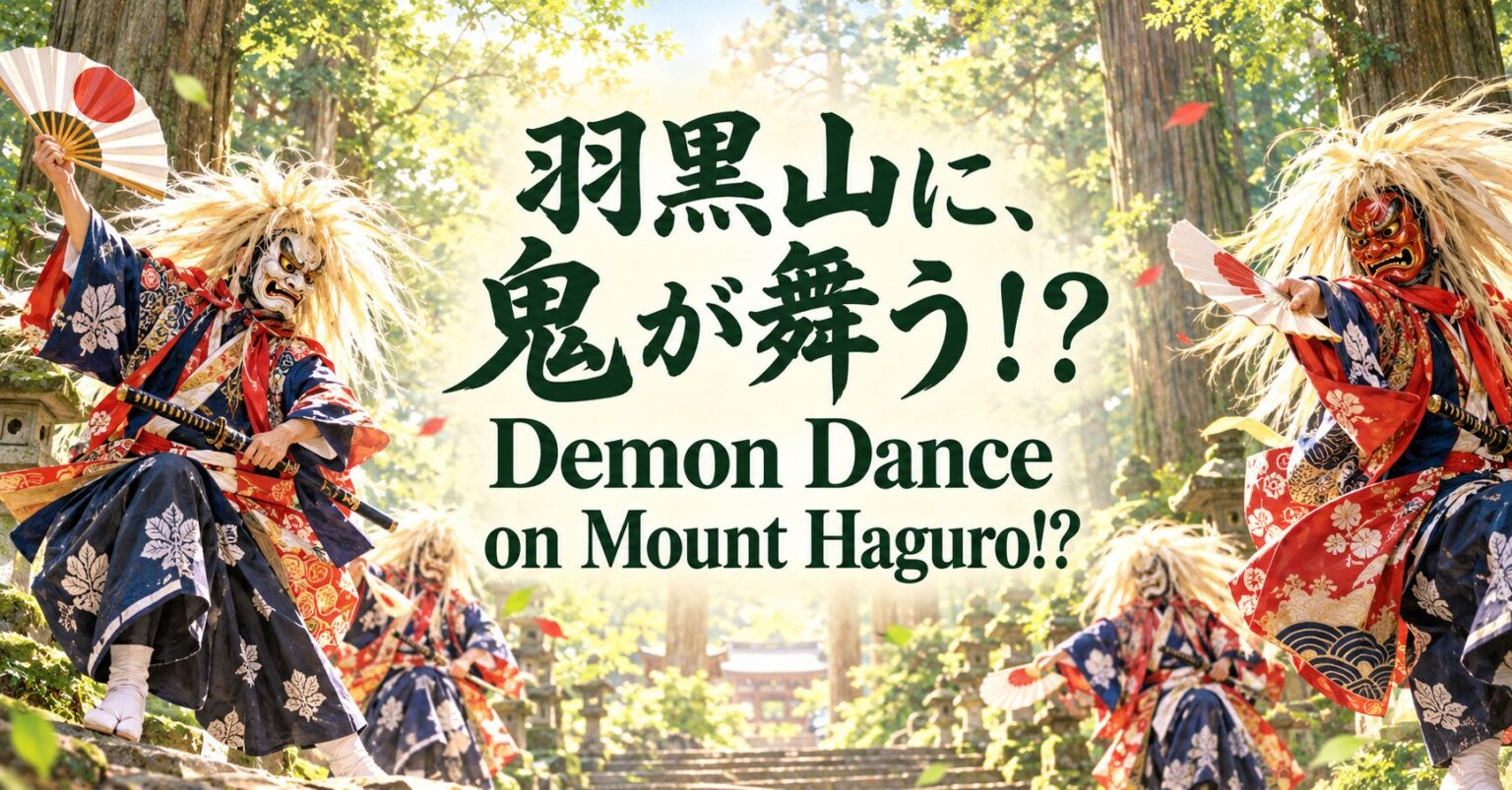
 Demons Dancing on Mount Haguro!?
 Why a dragon god at a Buddhist temple? The mystery of Zenpoji (Tsuruoka) and its sea-guarding dragon faith
 Michelin-Starred Sakata: A Two-Star Tour Built on the Wealth of the Kitamae Ships
- STAY WITH US -
Your Base for Exploring Tsuruoka
A small guesthouse in central Tsuruoka, Yamagata. The perfect base for your trip to Dewa Sanzan and Shonai.
Book Now →