
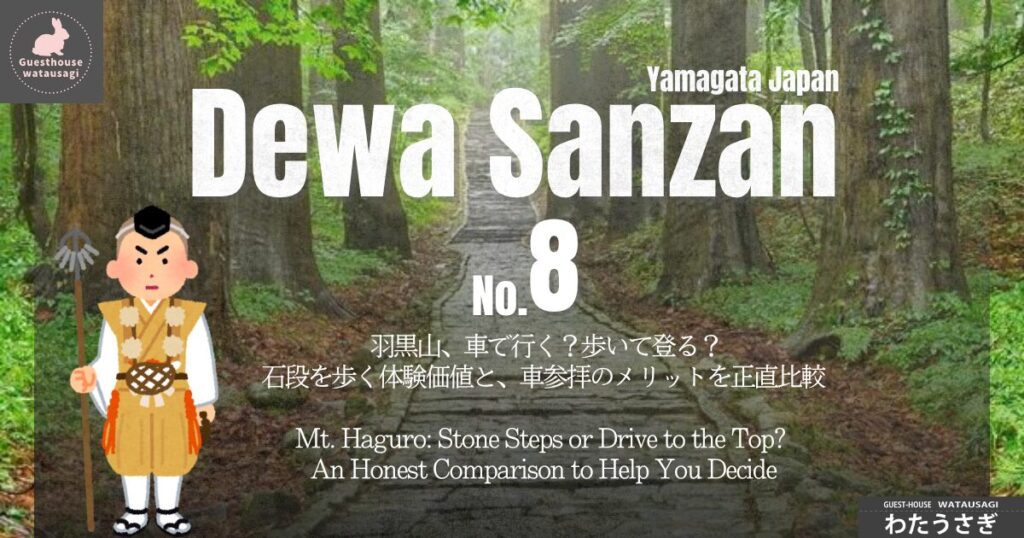
One question comes up constantly from visitors planning a trip to Mt. Haguro: do I need to walk the 2,446 stone steps, or can I drive to the summit?
The short answer: you have a genuine choice, and both options are valid. The longer answer is that they offer completely different experiences — and which one is right for you depends on what you're looking for, your fitness level, your time, and who you're travelling with.
In this article, I'll lay out both routes honestly — what each one gives you, what each one asks of you, and how to decide which fits your trip. 😊
→ Haguro top 10 highlights [Article No.5]
→ What to wear and bring: Haguro practical guide [Article No.4]
The Two Routes: A Quick Overview
There are two main ways to make the pilgrimage to Mt. Haguro.
Both routes lead to the same destination — the Sanjin Gosaiden shrine at the summit. But the journey to get there is an entirely different experience.
The Case for Walking the Stone Steps
If you have the fitness and the time, walking the stone staircase is the right choice — and not just because it's more traditional. The staircase is, in itself, one of the finest walking experiences in Japan.
The Gate That Changes Everything
The stone staircase experience begins at the Zuishinmon Gate — a large, vermillion-painted gate that marks the boundary between the ordinary world and the sacred precinct. The moment you pass through this gate, something shifts. The sounds of the car park and the road fall away. The air changes — cooler, stiller, ancient-feeling.
This transition — from the everyday into the sacred — is felt fully only when you walk through it. Driving to the summit bypasses it entirely. That's not a small thing.
The Five-Storied Pagoda: A Discovery, Not a Stop
About 10 minutes into the staircase, the forest delivers one of its most striking moments: a five-storied pagoda emerges from between the ancient cedar trees. It appears without warning, filling the space between the trunks with its tiers and its bronze finial.
When you walk the steps, this is a discovery. You come around a bend in the path and suddenly it's there — a National Treasure of Japan that has stood in this forest for centuries. The surprise of it, the contrast between the living forest and the ancient structure, is an emotional experience.
If you drive to the summit and visit the pagoda separately, you'll still see a magnificent building. But the discovery moment is gone. You'll arrive knowing it's there, rather than finding it.
The Cedar Forest — 1.7 Kilometres of Irreplaceable Atmosphere
The stone staircase runs for approximately 1.7 kilometres through an ancient cedar forest. The cedars on either side are between 300 and 600 years old — many over 30 metres tall — and the effect of walking beneath them for an extended time is deeply different from glancing at them from a road.
The light through the canopy changes as you climb. The sounds change. The air changes. There's a quality to being inside this forest for an hour that accumulates gradually — a sense of scale and time and silence that arrives not in a single moment but over the course of the walk. This cannot be replicated in 10 minutes.
On misty days, the effect is otherworldly. On clear mornings, the light slants through the cedars in golden columns. In autumn, the surrounding deciduous trees add warm colour against the deep green of the cedar canopy. Each visit to the staircase is different — and each one is worth doing.
The Ninosaka Chaya Tea House
Halfway up the staircase, at the top of the second slope, sits the Ninosaka Chaya: a small traditional tea house that serves chikara mochi (strength rice cakes). This is one of those unexpected pleasures that walking the steps earns you.
The experience of sitting on a wooden veranda, eating sweet mochi with the ancient forest around you, after the exertion of the first half of the climb — it's simple and specific and completely impossible to access from the summit car park. Small things matter in travel. This is one of them.
Arrival at the Summit Means Something Different
When you arrive at the Sanjin Gosaiden shrine after 2,446 steps, you've earned the arrival. There's a physical and emotional investment in the journey that makes the destination feel different. The incense, the shrine bells, the atmosphere of the summit precinct — you receive these differently when you've walked to them.
This is not mystical. It's just true of any meaningful destination reached on foot versus by vehicle. The effort changes the arrival.
The Case for Driving to the Summit
Please don't think of the summit car park as a compromise or a shortcut. There are perfectly good reasons to drive — and the summit experience itself is complete and meaningful regardless of how you arrived.
Driving makes clear sense if you:
Have knee, hip, or ankle concerns that make 2,000+ steps inadvisable / Are travelling with elderly companions or young children / Have limited time and want to combine Haguro with other destinations the same day / Are visiting during or shortly after wet weather when wet stone steps are a slip risk / Simply want to visit the summit shrine without the physical challenge — this is a completely legitimate priority
The Summit Is Complete in Itself
The Sanjin Gosaiden — the grand thatched-roof shrine housing the deities of all three Dewa Sanzan mountains — is fully accessible from the summit car park. The Bell Tower, the Mausoleum of Prince Hachiko, the goshuin desk, the omamori shop, the summit tea house — all of it is there. The act of worship at this shrine is unchanged by which route you took.
Many visitors who drive to the summit are deeply moved by the experience. The scale of the shrine building, the incense smoke, the sound of ritual inside, the ancient atmosphere of the summit precinct — these are real and powerful regardless of whether you walked the staircase or not.
A Practical Advantage: Making the Most of Your Time
If you’re combining your visit with sightseeing around Tsuruoka, hoping to visit Yudonosan the same day, or travelling with small children or companions who tire easily, driving to the summit isn’t “giving up on Mt. Haguro” — it’s a smart way to build Mt. Haguro into your itinerary.
You Can Still See the Five-Storied Pagoda
If you drive to the summit but want to see the pagoda, it's possible to walk down the upper portion of the staircase from the summit side. The pagoda is approximately a 15-20 minute walk down from the summit — you can see it, spend time with it, and walk back up. You'll miss the staircase experience from the bottom, but the pagoda itself is fully accessible.
This is a reasonable middle-ground option for those who drive up but want to see the National Treasure pagoda up close.
The Hybrid Approach — Walk Up, Drive Down
There's a third option that many visitors find works extremely well: walk the stone staircase on the way up, and drive back down from the summit.
This requires a small amount of logistics (leaving your car at the Zuishinmon Gate, taking a taxi or shuttle from the summit, or arranging to be picked up) — but the reward is substantial. You get the full upward experience: the gate transition, the pagoda discovery, the cedar forest at its best, the tea house, the earned arrival at the summit. And on the descent, your knees are spared the additional 45 minutes of downward pressure on stone steps.
The descent is less dramatic than the ascent in terms of experience — the discoveries have already happened. Getting down efficiently is a reasonable choice. Many repeat visitors to Haguro do exactly this.
How to Decide: A Practical Guide
Still deciding which route is yours? Run through these two quick checklists.
Walking the Stone Steps Is Right for You If…
You’re a confident walker and don’t mind 2–3 hours on foot
You want to experience Mt. Haguro deeply
You want to take in the cedar avenue and the pagoda fully
You have time to spare
You’ll enjoy the steps rain or shine
Driving to the Summit Is Right for You If…
You have concerns about your knees, back, or ankles
You’re a senior visitor, or travelling with small children
You’re not feeling your best on the day
Your time is limited and you want to see other places too
Reaching and worshipping at the Sanjin Gosaiden is your top priority
Practical Information for Both Routes
Zuishinmon Gate Car Park (for stone staircase walkers)
Located at the base of the stone staircase, this car park is the starting point for all staircase visits. Bus stops for the service from Tsuruoka Station are also here. Free parking is available, with paid overflow parking nearby in peak season.
Summit Car Park (for drivers)
Accessible via the mountain road — well-signposted from the main road. Parking fee applies. In peak season (Golden Week, Obon, October weekends) this car park fills early — arrive before 9 AM if possible.
Shuttle and Taxi Options
For those wishing to walk up and drive (or be driven) down, inquire locally about taxi services from the summit. The guesthouse or local tourist information can advise on current options.
Wrap-up
There is no wrong answer here — neither route is right or wrong.
Walking the staircase gives you something irreplaceable — the forest, the pagoda discovery, the tea house, the earned summit. These are treasures reserved for those who climb the steps.
Driving to the top gives you something real — the summit shrine, the atmosphere, the goshuin — on terms that work for your body and your schedule. And your worship at the Sanjin Gosaiden, your true destination, is exactly the same on either route.
What matters is that you come to Mt. Haguro. However you arrive at the Sanjin Gosaiden, the 1,400 years of sacred atmosphere that surrounds it doesn't check your route. It simply receives you. 😊
→ Mt. Haguro top 10 highlights [Article No.5]
→ What to wear and bring: Haguro practical guide [Article No.4]
→ Dewa Sanzan model course [Article No.6]
Guesthouse Watausagi sits right in the heart of Dewa Sanzan territory — perfectly positioned between Hagurosan, Gassan, and Yudonosan. Guests come from across Japan and around the world to explore these sacred mountains. Make Watausagi your base and discover the spiritual world of Dewa Sanzan! 😊
We also share the charms of our home region — Yamagata, Tsuruoka, and the Shonai area.
I'm always sharing updates and local tips on Instagram Stories. Follow us on Instagram and stay in the loop! 😊
And a like or a share is always, always appreciated 💕
📖 やまがたいいとこ の関連記事
 Demons Dancing on Mount Haguro!?
 Why a dragon god at a Buddhist temple? The mystery of Zenpoji (Tsuruoka) and its sea-guarding dragon faith
 Michelin-Starred Sakata: A Two-Star Tour Built on the Wealth of the Kitamae Ships
- STAY WITH US -
Your Base for Exploring Tsuruoka
A small guesthouse in central Tsuruoka, Yamagata. The perfect base for your trip to Dewa Sanzan and Shonai.
Book Now →