
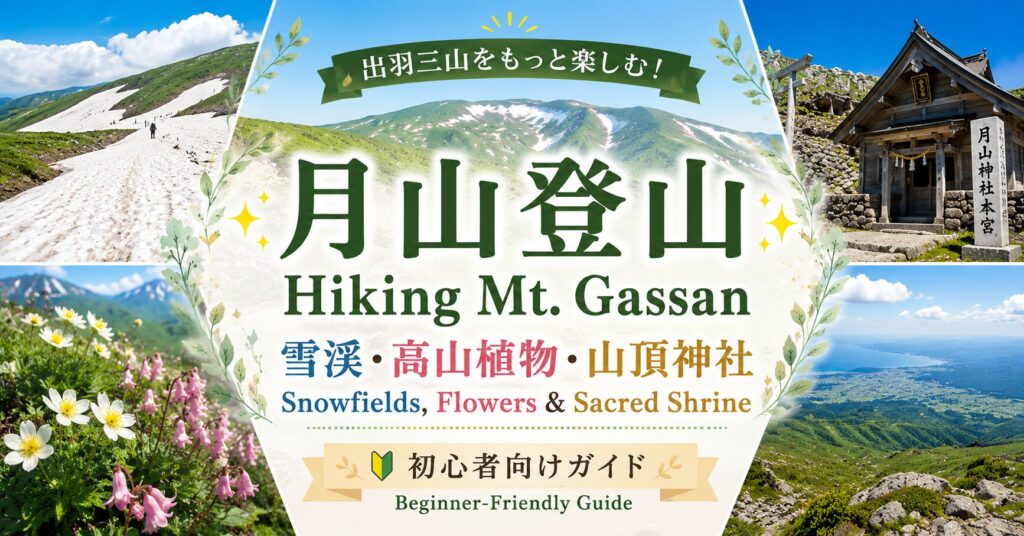
Mt. Gassan (Gassan, 月山) is the most physically demanding of Dewa Sanzan's three sacred mountains — and the most unexpectedly spectacular.
Standing at 1,984 metres (6,509 ft), it's one of Japan's 100 Famous Mountains, a designated sacred site for over 1,400 years, and home to snowfields that persist well into July, rare alpine wildflowers blooming in the shadow of those same snowfields, and a summit shrine that can only be visited during the short summer season.
In this guide, I'll walk you through what makes Gassan extraordinary, how to reach the summit, what to wear and bring, and what to watch out for. The goal: that you arrive prepared, stay safe, and come back with a Gassan experience you'll be talking about for years. 😊
→ Dewa Sanzan overview [Article No.1]
→ Dewa Sanzan access guide (Article No.3)
→ Full Dewa Sanzan itinerary including Gassan [Article No.6]
Mt. Gassan: Essential Facts
| Item | Details |
|---|---|
| Elevation | 1,984 m (6,509 ft) — one of Japan's 100 Famous Mountains |
| Location | Yamagata Prefecture, Tohoku region |
| Open Season | Early July – mid-October (varies each year) |
| Main Trailheads | Usuzawa-guchi (ropeway available) / 8th Station |
| Summit facilities | Mt. Gassan Shrine (summer only) / Summit hut |
| Difficulty | Beginner–Intermediate (manageable with preparation) |
| Signature features | July snowfields, dense alpine wildflowers, sacred summit shrine |
Why Mt. Gassan Is Extraordinary
Snowfields in July — Walking on Snow in Summer
The most immediately startling thing about Mt. Gassan is the snow.
In early July, while the valleys below are in the full heat of summer, the slopes of Gassan above 1,500 metres are still blanketed in white. The hiking trail crosses multiple snowfields, and you walk across actual snow — firm, cold, crunching underfoot — while wildflowers bloom in the patches of exposed rock beside you.
The visual effect is remarkable: snow and flowers in the same frame, a summer sky overhead, the silence of the high mountain broken only by your footsteps. This combination is uniquely Gassan — there is nowhere else in Japan quite like it in July.
The snowfields require some care — more on that in the safety section — but they are one of the main reasons to come.
Alpine Wildflowers — A Mountain in Full Bloom
Mt. Gassan has a reputation among Japanese botanists and nature photographers as one of the finest alpine wildflower habitats in the country. The mountain earns that reputation every July and August.
As the snow recedes through summer, it leaves behind explosions of wildflowers in the meltwater-fed soil: Chinguruma (cotton grass windflowers), Hakusan-ichige (white alpine anemone), Nikko-kisuge (day lily), Usuyu-kiso, Kobaikei-so — dozens of species bloom in succession from early July through late August, creating a constantly changing floral landscape as you climb.
The peak period for variety and density is mid-July to mid-August. In September, the alpine vegetation turns to rust and gold, and the clarity of the autumn air makes the summit views extraordinary.
Mt. Gassan Shrine — A Summit Worthy of Pilgrimage
At the summit of Mt. Gassan, at nearly 2,000 metres, sits Mt. Gassan Shrine — the sacred site representing the 'mountain of the past' in Dewa Sanzan's pilgrimage of rebirth. The shrine is only accessible during the open season (early July to mid-October).
To worship here, you first have to climb a mountain into the clouds. The physical effort, the thinned air, the sense of remoteness — together they give the act of worship a quality that no lower-elevation shrine can replicate. It is a place where the feeling of standing above the clouds and the sanctity built up over a long history of pilgrimage coexist.
The goshuin stamp is given at the summit office (summer season only). For anyone aiming to complete the Dewa Sanzan goshuin collection, Gassan is the one that takes real effort to earn — an essential stop!
📍 Mt. Gassan Shrine: Summit at 1,984m. Separate entry fee required. Open summer season only.
The View from the Top
On clear days, the summit offers an exceptional view: the Shonai Plain stretching to the Sea of Japan, Mt. Chokai to the north, and the Zao mountains to the south — a full 360-degree panorama on a fine day.
That said, cloud often gathers around the summit, building from midday onward. The right mindset: a superb view if it's clear, an ethereal, dreamlike mood if it's not. 😊
The Two Main Routes
Gassan has two main trailheads. Choose between them based on your fitness, the time you have, and what you want from the day.
Route 1: Usuzawa-guchi — With or Without the Ropeway
The Usuzawa-guchi trailhead is the most popular starting point for Gassan. A ropeway (chairlift) is available here — but it's an option, not a requirement. You can walk the full route from the car park on foot if you prefer.
With ropeway: summit approximately 1.5–2 hours one way / 3–4 hours round trip
Without ropeway: summit approximately 2.5–3 hours one way / 5–6 hours round trip
Difficulty: beginner to intermediate (easier if you take the ropeway)
The ropeway simply carries you from the car park up to approximately 1,520 metres, cutting out the lower section of the approach. Whether you take it or not, the trail above is the same — snowfields, wildflowers, the summit shrine.
Skipping the ropeway is a perfectly valid choice. The full ascent on foot gives you a greater sense of achievement and a longer immersion in the mountain environment. If time or fitness is a concern, the ropeway makes an already manageable hike more accessible. 😊
The trail also crosses snowfields where you can experience summer snow-walking. An intermediate summit called Ubagadake (姥ヶ岳) sits about 20 minutes above the ropeway top station — it offers excellent views and makes a reasonable turnaround point for anyone who finds the full summit too demanding.
📍 Usuzawa-guchi: ~1 hour from central Tsuruoka by car. Ropeway fare: ~¥1,000 round trip (subject to change). Ropeway boarding is a few minutes' walk from Usuzawa car park.
Route 2: 8th Station — The Shorter Approach
The 8th Station sits at a higher elevation, allowing a more direct path to the summit.
8th Station to summit: approximately 1.5–2 hours one way
Round trip: approximately 3–4 hours
Difficulty: beginner to intermediate
A good option for limited time, repeat visitors, or those who want the most direct path to the summit shrine. The approach via the Midagahara (弥陀ヶ原) highland wetland boardwalk is beautiful in its own right.
📍 8th Station: ~1 hour 10 minutes from central Tsuruoka by car. The Midagahara highland wetland sits near the trailhead.
| Usuzawa (with ropeway) | Usuzawa (no ropeway) | 8th Station | |
|---|---|---|---|
| Summit (one way) | ~1.5–2 hours | ~2.5–3 hours | ~1.5–2 hours |
| Round trip | ~3–4 hours | ~5–6 hours | ~3–4 hours |
| Cost | Ropeway fare (~¥1,000) | free | free |
| Snowfield crossing | ◎ Multiple sections Jul–Aug | ◎ Multiple sections Jul–Aug | △ Less extensive |
| Wildflowers | ◎ Outstanding | ◎ Outstanding | ◎ Good (Midagahara nearby) |
| Best for | First-timers, those short on time or energy | Full-ascent experience, confident hikers | Limited time, repeat visitors |
What to Wear — The Most Critical Preparation
More visitors make serious mistakes with clothing on Gassan than with any other aspect of the trip. The core error: treating a summer hike as a warm-weather activity. At 1,984 metres, summer temperatures do not apply.
Essential Clothing
✅ Insulating mid-layer (fleece or light down jacket) — summit temperatures in August regularly fall below 10°C (50°F). Non-negotiable.
✅ Waterproof jacket and trousers — pack these even with a sunny forecast
✅ Moisture-wicking base layer — long-sleeved for warmth and sun protection
✅ Hiking trousers — not jeans (jeans are heavy and terrible when wet)
✅ Hat — warmth and sun protection above the treeline
✅ Gloves — essential for July snowfields, recommended through August
⚠️ T-shirt and shorts alone is dangerous on Gassan. Hypothermia risk at the summit is real, even in summer.
⚠️ Cotton becomes dangerously cold when wet. Wear synthetic or wool throughout.
Footwear and Poles
✅ Hiking boots or waterproof trail shoes — ankle support is valuable on uneven terrain
✅ Thick hiking socks — blister prevention matters on a 3–4 hour round trip
✅ Trekking poles — strongly recommended, especially for snowfields and descent
⚠️ Regular trainers are inadequate for wet rock and snowfield terrain.
What to Pack
Water: at least 1 litre — almost no refill points on the trail
Food: lunch and snacks. Summit hut sells items but at mountain prices.
Map or GPS app: cloud descends fast near the summit
First aid kit: blister plasters, pain relief, antiseptic
Sun protection: sunscreen and sunglasses — snow reflection amplifies UV
Camera: snowfields, wildflowers, summit views. 📸
Cash: shrine entry fee, goshuin, hut purchases
Safety — The Non-Negotiables
Prepare for Sudden Weather Changes
Gassan's weather changes fast. Even when the foot of the mountain is clear, the summit is often wrapped in cloud, and clouds tend to build through the afternoon, sometimes bringing sudden showers or fog.
⚠️ Begin your hike no later than 7:00 AM. Aim to reach the summit before 10 AM. Begin descending by midday. Mt. Gassan's weather deteriorates reliably in the early afternoon — this timing is not conservative, it's standard practice.
Snowfield Safety
From July to early August, snowfields remain across sections of the trail. Because they lie on a gradient, a careless step can lead to a slip or a slide.
⚠️ Walk slowly and deliberately on snow. Test each step before committing your weight.
⚠️ Follow established footprints — don't improvise your own route across snow.
⚠️ Use trekking poles for balance on all snow sections.
Lightweight microspikes are available for rent at some trailheads in early July — check locally before your visit.
Altitude Sickness & Managing Your Condition
At nearly 2,000 metres, altitude sickness — headache, nausea, shortness of breath — is a real possibility.
Don't rush the ascent. Keep a slow, steady pace so your body can acclimatize to the elevation.
Hydrate frequently, even before you feel thirsty.
If you start to feel unwell, decide to descend without hesitation — symptoms that don't ease are a signal to go down.
Having the courage to judge 'not today' is itself an important mountaineering skill. The mountain will still be there next time.
Check the Open Season
⚠️ Gassan's open season runs from early July to mid-October, but the exact dates shift slightly from year to year. If your goal is to worship at the summit shrine, always check the official website for the latest opening information before finalizing your plans.
Sample Day Plan
Here's a simple model for how a Gassan day might actually unfold.
Day Trip (Usuzawa-guchi, with ropeway)
5:30 AM — Depart from Guesthouse Watausagi (or central Tsuruoka)
6:30 AM — Arrive at Usuzawa car park
7:00 AM — Ropeway ride, begin hiking
9:00–10:00 AM — Summit: Mt. Gassan Shrine, worship, goshuin
10:30 AM — Begin descent
12:30–1:00 PM — Return to trailhead
2:00 PM — Back in Tsuruoka for lunch and recovery
If skipping the ropeway, push departure back by about one hour (aim for 4:30–5:00 AM). The extra time on the trail is well worth it for those who want the full mountain experience from the bottom up. 😊
An early start is the golden rule of climbing Gassan. To stay ahead of the afternoon weather deteriorating, get moving as early as you can!
→ Detailed model course including Gassan [Article No.6]
Wrap-up
Mt. Gassan offers a kind of experience you won't find anywhere else in Dewa Sanzan.
Snowfields in July, alpine flowers in every colour, a shrine at the summit, sweeping panoramic views — few mountains anywhere in Japan bring all of these together in a single climb.
Even for beginners, with two solid preparations — the right gear and an early start — Gassan is well within reach. Do go and experience its world on your own two feet at least once. 😊
→ When to visit: Dewa Sanzan Season Guide(ArticleNo.2)
→ Mt. Haguro highlights [Article No.5]
→ The mystery of Yudono [Article No.10]
Guesthouse Watausagi is a favourite stay for mountain lovers. Located almost exactly between Mt. Chokai and Mt. Gassan — two of Japan's 100 Famous Mountains — it's the perfect base for hikers. Climbers gather here from all over Japan during the mountain season. Checkout time is flexible, so early-morning departures are no problem! 😊
We also share the charms of our home region — Yamagata, Tsuruoka, and the Shonai area.
I'm always sharing updates and local tips on Instagram Stories. Follow us on Instagram and stay in the loop! 😊
And a like or a share is always, always appreciated 💕
📖 やまがたいいとこ の関連記事
 Demons Dancing on Mount Haguro!?
 Why a dragon god at a Buddhist temple? The mystery of Zenpoji (Tsuruoka) and its sea-guarding dragon faith
 Michelin-Starred Sakata: A Two-Star Tour Built on the Wealth of the Kitamae Ships
- STAY WITH US -
Your Base for Exploring Tsuruoka
A small guesthouse in central Tsuruoka, Yamagata. The perfect base for your trip to Dewa Sanzan and Shonai.
Book Now →