There is one place among Dewa Sanzan's three sacred mountains that I can tell you almost nothing about.
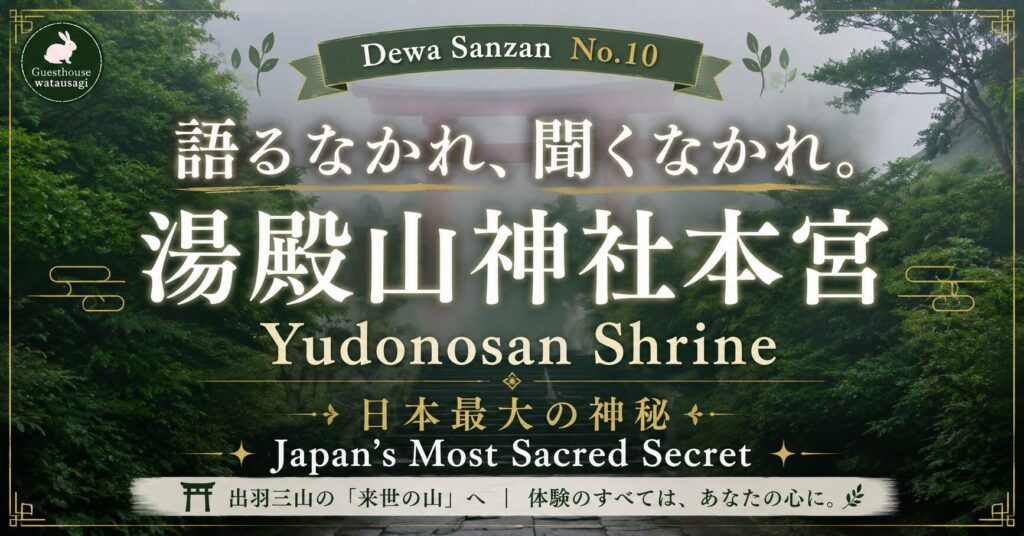
Mt. Yudono (Yudonosan, 湯殿山) — the third and final mountain in the Dewa Sanzan pilgrimage.
I can speak about Mt. Haguro and Mt. Gassan: the beauty of the cedar avenue, the sense of accomplishment on the stone steps, the vividness of the alpine flowers. With those mountains, there is so much that can be put into words.
But what you experience at the main shrine of Mt. Yudono is the one thing you must not put into words. Its inner shrine holds a distinction unique in Japanese religious practice: its contents are a closely kept secret, and visitors who enter the sacred grounds are asked, explicitly, not to describe what they encounter inside.
'Do not speak of it. Do not ask of it.'
This instruction — handed down through generations at Yudonosan — applies to everyone who passes through the sacred gate. Pilgrims, casual visitors, travel writers, guidebook authors. Everyone.
I have visited Yudonosan, but I cannot tell you what I found there. What I can tell you is why it matters, what to expect in practical terms, and why — despite, or perhaps because of, its secrecy — Yudonosan is one of the most powerful sacred experiences in Japan.
The rest, you'll have to discover yourself. 😊
→ Dewa Sanzan overview [Article No.1]
→ Dewa Sanzan access guide (Article No.3)
What Is Mt. Yudono?
Mt. Yudono is the third mountain in the Dewa Sanzan sacred complex, alongside Mt. Haguro and Mt. Gassan. In the pilgrimage theology of Dewa Sanzan, the three mountains represent a journey through present (Haguro), past (Gassan), and future (Yudono) — a symbolic death and rebirth known as the 'Pilgrimage of Rebirth.'
Yudono is the mountain of the future — of what comes after death, of the newly reborn self. It is the destination, the final sacred threshold, the point at which the journey transforms the pilgrim.
For over 1,400 years, yamabushi mountain priests have made this pilgrimage. Ordinary people have followed them. Today, visitors come from across Japan and from around the world, drawn by the mountain's reputation and by the quality of experience that only Yudonosan can offer.
Mt. Yudono is open from late April to early November (dates vary slightly each year). Outside this season, both the roads and the sacred grounds are closed. Always check current opening information before planning your visit.
→ When to visit: Season Guide [Article No.2]
Why the Secrecy?
The 'do not speak of it' instruction is unusual even in Japan's rich tradition of sacred places. Most shrines and temples welcome visitors to photograph, describe, and share their experiences. Yudonosan actively requests the opposite.
There's a reason — though explaining it fully would itself risk violating the spirit of the request. What I can say is this:
At Yudonosan, visitors don't merely observe a sacred object or space. They encounter something. The nature of that encounter is such that knowing what to expect in advance would fundamentally change what you receive from it. The surprise — the unprepared confrontation with something genuinely unexpected — is not incidental to the experience. It is the experience.
This is why the shrine asks you not to speak of it. Not to keep a secret for its own sake, but to preserve the integrity of the encounter for the next visitor — and the one after that, and the ones who will come in 50 years' time.
I will honour that request in this article. Go and find out for yourself. It is worth it.
What You Can Know Before You Go
Within the boundaries of what can be said, here is the practical information you need.
You Will Remove Your Shoes
Before entering the sacred grounds of Yudonosan Shrine, visitors remove their footwear. You approach the inner sanctuary barefoot — or in socks, depending on conditions. In early summer, the ground can be cold. This is deliberate and part of the experience.
Wear footwear that's easy to remove and put back on. Slip-on shoes are convenient. Socks are fine.
You Will Receive a Ritual Purification
A Shinto priest performs an oharai (御祓い) — a purification ritual — before visitors enter the inner sacred area. This is a brief ceremony involving waving a sacred wand (haraegushi) over those assembled. Bow your head when this happens. No specific prior knowledge is needed.
Photography is Prohibited Inside
No photographs are permitted inside the sacred grounds. Please put away your camera and smartphone before entering — not just to comply with the rule, but because the experience is one that deserves your full presence rather than a screen between you and it.
You will not have visual records of what you saw. You will have the memory, undiluted.
Goshuin and Omamori
The goshuin stamp and omamori protective charms available at Yudonosan are distinct from those at Haguro and Gassan — specific to this shrine and obtainable nowhere else. For those collecting the Dewa Sanzan goshuin, this is the third and final stamp.
Many visitors describe the Yudonosan goshuin as their most meaningful — perhaps because of what the journey to obtain it involved.
How Long to Allow
Allow one to two hours in total. From the parking area, a shuttle bus runs to the entrance of the main shrine (or it's a 15–20 minute walk); that estimate covers getting there, the visit itself, and the return.
Getting to Yudonosan — Practical Access
📍 For the exact opening and closing dates each year, check the official Yudonosan Shrine website before booking travel.
Mt. Yudono is not accessible by regular public transport. A rental car is the practical choice for almost all visitors.
From central Tsuruoka, the drive takes approximately 1 hour. The road is well-signposted; follow signs for 湯殿山 (Yudonosan).
Yudonosan and the Pilgrimage of Rebirth
The Dewa Sanzan pilgrimage is known as the 'journey of rebirth.'
At Haguro (the present) you face the self you are now; at Gassan (the past) you look back on what came before; and at Yudonosan (the future) you are reborn as a new self. This is the conceptual backbone of the three-mountain pilgrimage.
I believe Yudonosan's 'do not speak of it' rule also exists to protect this experience of rebirth. Rebirth is something you must feel in your own body, not something explained in words — and so, I suspect, speaking of it is forbidden.
This is only my interpretation, but it's true that many people, after completing all three mountains, say: 'Ah — so that's what it meant.'
But what that something is — go, and feel it for yourself. 😊
→ The philosophy of the Dewa Sanzan pilgrimage [Article No.16]
Places to Stop Before or After Your Visit
There are other places worth visiting around Yudonosan Shrine, before or after your time at the main shrine.
Yudonosan Shrine Sessha (Auxiliary Shrine)
On the road up to the main shrine, you'll find a sessha — an auxiliary shrine of Yudonosan. Its atmosphere differs from the main sanctuary, and many visitors stop here quietly along the way.
Senninsawa
Senninsawa is a ravine near Yudonosan where you can feel the abundance of the mountain's nature. The scenery is especially beautiful in the fresh green of early summer and in the autumn foliage.
Combining Yudonosan with the Other Mountains
Mt. Yudono is about a 45-minute drive from Mt. Haguro, so you can visit both in a single day. With more time, adding Mt. Gassan the next day makes for a rewarding 2-night, 3-day trip.
→ Dewa Sanzan model course [Article No.6]
A Word About Approaching Yudonosan
Some visitors arrive at Yudonosan expecting drama — a spectacular landscape, an elaborate ceremony, a towering sacred structure. The visual experience is not what makes Yudonosan remarkable.
What makes it remarkable is something else entirely. Something that happens in a specific place, in a specific moment, that doesn't translate into photographs or descriptions. Something that stays with you.
Come without expectations. Come having walked through the cedar forest of Haguro and, if possible, having climbed the snowfields of Gassan. Come having made the journey mean something before you arrive.
Then remove your shoes, receive the purification, and walk forward.
You'll understand when you get there. 😊
Wrap-up
Yudonosan is the most difficult sacred site in Japan to write about — for the best possible reason. The secrecy is not a barrier to experience. It is the experience.
'Do not speak of it. Do not ask of it.' As those words suggest, the essence of Yudonosan lies not in words but in the experience itself.
What kind of experience awaits you at Yudonosan, at the end of your three-mountain journey — that is something only those who have gone there can know. In a world where almost everything can be previewed, reviewed, photographed, and streamed, a place that simply asks you to go and find out for yourself is rare, and precious.
Make Yudonosan the conclusion of your journey across the three mountains. I'm sure it will become one of the most unforgettable shrine experiences you will have in Japan. Go. 😊
→ Mt. Haguro highlights [Article No.5]
→ Mt. Gassan Hiking Guide [Article No.9]
→ Dewa Sanzan model course [Article No.6]
Guesthouse Watausagi sits right in the heart of Dewa Sanzan territory — perfectly positioned between Hagurosan, Gassan, and Yudonosan. Guests come from across Japan and around the world to explore these sacred mountains. Make Watausagi your base and discover the spiritual world of Dewa Sanzan! 😊
We also share the charms of our home region — Yamagata, Tsuruoka, and the Shonai area.
I'm always sharing updates and local tips on Instagram Stories. Follow us on Instagram and stay in the loop! 😊
And a like or a share is always, always appreciated 💕
📖 やまがたいいとこ の関連記事
 Demons Dancing on Mount Haguro!?
 Why a dragon god at a Buddhist temple? The mystery of Zenpoji (Tsuruoka) and its sea-guarding dragon faith
 Michelin-Starred Sakata: A Two-Star Tour Built on the Wealth of the Kitamae Ships
- STAY WITH US -
Your Base for Exploring Tsuruoka
A small guesthouse in central Tsuruoka, Yamagata. The perfect base for your trip to Dewa Sanzan and Shonai.
Book Now →