
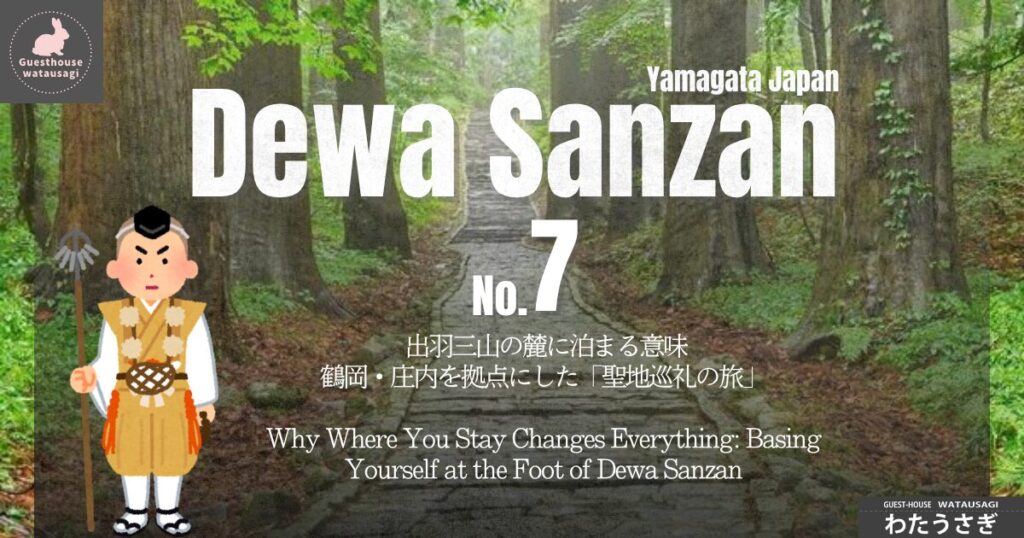
When planning a trip to Dewa Sanzan, most people spend a lot of time thinking about which mountains to visit and how to get there.
Very few spend enough time thinking about where to stay.
That's a mistake — because where you base yourself is one of the most consequential decisions of the whole trip.
In this article, I want to make the case for staying at the foot of the mountains rather than visiting as a day trip — and explain why Tsuruoka, with Guesthouse Watausagi as your base, gives you an experience that day-trippers simply can't access. 😊
Three Reasons Why Staying Near Dewa Sanzan Changes the Trip
Reason 1: You Can Visit at Dawn — When the Mountains Are at Their Best
The single most transformative thing you can do at Mt. Haguro is visit before most people have had breakfast.
Before 7 AM, the 2,446-step stone staircase is nearly empty. Morning light filters through the ancient cedar canopy at angles that don't exist at midday. Mist rises from the forest floor. The sound of a single bird echoes. This version of Haguro — quiet, atmospheric, and deeply still — is the one that stays with you for the rest of your life.
It's not accessible to day-trippers arriving from distant cities. It requires staying nearby the night before, waking early, and driving the 30 minutes to the Zuishinmon Gate before the world starts.
The same logic applies even more strongly to Mt. Gassan. The summit weather typically deteriorates in the early afternoon — cloud rolls in, visibility drops, and the temperature falls. Reaching the summit in clear conditions means starting the hike no later than 7 AM. From Guesthouse Watausagi, that means a 5:30 AM departure. It's early — but completely manageable when you're already there. It's impossible from a city further away.
→ Early morning at Haguro — what to expect [Article No.29]
→ Mt. Gassan hiking guide [Article No.9]
Reason 2: You Can Move at the Pace the Mountains Deserve
Dewa Sanzan is not a theme park. The sacred sites here — the ancient forest, the stone staircase, the National Treasure pagoda, the summit shrines — reward people who slow down.
Day-trippers, inevitably, rush. You arrive with a return schedule already in mind. You watch the clock at the summit. You skip the second look at the pagoda because the bus leaves in 40 minutes. You don't sit at the Ninosaka Chaya tea house because there isn't time.
When you're based nearby, the pressure disappears. Haguro on Day 1 can be as long or as short as it wants to be. Yudono on Day 2 can be approached without the shadow of a departure looming. You give each mountain the time it actually needs — and in return, each mountain gives you considerably more.
Many visitors who come to Dewa Sanzan as a day trip and later return for an overnight stay report that the experience feels like an entirely different place. Not because anything changed — but because they themselves arrived differently.
Reason 3: You Discover That the Region Itself Is Extraordinary
Tsuruoka City and the surrounding Shonai region hold a remarkable distinction: Tsuruoka was the first city in Japan to be designated a UNESCO Creative City of Gastronomy.
This is not a marketing claim. The Shonai plain produces rice of exceptional quality, seafood from the Sea of Japan coast, and a range of locally endemic heirloom vegetables — dadacha-mame (an incomparable local edamame variety), Atsumi turnip, Minda eggplant — that exist nowhere else in Japan. The food here is genuinely worth building a trip around.
A dinner in Tsuruoka after a day on the mountain — local fish, local sake, local vegetables prepared thoughtfully — adds a dimension to the Dewa Sanzan experience that no amount of shrine-visiting alone can provide. The mountain feeds the spirit. The table feeds everything else. 😊
Beyond food, Tsuruoka is a historic castle town with museums, a striking Meiji-era Catholic church (a National Important Cultural Property), coastal hot spring resorts overlooking the Sea of Japan, and an unhurried pace that suits both the mountains and the visitor.
→ Tsuruoka's food culture and what to eat [Article No.35]
The Region Itself: Tsuruoka and Shonai
Many visitors focus only on the three mountains — but the Shonai–Tsuruoka region around them is genuinely worth exploring in its own right.
Food Culture
As mentioned, Tsuruoka is a UNESCO Creative City of Gastronomy. It's especially known for its zairai (heirloom) crops — dadacha-mame edamame, Atsumi turnip, Minda eggplant — varieties so local you simply can't find them in Tokyo.
The city is full of restaurants committed to local, seasonal cooking — the kind of food that makes you want to come back for another meal on your next trip.
Hot Springs
The Shonai area is dotted with hot spring towns — perfect for soaking away the fatigue of a day on the mountain.
Yunohama Onsen: a seaside hot spring famous for its spectacular sunsets over the Sea of Japan.
Atsumi Onsen: a calm, traditional hot spring town within easy reach of central Tsuruoka.
Yura Onsen: a quiet, off-the-radar spot with a hidden-gem feel.
Culture & History
Tsuruoka was a castle town ruled by the Sakai clan during the Edo period, and traces of its samurai heritage remain throughout the city.
Chido Museum: a museum surveying Tsuruoka's history and culture, with several Important Cultural Property buildings on its grounds.
Tsuruoka Catholic Church: a Meiji-era church and registered National Important Cultural Property, built in a Gothic style that's rare in Yamagata.
Shonai Shrine: a shrine at the heart of the old castle town, set within Tsuruoka Park and especially popular in cherry-blossom season.
Visiting Dewa Sanzan and exploring central Tsuruoka in the same trip — that combination is the classic way to experience Shonai.
Comparing Day Trip vs. Staying at the Base
Here's how a day trip and an overnight stay at the base compare — the same mountains, a very different experience.
Dawn visits: nearly impossible on a day trip; with an overnight stay, you just wake up early.
Pace: day-trippers keep watching the clock; staying nearby lets you move at the mountains' pace.
Number of mountains: one if you're lucky on a day trip; two or three comfortably with an overnight stay.
Local food and culture: limited on a day trip; with a stay, you enjoy dinner and breakfast too.
The next day: a day trip has none; staying gives you a full second day.
Depth: a day trip is a dash; an overnight stay sinks in and stays with you.
About Guesthouse Watausagi
Guesthouse Watausagi is a small guesthouse located almost exactly at the geographic midpoint between all three Dewa Sanzan mountains — about 30 minutes from Mt. Haguro, and within an hour of both Mt. Gassan and Mt. Yudono.
It was designed with exactly this kind of pilgrimage trip in mind. Guests come from across Japan and from around the world, and most of them are here for the same reason: to experience Dewa Sanzan properly, not in a rush.
What Makes Watausagi the Right Base
Central location between all three mountains — the most strategically placed accommodation in the area
Flexible checkout time — no pressure on early departure mornings for Gassan or Haguro
A community of fellow travellers from Japan and abroad — the conversations here are part of the experience
Local knowledge from the host: conditions, routes, restaurants, and things you won't find in any guidebook
Unpretentious, comfortable, and fairly priced — the energy goes into the surroundings, not the lobby
Watausagi Is Right For You If:
You're visiting two or more mountains and need a central base
You want early morning access to Haguro or a pre-dawn start for Gassan
You're travelling solo and want to connect with other pilgrims and travellers
You want honest local recommendations for where to eat and what to see
You believe that how you travel matters as much as where you go
Guesthouse Watausagi sits right in the heart of Dewa Sanzan territory — perfectly positioned between Hagurosan, Gassan, and Yudonosan. Guests come from across Japan and around the world to explore these sacred mountains. Make Watausagi your base and discover the spiritual world of Dewa Sanzan! 😊
A Sample 2-Day Itinerary from Watausagi
To make this concrete — here's how two days based at Watausagi looks in practice:
Day 1: Mt. Haguro
9:00 AM — Depart for Mt. Haguro (30 min by car)
9:30 AM — Begin stone staircase: Zuishinmon Gate, Five-Storied Pagoda, cedar forest
11:00 AM — Summit: Sanjin Gosaiden shrine, goshuin, summit shop
12:30 PM — Descend and return to car
Afternoon — Tsuruoka city: Chido Museum, Tsuruoka Catholic Church, or simply wander
Evening — Dinner in Tsuruoka: local seafood, dadacha-mame, regional sake
Night — Check in to Watausagi, rest, prepare for Day 2
Day 2: Mt. Yudono
8:00 AM — Depart from Watausagi (flexible checkout — bags can stay)
9:00 AM — Arrive Mt. Yudono car park
9:30 AM — Sacred grounds: shoes off, purification ceremony, the experience that can't be described
11:00 AM — Depart Mt. Yudono
12:30 PM — Lunch in Tsuruoka (Shonai's UNESCO food culture deserves a proper meal)
Afternoon — Head to Tsuruoka Station or Shonai Airport with time to spare
This is what a Dewa Sanzan trip looks like when it's done properly. 😊
→ Full itinerary details: Dewa Sanzan 2-Day and 3-Day Model Courses [Article No.6]
What About the Mountain Temple Lodges (Shukubo)?
There is another accommodation option in the Dewa Sanzan area worth mentioning: the shukubo, or temple lodging, at Mt. Haguro's summit. These lodges offer a very different kind of stay — sleeping on tatami in a traditional pilgrim's inn, eating shojin ryori (Buddhist vegetarian cuisine), and participating in morning rituals and prayers.
The shukubo experience is extraordinary in its own right, and not something we'd discourage. But it serves a different purpose from Watausagi.
If your priority is immersive spiritual experience at Haguro specifically — sleep where the yamabushi sleep, eat what they eat, wake to the sound of the bell — the shukubo is for that night.
If your priority is a flexible base for exploring all three mountains, with the freedom to start early and move where the day takes you, that's what Watausagi is built for.
Many visitors choose both: a shukubo night at Haguro for the full immersion, and Watausagi for the other nights. The two are complementary, not competing. 😊
Wrap-up
Dewa Sanzan has been calling people to this corner of Japan for over 1,400 years. The sacred mountains deserve to be approached with time, intention, and a willingness to let the experience unfold at its own pace.
Staying at the foot of the mountains — rather than rushing in and out — is simply the right way to do this trip. It gives you the early mornings, the unhurried afternoons, the proper meals, and the space to absorb what you've seen.
Guesthouse Watausagi is here to make that possible. We'd love to be your base. 😊
"Live a little, while you stay" — we'd be honoured to be your base for exploring Dewa Sanzan. 😊
→ Access and transport: Getting to Dewa Sanzan [Article No.3]
→ Full 2-day and 3-day itineraries [Article No.6]
Guesthouse Watausagi sits right in the heart of Dewa Sanzan territory — perfectly positioned between Hagurosan, Gassan, and Yudonosan. Guests come from across Japan and around the world to explore these sacred mountains. Make Watausagi your base and discover the spiritual world of Dewa Sanzan! 😊
We also share the charms of our home region — Yamagata, Tsuruoka, and the Shonai area.
I'm always sharing updates and local tips on Instagram Stories. Follow us on Instagram and stay in the loop! 😊
And a like or a share is always, always appreciated 💕
📖 やまがたいいとこ の関連記事
 Demons Dancing on Mount Haguro!?
 Why a dragon god at a Buddhist temple? The mystery of Zenpoji (Tsuruoka) and its sea-guarding dragon faith
 Michelin-Starred Sakata: A Two-Star Tour Built on the Wealth of the Kitamae Ships
- STAY WITH US -
Your Base for Exploring Tsuruoka
A small guesthouse in central Tsuruoka, Yamagata. The perfect base for your trip to Dewa Sanzan and Shonai.
Book Now →