Most sacred mountains in Japan offer one thing: a shrine at the top, the effort of getting there, and the atmosphere of the place itself. These are not small things. But Dewa Sanzan offers something more structured — a journey deliberately designed to transform the person who makes it.
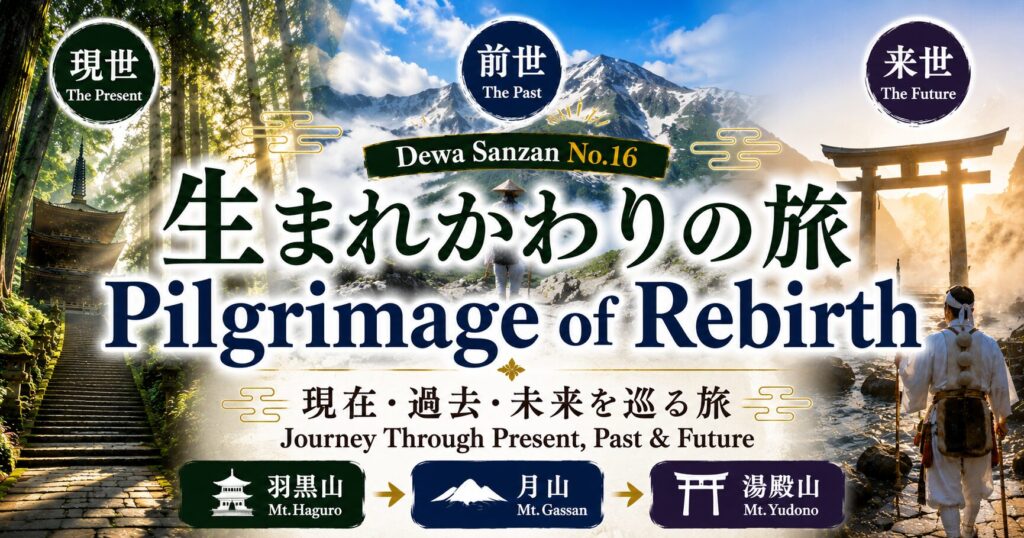
The three mountains of Dewa Sanzan — Haguro, Gassan, and Yudono — each represent a specific dimension of human experience in time:
Mt. Haguro = The Present Mt. Gassan = The Past Mt. Yudono = The Future
Visiting all three mountains in sequence is understood as a symbolic death and rebirth: a passage through the present self, into the realm of the past (death), and out the other side as a renewed person.
This is the Pilgrimage of Rebirth (umarekawari no tabi, 生まれかわりの旅) — and it is the conceptual heart of Dewa Sanzan.
Whether you approach this as spiritual practice, cultural experience, or simply a framework for making a three-mountain trip feel like more than three separate visits — understanding it changes the experience. 😊
→ Dewa Sanzan overview [Article No.1]
→ Shugendo: the practice behind the pilgrimage [Article No.15]
What the Pilgrimage of Rebirth Is
Each of Dewa Sanzan’s three mountains stands for a different “world” (yo) along the axis of human time:
Mt. Haguro (Hagurosan) = The Present — the world you live in now
The mountain where you face your present self. Climbing its 2,446 stone steps to pray at the Sanjin Gosaiden is about accepting who you are now — and getting ready for the journey ahead.
Mt. Gassan (Gassan) = The Past — the world of death and what came before
The mountain that symbolizes death. You climb to a high summit, confront the finiteness of life, look back on the past, and experience a kind of “death” here.
Mt. Yudono (Yudonosan) = The Future — the world of the self reborn
The mountain of rebirth and new beginnings. Through the secret experience of “speak not, ask not,” you are reborn as a new self.
Walking these three mountains in order — re-examining who you are now, facing the past (death), and being reborn as someone new — is the essence of the Pilgrimage of Rebirth.
Why “Death and Rebirth”? Buddhism Meets Mountain Worship
The idea of a “Pilgrimage of Rebirth” is rooted deeply in the worldview of Shugendo.
Shugendo fused the Buddhist concept of death and rebirth (samsara) with Japan’s ancient mountain worship, in which the mountains are dwelling places of the gods.
In Buddhism, beings die and are reborn again and again. Shugendo aimed to experience this cycle of death and rebirth directly, as actual mountain practice.
Enter the mountain, pass through hardship, and come out transformed — this is the core Shugendo experience of “dying on the mountain and being reborn.”
The Pilgrimage of Rebirth is, in a sense, this Shugendo experience “translated” into a form that ordinary visitors — not only trained ascetics — can understand and walk for themselves.
A Closer Look at What Each Mountain Means
Mt. Haguro (The Present): Facing “the Self You Are Now”
Haguro represents the present world — the life you are living now, the self you currently inhabit.
Climbing its 2,446 stone steps, one at a time, is an encounter with the weight, the fatigue, and the limits of your real, present self.
When you finally reach the summit and press your hands together at the Sanjin Gosaiden, there is a quiet fullness in it: “I came this far, as the person I actually am.”
Haguro is the most accessible of the three and the one most people visit. As a starting point — “the present” — nothing could be more fitting: everyone is alive in this world right now, and it is from that reality that the journey begins.
Mt. Gassan (The Past): Facing “Death” and Looking Back
Gassan represents the past life — the realm that precedes this existence, understood in the tradition as the world of death.
Climbing a high mountain of nearly 2,000 meters pushes you to the edge of your physical limits — something close to an encounter with death itself.
As you reach the summit shrine and pray, you feel the finiteness of your own life, and your thoughts turn to the time before it — the past.
Snowfields linger even in July, and only alpine flowers bloom at 2,000 meters — a space cut off from daily life, with the air of “the other world.” Climb it yourself and you understand, in your body, why Gassan is called the mountain of the past.
Mt. Yudono (The Future): Walking On as “the Self Reborn”
Yudono represents the future life — the new world that comes after rebirth.
The experience within its sacred ground — “speak not, ask not” — stays with you as something words cannot hold. What you meet here is said to bring a fundamental change, as if you had been reborn as a new self.
When you finish the three-mountain journey and leave Yudono, more than a few people feel that “something has changed” from who they were before they set out.
That is the experience of “rebirth.”
The Order of the Pilgrimage: Why Haguro → Gassan → Yudono?
The traditional pilgrimage order is Haguro, then Gassan, then Yudono.
It follows the flow of time itself — present → past → future; that is, now → death → rebirth.
Why this order? So that you can experience, as an actual sequence of mountain visits, the process of a living person (the present) passing through the world of death (the past) and being reborn as a new self (the future).
There is a practical logic too: Haguro is the most accessible and least demanding, Gassan is a serious climb that takes real stamina, and Yudono is the “closing” that follows — physically and emotionally, this order makes a natural flow.
Voices of Those Who Felt the “Rebirth”
Here are a few words from people who actually walked the three mountains — all guests who stayed with us at Watausagi.
“When I finished climbing Gassan, something felt resolved. It had been so physically hard, yet somehow my heart felt lighter.”
“When I came back from Yudono, I strangely felt I could keep going. I can’t explain it well, but something had definitely changed.”
“More than having visited all three mountains, the change that happened inside me during the journey was the bigger thing.”
“Rebirth” is spoken of as a religious experience, but put another way, it is the feeling of something inside you being reset.
Whether or not you hold any religious belief, this sense of a “reset” seems to be something many people feel after the Dewa Sanzan pilgrimage.
Even If You Can’t Visit All Three
“Gassan is a real hike, so maybe it’s beyond me.” “I had to skip Yudono.” Many visitors feel this way.
And that’s perfectly fine. You don’t need to be Buddhist or Shinto, or to believe any of this, for the pilgrimage to mean something.
Even if you climb only Mt. Haguro, knowing the framework of the Pilgrimage of Rebirth changes the experience. Walk it aware that “this mountain is the present — my present, the self I am right now,” and the meaning of each stone step shifts. The staircase is real no matter what you believe, and the sense of having walked through sacred ground is open to anyone who makes the climb.
There is no single “correct answer” to a Dewa Sanzan journey. Go at your own pace, and make the Pilgrimage of Rebirth your own. The mountains receive everyone. 😊
Wrap-up
The Pilgrimage of Rebirth is not mere sightseeing — it is a journey of facing what is inside you.
At Haguro you re-examine your present self, at Gassan you face the past and death, and at Yudono you are reborn as someone new.
This structure, carried on for 1,400 years, still holds meaning for us who live in the present day.
Carry the idea of the “Pilgrimage of Rebirth” in your heart, and come walk Dewa Sanzan. The mountains have been waiting a long time to do this with you. 😊
→ Getting to Mt. Haguro [Article No.3]
→ Dewa Sanzan model course [Article No.6]
→ The mystery of Yudono [Article No.10]
Guesthouse Watausagi sits right in the heart of Dewa Sanzan territory — perfectly positioned between Hagurosan, Gassan, and Yudonosan. Guests come from across Japan and around the world to explore these sacred mountains. Make Watausagi your base and discover the spiritual world of Dewa Sanzan! 😊
We also share the charms of our home region — Yamagata, Tsuruoka, and the Shonai area.
I'm always sharing updates and local tips on Instagram Stories. Follow us on Instagram and stay in the loop! 😊
And a like or a share is always, always appreciated 💕
📖 やまがたいいとこ の関連記事
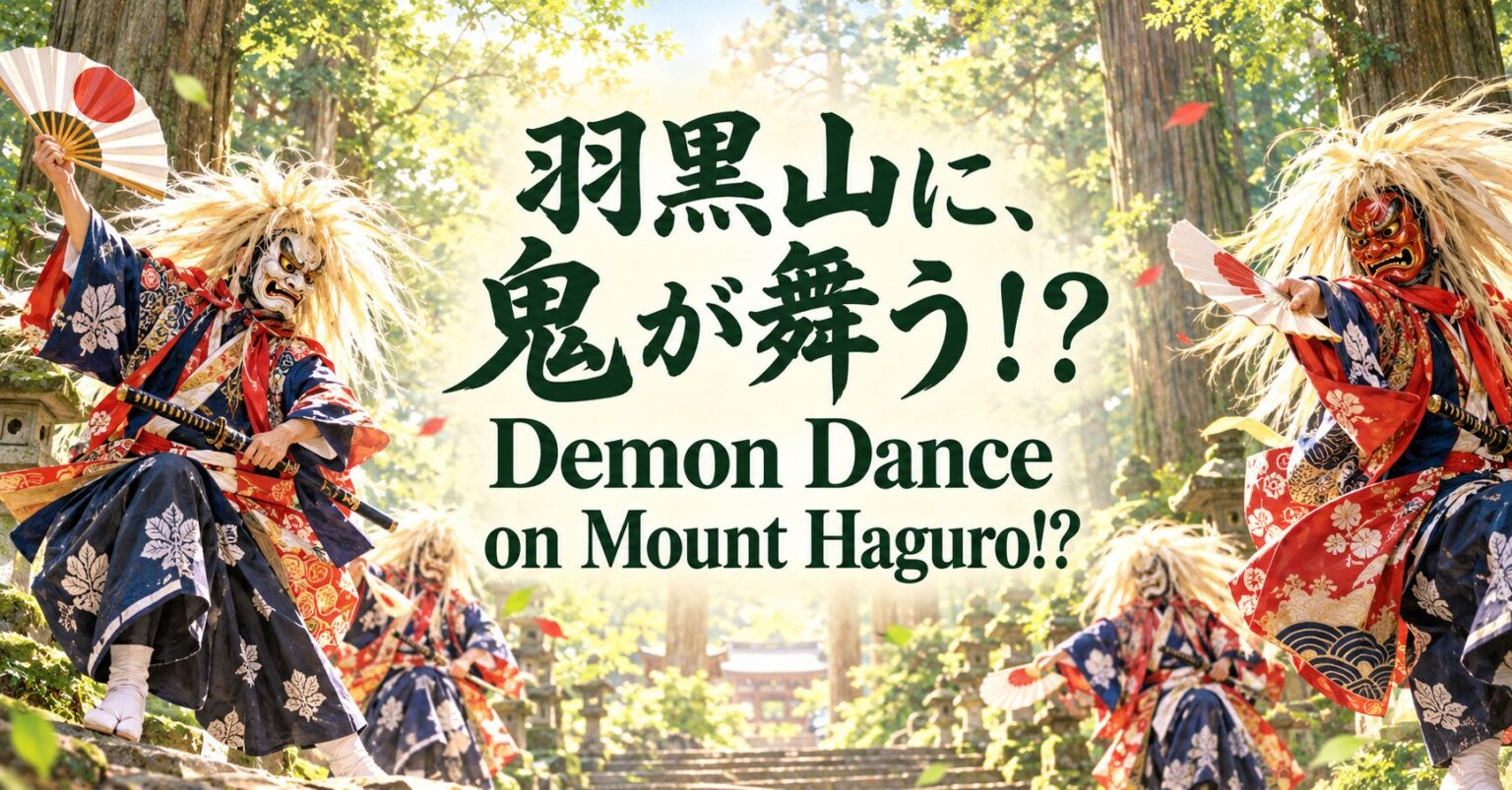
 Demons Dancing on Mount Haguro!?
 Why a dragon god at a Buddhist temple? The mystery of Zenpoji (Tsuruoka) and its sea-guarding dragon faith
 Michelin-Starred Sakata: A Two-Star Tour Built on the Wealth of the Kitamae Ships
- STAY WITH US -
Your Base for Exploring Tsuruoka
A small guesthouse in central Tsuruoka, Yamagata. The perfect base for your trip to Dewa Sanzan and Shonai.
Book Now →