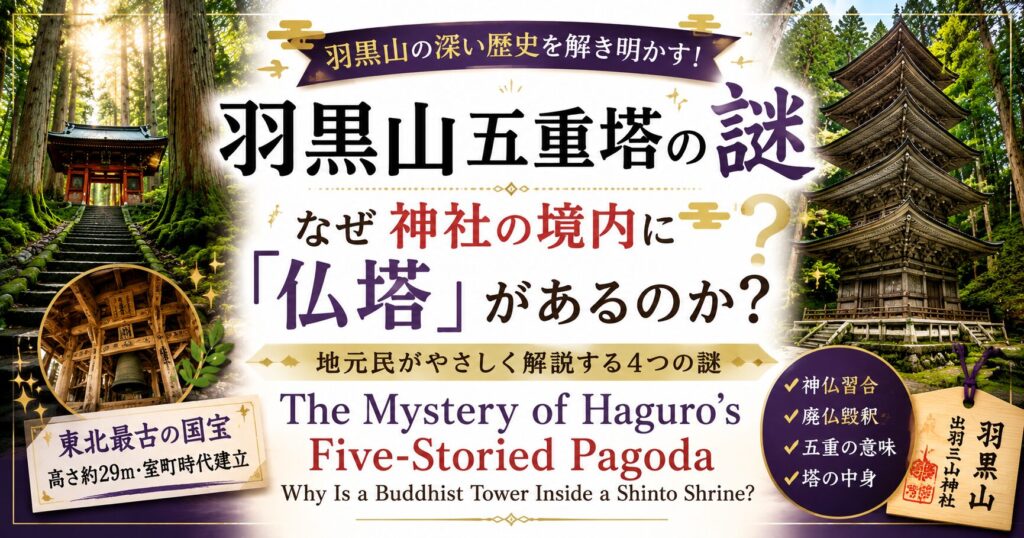
Ten minutes into the stone staircase at Mt. Haguro, the cedar forest delivers one of its most startling surprises: a five-storied pagoda, appearing suddenly from between the ancient trunks.
It is a National Treasure of Japan. It is the oldest pagoda in the Tohoku region. It is approximately 29 metres tall. And it has stood in this spot for somewhere between 600 and roughly 1,100 years.
It is also — unmistakably — a Buddhist structure standing inside a Shinto shrine.
Why is a Buddhist pagoda standing inside a Shinto shrine?
And why — after everything that has happened in Japanese religious history — is it still here?
These two questions open into the full complexity of Japanese religious history — and into one of the most remarkable stories of survival that any building in Japan can tell.
→ The stone staircase guide [Article No.12]
→ The full history of Buddhism-Shinto fusion and separation [Article No.20]
The Basic Facts
Official name:Hagurosan Gojunoto (Mt. Haguro Five-Storied Pagoda)
Location:On the stone staircase, approximately 10 minutes above the Zuishinmon Gate
Height:Approximately 29 metres (95 ft)
Current structure:Muromachi period (14th–15th century CE)
Original construction:Early Heian period (9th–10th century CE) is the most widely supported theory
Cultural designation:National Treasure of Japan — the highest designation for cultural heritage
Regional distinction:Oldest surviving pagoda in the Tohoku region
Mystery 1: Why Is a Buddhist Pagoda Inside a Shinto Shrine?
A pagoda is a Buddhist structure. It belongs in a Buddhist temple compound.
Mt. Haguro, however, is — in its current official form — a Shinto sacred site: the precinct of the Dewa Sanzan Shrine.
So why is a Buddhist pagoda standing inside a Shinto precinct?
The contradiction is only apparent if you assume that Buddhism and Shinto were always separate. For most of Japanese history, they were not.
The pagoda was built during the era of Shinbutsu-shugo — the 1,200-year Japanese tradition in which Shinto and Buddhism were understood not as competing religions but as complementary manifestations of the same sacred realities. During this era, shrine precincts routinely included Buddhist temple buildings; Buddhist monks participated in Shinto rituals; the same sacred site served both traditions simultaneously.
Within the Shinbutsu-shugo worldview, a pagoda inside a Shinto precinct was not a contradiction. It was the natural architecture of a place that honoured both traditions. Mt. Haguro was one of Japan's foremost examples of this integrated sacred landscape.
So the question 'why is a Buddhist pagoda here?' is actually two questions compressed into one: 'why was it built here?' (because this was a syncretic sacred site for over a millennium) and 'why is it still here?' (because of what happened in 1868 — and what didn't happen to this building).
→ Shinbutsu-shugo explained in full [Article No.20]
Mystery 2: Why Did It Survive the Meiji Destruction?
In 1868, the Meiji government issued the Shinbutsu Bunri-rei — the edict ordering the separation of Buddhism and Shinto.
What followed was Haibutsu Kishaku (廃仏毀釈): a wave of destruction of Buddhist objects and buildings at Shinto sites across Japan. It targeted precisely the kind of structure the Haguro pagoda represented — a Buddhist building standing within a Shinto sacred site.
By rights, the Five-Storied Pagoda should have been dismantled. Structures of this kind were dismantled all across Japan during this period. The Haguro pagoda was not.
The precise reasons are not fully documented. What various accounts suggest is a combination of factors:
- The sheer scale of the structure — 29 metres, deeply rooted in the mountain precinct — made demolition a significant undertaking
- Advocacy from individuals who understood the building's historical and aesthetic value appears to have slowed or prevented the process
- The pace and intensity of Haibutsu Kishaku varied significantly across different domains, and the Dewa Sanzan area may have experienced a less extreme version of the separation than some regions
The result is one of the most significant accidental survivals in Japanese architectural history. A building that was targeted for destruction, that logically should not exist in its current context, that stands today as a National Treasure precisely because it embodies the history that the Meiji government tried to erase.
That the pagoda is still here is, in a genuine sense, a miracle. And it is a miracle with witnesses: anyone who walks the Haguro staircase today is looking at it.
Mystery 3: Why Five Stories? What Do They Mean?
The 'five' of a five-storied pagoda is not arbitrary. In Buddhist cosmology, the universe is understood as composed of five fundamental elements — Godai (五大), the Five Great Elements:
| Story | Element | Japanese | What It Represents |
|---|---|---|---|
| First (lowest) | Earth | 地 (chi) | Solidity, foundation, the physical world |
| Second | Water | 水 (sui) | Fluidity, adaptability, life-sustaining liquid |
| Third | Fire | 火 (ka) | Energy, transformation, heat and light |
| Fourth | Wind/Air | 風 (fu) | Movement, breath, the invisible force |
| Fifth (highest) | Void/Space | 空 (ku) | Emptiness, the unmanifest, pure consciousness |
A five-storied pagoda is, in this framework, a vertical model of the universe — the cosmos arranged from its densest physical manifestation (earth) at the base to its most refined and open expression (void) at the apex. The pagoda does not merely stand in a sacred landscape. According to the Buddhist understanding that shaped its construction, it is a sacred landscape in miniature.
This meaning is invisible to someone looking at the pagoda without this knowledge. But knowing it changes how you stand before the structure. You are not looking at five decorative tiers of wood and tile. You are looking at an attempt to represent everything — in 29 metres of ancient timber.
Mystery 4: What Is Inside?
The interior of the Haguro Five-Storied Pagoda is not open to the public. Visits are to the exterior only.
In general, Japanese pagodas contain a central pillar (shinbashira, 心柱) that runs through all five storeys and serves as the structural heart of the building — a feature that, in earthquake-prone Japan, has allowed many pagodas to survive for centuries while surrounding structures have not. The shinbashira works somewhat like a pendulum, allowing the building to sway without failing.
Many pagodas also contain Buddhist relics — sarira (仏舎利), understood as the physical remains of the Buddha or sacred objects associated with the tradition. Whether the Haguro pagoda contains such relics is not publicly documented.
The interior's inaccessibility adds to the pagoda's mystery rather than diminishing it. The building has stood here for 600 years minimum. What it has kept within those walls — structurally, historically, spiritually — is its own.
How to Experience the Pagoda
The Five-Storied Pagoda can only be reached by walking the stone staircase — approximately 10 minutes from the Zuishinmon Gate. Driving to the summit and walking back down takes approximately 15–20 minutes to reach the pagoda from the other direction.
The experience of the pagoda that most visitors describe as most powerful is the approach: coming around a bend in the staircase and having the structure appear, full-formed, from between the cedar trunks. This is a discovery moment — the pagoda as revelation rather than destination.
For the best viewing:
- Step back until you can see all five storeys simultaneously, with cedar trunks framing the structure — this is the classic composition
- Walk slowly around the perimeter — the pagoda looks different from each angle, and the relationship between the tiers changes as you move
- Look closely at the bracketing details in the eaves — the woodwork is exceptionally refined and worth studying up close
- In mist or rain, the upper storeys may disappear into grey — an effect that changes the building's character entirely and can be more striking than clear-day visibility
Allow 15–20 minutes here. The pagoda rewards people who stop.
Five-Storied Pagoda: On the stone staircase, approximately 10 minutes from the Zuishinmon Gate. Free to view. Photography permitted. Interior is not accessible.
→ Photography guide: how to get the best pagoda shots [Article No.13]
→ Pagoda architecture and construction history in detail [Article No.23]
What the Pagoda Tells Us
The Five-Storied Pagoda of Mt. Haguro is not a beautiful old building that happens to be in an interesting location.
It is physical evidence of 1,200 years of religious synthesis. It is a survivor of deliberate destruction. It is a statement about what a mountain values enough to protect. It is a representation of the cosmos in timber and tile. And it is the most striking single object on one of Japan's most historically significant sacred staircases.
When you pass it on your way up — or come specifically to find it — the question to hold is not 'what is it?' but 'what does its being here mean?'
The answer is layered. The beauty is immediate. The history is deep.
Take your time with it.
Wrap-up
The four mysteries of the Haguro pagoda — why it's in a Shinto shrine, why it survived, why it has five stories, what's inside — each lead deeper into Japanese religious and cultural history.
- Why is a Buddhist pagoda inside a Shinto shrine? → Because it was built during the 1,200-year age of Shinbutsu-shugo, when Shinto and Buddhism were one.
- Why did it survive the Meiji destruction? → A combination of factors spared it — a miraculous survivor of haibutsu kishaku.
- Why does it have five stories? → They symbolise the Buddhist Godai (earth, water, fire, wind, void) — a model of the whole cosmos.
But the pagoda itself doesn't require explanation to be extraordinary. It appears suddenly from between ancient cedar trees, on a stone staircase that has been walked for 1,400 years, and it is simply there — massive and still and old and complicated and beautiful.
That is enough. Everything else is context.
→ Shinbutsu-shugo and haibutsu kishaku: the full history [Article No.20]
→ Pagoda architecture and construction history in detail [Article No.23]
→ The complete stone staircase guide [Article No.12]
Guesthouse Watausagi sits right in the heart of Dewa Sanzan territory — perfectly positioned between Hagurosan, Gassan, and Yudonosan. Guests come from across Japan and around the world to explore these sacred mountains. Make Watausagi your base and discover the spiritual world of Dewa Sanzan!
We also share the charms of our home region — Yamagata, Tsuruoka, and the Shonai area.
I'm always sharing updates and local tips on Instagram Stories. Follow us on Instagram and stay in the loop! 😊
And a like or a share is always, always appreciated 💕
📖 やまがたいいとこ の関連記事
 Demons Dancing on Mount Haguro!?
 Why a dragon god at a Buddhist temple? The mystery of Zenpoji (Tsuruoka) and its sea-guarding dragon faith
 Michelin-Starred Sakata: A Two-Star Tour Built on the Wealth of the Kitamae Ships
- STAY WITH US -
Your Base for Exploring Tsuruoka
A small guesthouse in central Tsuruoka, Yamagata. The perfect base for your trip to Dewa Sanzan and Shonai.
Book Now →