
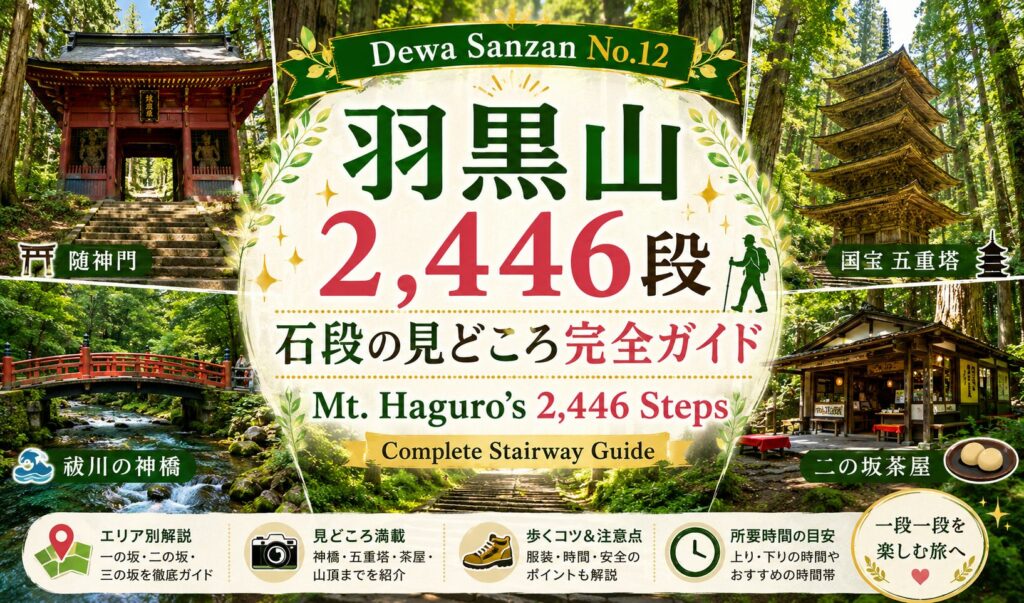
The 2,446 stone steps of Mt. Haguro are not simply a way of getting to the top.
They are the experience.
A National Treasure pagoda appears from between ancient cedar trees. A sacred stream crosses the path via a vermillion bridge. A mountain tea house materialises at the halfway point. The forest deepens and changes around you as you climb. And at the top, a grand thatched-roof shrine waits — earned, not merely arrived at.
This guide walks you through every significant moment on the stone staircase — the three slopes, the highlights at each stage, what to look for and when to stop — so that when you walk it yourself, you know what to pay attention to. 😊
→ Haguro top 10 highlights [Article No.5]
→ What to wear and bring: Haguro practical guide [Article No.4]
→ Stone steps vs. driving: which is right for you? [Article No.8]
The Staircase at a Glance
| Item | Details |
|---|---|
| Total steps | 2,446 |
| Total distance | Approximately 1.7 km |
| Elevation gain | Approximately 150 m (490 ft) |
| Structure | Three sections: Ichinosaka, Ninosaka, Sannosaka |
| Ascent time | 40–60 minutes (without extended stops) |
| Descent time | 30–40 minutes |
| Surface | Mix of stone slabs, tree roots, mossy sections — uneven throughout |
The staircase runs from the Zuishinmon Gate at the base to the summit precinct housing the Sanjin Gosaiden shrine. There is no requirement to climb without stopping — the opposite is true. The highlights are distributed along the route, and the walk rewards those who take their time.
The Starting Point: Zuishinmon Gate
The stone staircase experience begins before the first step — at the Zuishinmon Gate.
This large, vermillion-painted gate marks the boundary between the world outside and the sacred precinct within. Passing through it is not a neutral act. The sound of the car park and the road falls away. The air changes. The cedar forest is already beginning on the other side.
Before you start, practical matters: toilets are available at the gate. The next toilets are not until the Ninosaka Chaya tea house, approximately halfway up. Drinks and snacks from nearby shops can be picked up here — there are no vending machines on the staircase itself.
Stand at the gate for a moment before you begin. Look into the forest ahead. This is a threshold. Cross it deliberately.
📍 Zuishinmon Gate: Start of the stone staircase. Bus stop, car park, toilets, and small shops nearby.
First Slope (Ichinosaka) — The Forest Opens, and Then the Pagoda Appears
Beyond the Zuishinmon Gate, the stone staircase enters the cedar forest and the first slope begins.
Ichinosaka is the gentlest of the three sections. The gradient is moderate, the forest is establishing itself around you, and the atmosphere is shifting — a slow transition from the ordinary into something older and quieter. This is also where the two most dramatic moments of the early climb occur.
And the highlight of this opening section is, without question, your first encounter with the Five-Storied Pagoda.
First Slope (Ichinosaka) ~900 steps 約15–20 min
The opening section. Moderate gradient. The cedar forest surrounds you. The Haraigawa sacred stream crossing and the Five-Storied Pagoda are both in this section.
Highlight 1: Haraigawa Stream and the Sacred Bridge
A short way into the first slope, the stone path crosses Haraigawa (祓川) — the Purification River — via a red wooden bridge. In Shinto tradition, crossing a bridge over running water represents a cleansing: the washing away of impurity before proceeding deeper into sacred territory.
Stop on the bridge. The sound here — the stream below, the wind through the cedar canopy above, the absence of everything else — is one of the quieter pleasures of the Haguro climb. On misty mornings, the stream disappears into the forest below and the bridge seems to float in white.
This is also an excellent early photography spot: the red bridge, the cedar trunks, the green light filtering through the leaves. 📸
📍 Haraigawa Bridge: A short way from the Zuishinmon Gate. Red bridge over a clear stream. One of the early highlights.
Highlight 2: The Five-Storied Pagoda — National Treasure
Past the Haraigawa bridge, the stone staircase curves through the forest — and then, without warning, the Five-Storied Pagoda appears.
This is one of the most arresting moments on the entire Dewa Sanzan pilgrimage. The pagoda fills the space between the cedar trunks suddenly, fully formed, as if it had always been there — which, of course, it has. For approximately 600 years.
This is the Gojunoto of Mt. Haguro — a National Treasure of Japan and the oldest pagoda in the Tohoku region. At 29 metres (95 ft), it rises in five tiers from a base embedded among the ancient roots, topped by a bronze finial that catches what light makes it through the canopy.
Don't walk past this. Don't give it a glance and move on. Find the angle where you can see all five storeys clearly against the cedar backdrop. Walk around it. Look at the woodwork in the eaves and the joints in the pillars. This is a 600-year-old construction that has stood in this forest through everything — fires, storms, wars, the removal of Buddhism from Shinto sites in 1868, restoration campaigns, modern tourism. It is still here.
Allow 15–20 minutes here at minimum. The pagoda at different times of day and different seasons looks different. On a misty morning, the upper storeys disappear into grey. On a clear afternoon in autumn, the cedar trees around it turn gold. Each visit is different.
📍 Five-Storied Pagoda: Approximately 10 minutes from the Zuishinmon Gate. Free to view from outside. Photography permitted.
→ The mystery of the pagoda: why is a Buddhist tower here? [Article No.21]
→ Who built it and when: the full history [Article No.23]
Second Slope (Ninosaka) — The Steepest and My Personal Favourite
Beyond the Five-Storied Pagoda, the second slope begins.
Ninosaka is the steepest section of the staircase, and it's where the physical effort reaches its peak.
It's also — in my view — the most beautiful section of the entire climb.
The cedar trees on either side of Ninosaka are among the largest on the mountain. Their trunks are wider than a person's arm span. The canopy above closes completely, reducing even midday light to a dim green atmosphere. Walking through Ninosaka feels like walking through something ancient in a way that the other slopes don't quite match.
Second Slope (Ninosaka) ~800 steps 約15–20 min
The steepest section. Physically demanding, but the cedar forest is at its most overwhelming here. At the top of Ninosaka: the tea house.
Highlight 3: The Ninosaka Chaya Tea House
At the top of the second slope — exactly where you need it most — the Ninosaka Chaya appears.
This small, traditional tea house selling chikara mochi (力餅, 'strength rice cakes') has been feeding pilgrims on the Haguro staircase for generations. The mochi are soft, sweet, and served with various toppings. After the effort of Ninosaka, they are among the most satisfying things you will eat in Japan.
The tea house has a wooden veranda looking out over the cedar forest. Sit down. Take the weight off your legs. Eat slowly. Watch the light in the trees. Listen to the forest sounds. This is not a break from the pilgrimage experience — it is part of it.
You are approximately halfway to the summit (or a little past halfway). The third slope is easier than the second. Rest here as long as you need.
📍 Ninosaka Chaya: Top of the second slope. Chikara mochi specialty. Open seasonally — hours vary. Drinks also available.
Third Slope (Sannosaka) — The Final Push and the Summit Reveal
Refreshed from the tea house, the third and final slope: Sannosaka.
Sannosaka is slightly easier than Ninosaka in gradient — not easy, but the end is within reach. The forest begins to change as you climb higher; the density thins slightly, and light comes in from new angles. You can feel the altitude building.
And then the staircase ends. The forest opens. The summit precinct appears.
This arrival — emerging from the cedar forest into the open precinct after 2,446 steps — has a theatrical quality that is clearly intentional. The contrast between the dim, enclosed forest and the open summit creates a genuine arrival moment. Many people stop here and simply stand for a moment, processing what they've just done.
Third Slope (Sannosaka) ~700 steps 約15–20 min
The final section. Slightly easier gradient. The forest thins as you approach the summit. At the top: the cedar forest opens and the summit precinct is revealed.
Highlight 4: Sanjin Gosaiden and the Summit Precinct
The summit precinct of Mt. Haguro is anchored by the Sanjin Gosaiden (三神合祭殿) — the Grand Unified Shrine of the Three Sacred Mountains.
This is an imposing building: approximately 28 metres tall, with a triple-layered thatched roof of unusual complexity. It houses the deities of all three Dewa Sanzan mountains under one roof — a unification that took place in the Meiji period, when the forced separation of Buddhism and Shinto complicated the winter accessibility of the other two mountains.
The Sanjin Gosaiden is designated a National Important Cultural Property. It is also an active shrine — bells ring during rituals inside, incense smoke rises from the main entrance, and priests move through the precinct with quiet purpose. This is not a museum exhibit. It is a living religious site with 1,400 years of continuous use behind it.
Beyond the Sanjin Gosaiden, the summit precinct includes the Bell Tower (whose morning bell resonates across the mountain), the Mausoleum of Prince Hachiko (the legendary founder of Haguro's sacred tradition), goshuin and omamori desks, and a summit shop selling food, local products, and shrine items.
Take your time here. You have climbed 2,446 steps to arrive. The summit deserves more than a quick look and a photo. Sit. Breathe. Notice where you are.
📍 Sanjin Gosaiden: Mt. Haguro summit. Open throughout the year. Some areas require entry fee. Goshuin and omamori available.
→ About the Sanjin Gosaiden [Article No.17]
Safety Notes for the Staircase
The footing is a mix of old stone slabs, tree roots and moss — genuinely slippery after rain, so reduce your pace significantly
Shoes with proper grip are essential — sturdy trainers at minimum
The descent is harder on the knees than the ascent — trekking poles are valuable
Sort out water before you start — apart from the tea house, there are no shops or vending machines on the staircase
Toilets exist at exactly three points: the Zuishinmon Gate, the Ninosaka Chaya, and the summit
How to Make 2,446 Steps Feel Easier
2,446 steps sounds intimidating — but a few simple habits make the climb dramatically easier.
Pace yourself from the start — the consistent mistake is beginning too fast and running out of energy on Ninosaka
Use the highlights as waypoints — 'to the pagoda,' 'to the bridge,' 'to the tea house,' 'to the summit.' Breaking the climb into sections makes it feel more achievable.
Breathe deliberately on the steeper sections — slow down rather than push through breathlessness
Take the descent seriously — if your knees start to complain, slow right down. Taking the bus or car down is a legitimate option.
The Staircase by Time of Day
The same staircase looks and feels completely different depending on when you walk it.
Before 8 AM (early morning): near-empty, mist possible, oblique morning light through the cedars — the most atmospheric time, highly recommended
8–11 AM: good light angle, relatively quiet, pleasant temperature — a good photography window (avoid the late July–August heat)
11 AM–2 PM: the busiest period, warm in summer — perfectly fine, just busier; the cedar shade keeps it manageable
After 3 PM: light turns golden-orange through the trees, quieter — beautiful in autumn; check return transport if relying on the bus
Early morning is consistently the best time for the full staircase experience. The practical requirement — staying nearby the night before — makes Guesthouse Watausagi the natural solution. 😊
→ Early morning at Haguro — a full experience report [Article No.29]
Wrap-up
The 2,446 steps of Mt. Haguro are not an obstacle between you and the summit. They are the reason to come.
The transition at the Zuishinmon Gate. The surprise of the sacred bridge. The pagoda appearing from the forest. The overwhelming cedar canopy of Ninosaka. The rest at the tea house. The final push of Sannosaka. The forest opening onto the summit.
Each of these moments is earned by the steps before it. None of them is accessible any other way.
Walk slowly. Look at everything. Stop often. The 2,446 steps will take care of the rest. 😊
→ Visiting Mt. Haguro with children [Article No.11]
→ Dewa Sanzan 2-day itinerary [Article No.6]
→ Haguro top 10 highlights [Article No.5]
Guesthouse Watausagi sits right in the heart of Dewa Sanzan territory — perfectly positioned between Hagurosan, Gassan, and Yudonosan. Guests come from across Japan and around the world to explore these sacred mountains. Make Watausagi your base and discover the spiritual world of Dewa Sanzan! 😊
We also share the charms of our home region — Yamagata, Tsuruoka, and the Shonai area.
I'm always sharing updates and local tips on Instagram Stories. Follow us on Instagram and stay in the loop! 😊
And a like or a share is always, always appreciated 💕
📖 やまがたいいとこ の関連記事
 Demons Dancing on Mount Haguro!?
 Why a dragon god at a Buddhist temple? The mystery of Zenpoji (Tsuruoka) and its sea-guarding dragon faith
 Michelin-Starred Sakata: A Two-Star Tour Built on the Wealth of the Kitamae Ships
- STAY WITH US -
Your Base for Exploring Tsuruoka
A small guesthouse in central Tsuruoka, Yamagata. The perfect base for your trip to Dewa Sanzan and Shonai.
Book Now →