
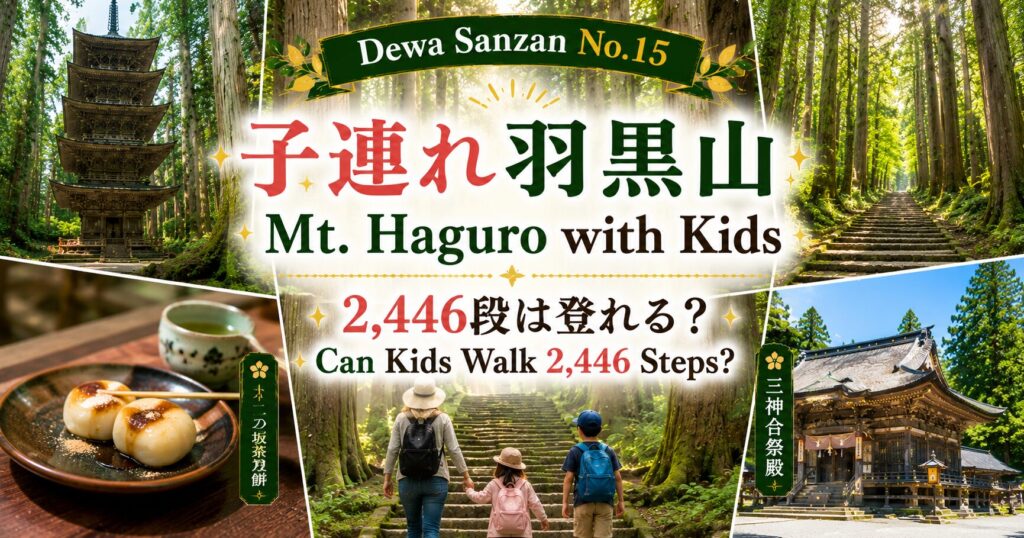
Can children walk the 2,446 stone steps of Mt. Haguro?
It's the question every family travelling to Dewa Sanzan asks.
The honest answer: it depends entirely on the age and fitness of your child — and on how much flexibility you build into your plan. Haguro is absolutely accessible to families with children. It may just look a little different from the adult-only version of the visit.
In this guide, I'll give you honest guidance on what to expect at each age group, how to use the driving option to make Haguro work for every family, what children genuinely enjoy on the mountain, and how to plan a visit that everyone — kids included — actually remembers fondly. 😊
→ Haguro's top 10 highlights [Article No.5]
→ What to wear and bring: Haguro practical guide [Article No.4]
Let's Be Realistic: What Is the Staircase Actually Like?
The number 2,446 sounds daunting. But it's worth understanding what kind of climb this actually is.
Mt. Haguro's stone staircase climbs approximately 150 metres (490 ft) over 1.7 kilometres through a cedar forest. The steps vary in height and surface — some are smooth stone slabs, some are mossy and uneven, some have tree roots crossing them. The gradient varies between the three slopes, with the middle section (Ninosaka) being the steepest.
It is not a technical mountain climb. It is a long, uneven staircase through a forest. The comparison I'd offer is a very long forest walk with a lot of steps — more like a demanding park walk than a hike.
For adults in reasonable fitness, it's a workout but very manageable. For children, it depends on age and energy on the day.
Age-by-Age Guide: What to Expect
| Age Group | Stone Steps | Notes |
|---|---|---|
| 0–2 (infants) | × Not practical | Can be carried in a carrier/sling, but very demanding for the adult carrying. Drive to summit recommended. |
| 3–5 (toddlers) | △ Partial — with patience | Will walk some stretches, need carrying for others. Allow significant extra time and energy. |
| 6–7 (early primary) | △–○ About half likely | Energetic children may manage most of it. Less energetic children will need support or breaks. |
| 8–10 (primary age) | ○ Likely manageable | Most children this age with reasonable fitness can complete the full staircase with rest breaks. |
| 11+ (older children) | ◎ No problem | Many older children are more energetic than the adults with them. Let them lead. |
These are general guides only. Individual children vary enormously — and the same child might manage differently on a warm day versus a cool one, or when well-rested versus tired. Watch your child's actual energy and adjust accordingly.
The Drive Option — Not a Compromise, Just a Different Plan
If your children are very young, or if you're travelling with grandparents, or if anyone in your group has mobility concerns — driving directly to the summit car park is a completely valid approach.
Everything at the summit is accessible from the summit car park: the Sanjin Gosaiden shrine, the Bell Tower, the goshuin desk, the omamori shop, the summit tea house. The worship experience at the top is unchanged.
A practical middle option: drive to the summit, then walk partway down the stone staircase to visit the Five-Storied Pagoda (approximately 15–20 minutes down). Children who can't manage the full ascent can still see the National Treasure pagoda with a limited walk.
The hybrid approach — walk up, drive down — is also popular with families. Children who are excited at the start can walk the ascent, and tired legs on the way back are taken care of by the car. 😊
→ Stone steps vs. driving: full comparison guide [Article No.8]
Practical Information for Families
Prams and Wheelchairs
The stone staircase is not accessible by pram or wheelchair — the steps, roots, and uneven surfaces make this impractical. Infants need to be carried in a sling or baby carrier.
The summit precinct has some flatter sections, but also has steps and uneven paving. If wheelchair access is a requirement, contact the shrine in advance to check current conditions.
Toilets
Toilets are available at three points along the route:
At the Zuishinmon Gate car park (start of the staircase)
Near the Ninosaka Chaya tea house (halfway point)
At the summit precinct
There are no toilets between these points. With young children, make a point of stopping at each one — 'do you need to go?' at the gate, at the tea house, and at the summit is a much better strategy than discovering the need mid-staircase.
Rest Stops
Benches and flat resting spots are scattered along the staircase. You are never far from a place to stop and sit. There's no time pressure — rest as long as you need.
The Ninosaka Chaya tea house at the halfway point is the best rest stop on the mountain: a traditional wooden tea house selling chikara mochi (strength rice cakes), with a veranda looking out over the cedar forest. For children, this is a genuine reward. Build it into your plan as a promised stop. 😊
Timing Your Visit
With children, crowd management matters more than it does for adults. Crowded stairs with small children are stressful for everyone.
Best times: weekday mornings, early in the season (May–June), September
Avoid: Golden Week (late April–early May), Obon (mid-August), and October foliage weekends
Early morning is particularly good for families. The staircase is nearly empty before 9 AM, the light through the cedar canopy is beautiful, and children who are early risers often have their best energy of the day in the morning.
What Children Actually Enjoy at Haguro
Haguro is more interesting for children than many parents expect. Here are the moments that tend to land well:
The Five-Storied Pagoda
Children respond strongly to the pagoda. A 29-metre tower that has stood in this forest for 600 years, framed by giant cedar trees, tends to produce genuine awe — not the polite kind, but the real kind. 'How did they build that?' is a conversation starter that can last the rest of the climb.
The Scale of the Cedar Trees
From a child's eye level, 30-metre cedar trees that are older than most countries feel extraordinary. Running your hand along a trunk that's older than Columbus's voyage to America is the kind of thing that makes history tangible. Use it.
'This tree was already old when samurai walked through here' is the kind of line that makes the eyes go wide. 😊
The Chikara Mochi at the Tea House
Sweet rice cakes served at a wooden tea house halfway up a sacred mountain staircase, after real physical effort — this is one of those experiences that children file away permanently. Make it a promised reward: 'if you make it to the tea house, we'll have the special mountain mochi.' It works.
Counting the Steps
Tell children there are 2,446 steps before you start, and some of them will spend the entire climb counting. Set milestone celebrations: '500 steps! That's amazing.' 'Halfway!' 'Only 200 to go!'
Completing 2,446 stone steps is a genuine physical achievement for a child. Make it feel like one. The sense of accomplishment at the summit, for a child who has walked up themselves, is real.
A Sample Family Visit Plan
For families with children aged 8 and over (active)
Park at the Zuishinmon Gate car park
Walk the full staircase — agree on pace before starting, and let children set it
Stop at the Five-Storied Pagoda (10 minutes in) — proper time, not a glance
Rest at Ninosaka Chaya: chikara mochi, look out at the forest
Summit: Sanjin Gosaiden shrine, goshuin, explore the summit precinct
Descent: stone steps (if energy allows) or arrange to drive back down
Allow 3.5–4 hours including rest breaks. Don't rush the rest breaks.
For families with toddlers or mixed-age groups
Drive to the summit car park
Visit the Sanjin Gosaiden shrine, collect goshuin, browse the summit shop
Walk partway down the staircase toward the Five-Storied Pagoda if children have energy (20–30 min round trip)
Return to summit, lunch or snacks at the summit area
This is a complete and satisfying visit. Don't feel you've missed anything — the summit shrine is the heart of Haguro. 😊
Key Safety Points for Families
⚠️ Footwear is critical for children too. No sandals, flip-flops, or smooth-soled shoes on the staircase.
⚠️ Hold young children's hands on the descent — steps are uneven and the downward angle is harder to judge for small legs.
⚠️ Bring more water than you think you need. Children dehydrate faster than adults.
⚠️ After rain, the stone steps are genuinely slippery. Slow down significantly and hold hands.
⚠️ The cedar forest is cooler than open ground — bring a light layer for children even in summer.
💡 The golden rule of family visits to Haguro: there is no wrong way to do it. Whatever gets your children to the summit shrine — by steps or by car — is the right way for your family.
Wrap-up
Mt. Haguro is one of those rare places that works for families not despite its age and seriousness, but because of them.
Children respond to things that are genuinely old, genuinely large, and genuinely strange. The cedar forest, the stone staircase, the ancient pagoda, the incense smoke at the summit shrine — these are not things children have to be talked into appreciating. They feel them.
Come with enough time, appropriate footwear, plenty of water, and the willingness to let the mountain set the pace. The rest takes care of itself. 😊
→ Haguro top 10 highlights [Article No.5]
→ Stone steps or drive: full comparison [Article No.8]
→ Dewa Sanzan model course [Article No.6]
Guesthouse Watausagi sits right in the heart of Dewa Sanzan territory — perfectly positioned between Hagurosan, Gassan, and Yudonosan. Guests come from across Japan and around the world to explore these sacred mountains. Make Watausagi your base and discover the spiritual world of Dewa Sanzan! 😊
We also share the charms of our home region — Yamagata, Tsuruoka, and the Shonai area.
I'm always sharing updates and local tips on Instagram Stories. Follow us on Instagram and stay in the loop! 😊
And a like or a share is always, always appreciated 💕
📖 やまがたいいとこ の関連記事
 Demons Dancing on Mount Haguro!?
 Why a dragon god at a Buddhist temple? The mystery of Zenpoji (Tsuruoka) and its sea-guarding dragon faith
 Michelin-Starred Sakata: A Two-Star Tour Built on the Wealth of the Kitamae Ships
- STAY WITH US -
Your Base for Exploring Tsuruoka
A small guesthouse in central Tsuruoka, Yamagata. The perfect base for your trip to Dewa Sanzan and Shonai.
Book Now →