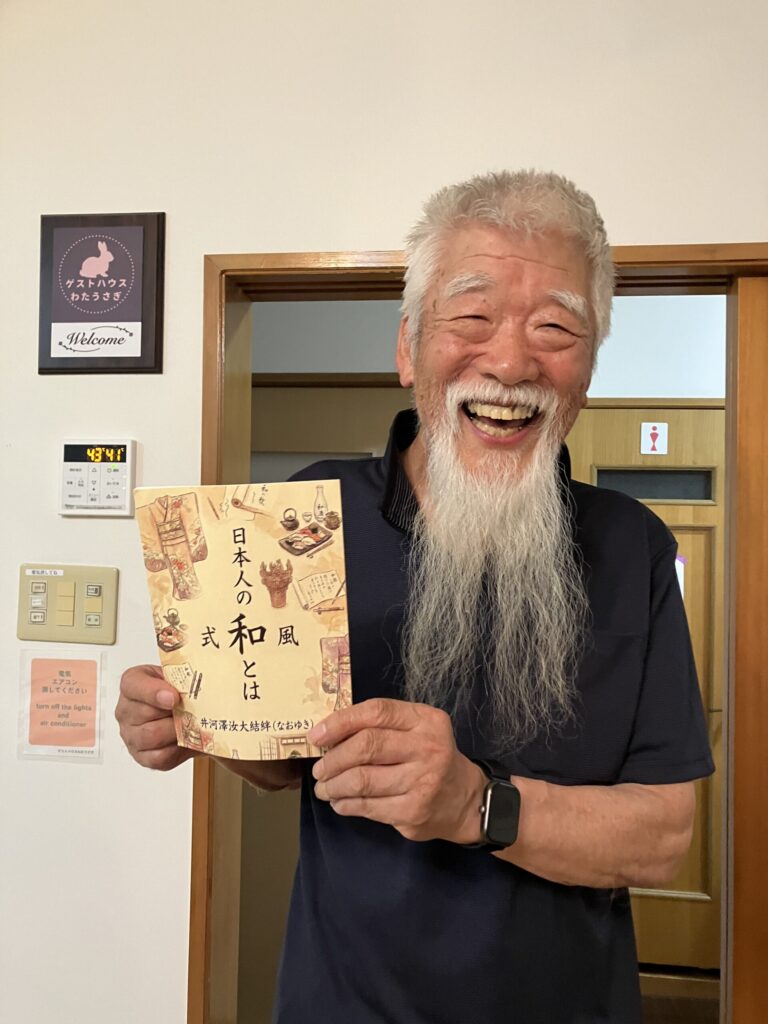
Today I'd like to share a book that a guest gave me during his stay. The title is "Nihonjin no Wa to wa" — "What Is the Japanese Wa?" You won't find it in any bookstore: the author self-published it himself. The way this book found its way to me was so lovely that I just have to tell you the story 💕
A Cheerful Gentleman Who Arrived Worn Out
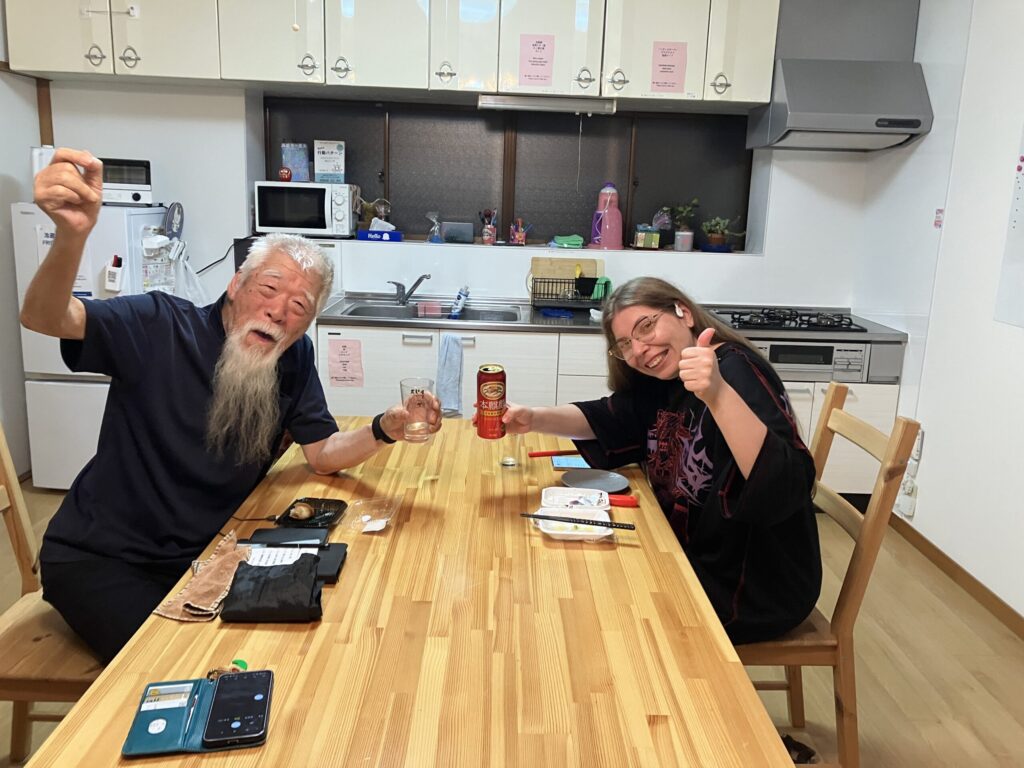
The guest that day was an older gentleman from Chiba Prefecture, near Tokyo. His legs seemed to trouble him a little, and he arrived completely worn out. He told me he had chosen Watausagi after seeing our high reviews and ratings.
Though tired at check-in, in the living room he turned out to be wonderfully bright and cheerful ✨ He chatted with me for ages, mingled easily with the other guests, and even shared a toast with a traveler from overseas. Moments like these are exactly why I love running a guesthouse 😊
"I Finally Met Someone I Wanted to Give This Book To"
That evening, he retired to his room early. A little later, he came back down to the living room — and this time, there was a book in his hand.
And then came the surprise. He had written the book himself.
He had been carrying a single copy of his own book with him on his travels, hoping to give it to someone. But the right person never appeared — until, at the very last stop of his journey, he met me. "I'm so glad I finally met someone I truly wanted to give this book to," he said.
Imagine walking through a journey with a book you wrote yourself, waiting to meet the person meant to receive it. Hearing words like that — it was one of those moments that make me feel truly glad I run this place ❣
Why Did Japan's Jomon Period Stay Peaceful for 10,000 Years?
The book's theme is "wa" (和) — the Japanese idea of harmony. It opens with a simple question: why did the Jomon period, Japan's prehistoric era of hunter-gatherers that lasted from roughly 14,000 to 300 BCE, remain peaceful for more than ten thousand years? The author — the gentleman himself — writes under the pen name Naoyuki Igasawa, spelled with the characters for "you" (na) and "bond" (kizuna): the very theme of the book.
Reading it, I kept saying "wow" out loud. Take the word "nawa" (縄), the rope whose twisted-cord patterns decorate Jomon pottery and give the era its name ("Jomon" literally means "cord-marked"). In old Japanese, "na" (汝) means "you," and "wa" (我) means "I." So the very sound "nawa" holds "you" and "me" side by side. A single strand is weak, but twist two together and you get a strong rope — Mr. Igasawa suggests that the cord patterns carved into Jomon pottery were not mere decoration, but a declaration of what he calls a "formula of the heart."
Then he goes one step further, unpacking the sounds of native Japanese words we still use today:
- Ki (気): the energy of life — vitality, motivation, spirit
- Mi (身): the body where that energy lives
- Na (汝): the person facing you — "you"
- Wa (我): yourself — "I" — which is also the sound of "wa" (輪), a circle
Put these together, he says, and a formula emerges:
Kimi (Ki + Mi) + Nawa (Na + Wa) = Wa (Harmony)
"Kimi" (君) — the Japanese word for "you" — is spirit (ki) and body (mi) united: in other words, one healthy, spirited human being. When that individual holds a "nawa" — a rope, a bond that ties hearts together — only then does a happy "wa," the circle that includes everyone, come into being.
What amazed me most was the order of the formula. It begins with "kimi" — a healthy self. You don't vanish into the circle; a spirited individual comes first, then the bond, and harmony follows. He suggests this is the formula for peaceful living that the Japanese arrived at over ten thousand years.
The book goes on to read waka poetry, the national anthem "Kimigayo," kimono, Japanese cuisine, and traditional Japanese rooms all through this single formula — I was hooked the whole way through ✨
The Discovery That You Don't Have to Erase Yourself
The chapter that touched me most is called "The Heart of Wa, Carried into the Future."
It says: "wa" is not about suppressing your individuality. It means treasuring yourself — "wa" (我), the I — while at the same time respecting the other person — "na" (汝), the you — and building a comfortable place together.
When people hear about "Japanese harmony," don't they often picture holding yourself back to fit in with everyone else? I always thought of it that way myself, so the idea that you don't have to throw away who you are felt refreshingly new to me.
And then it hit me: that's exactly what the living room at Watausagi is. Guests from different countries, each staying exactly who they are, sharing one space comfortably. That night, when the gentleman raised his glass with a guest from abroad — perhaps that scene itself was a small "wa" 😊
Final Thoughts
Today I introduced "What Is the Japanese Wa?" — a book given to me by a guest.
A single book traveled from its author's own hands all the way to a small guesthouse in Yamagata. "Na" (you) and "wa" (I), twisted together into a rope — what the book describes was happening right there in front of me. Perhaps the book itself was a "nawa," a rope that ties person to person.
Mr. Igasawa, thank you so much for this wonderful gift. We would love to welcome you back to Watausagi anytime 💕
About Guesthouse Watausagi
Guesthouse Watausagi is a small guesthouse in Tsuruoka, Yamagata Prefecture, in Japan's Tohoku region. We welcome many guests from Japan and abroad, and warm encounters happen in our living room almost every night. An encounter like the one in this story might be waiting for you, too 😊 We also make a great base for exploring the sacred Dewa Sanzan mountains and the Shonai area.
We share our daily life on Instagram, too! If you enjoyed this article, a like or a share would truly make my day ❣
📖 Related Posts from the Watausagi Diary
 Are You an “Input” or an “Output” Traveler? What Social Media Taught Me About Why I Travel
 How a Korean Guest Learned Japanese from AKIRA — 5 Anime That Actually Work
 Why Booking Direct Beats Booking.com Every Time — A Guesthouse Owner's Honest Guide
- STAY WITH US -
Your Base for Exploring Tsuruoka
A small guesthouse in central Tsuruoka, Yamagata. The perfect base for your trip to Dewa Sanzan and Shonai.
Book Now →