

The other day, a guest who came all the way from Gifu gave me a little souvenir.
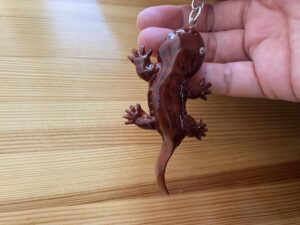
A keychain shaped like a giant salamander (ōsanshōuo).
Honestly, my first thought was, “Why a salamander…?” 😅
But the more I listened, the more everything started to make sense!
This guest had stayed with us last year too — a repeat visitor.
What followed after he began, “Near where I live…” was beyond anything I could have imagined as someone living in Tsuruoka.
There’s a 1-meter “master” living in the river nearby
“There’s a wild giant salamander over a meter long living in the river near my house.”
…A wild one. A whole meter.
For a while, I couldn’t picture it in my mind.
I mean, it’s one meter long!
And they just live in the river like it’s perfectly normal???
Looking it up later, I learned the giant salamander is one of the largest amphibians in the world.
And it lives a very long time — there are records of individuals living over 50 years in captivity.
The Lifespan and Growth Stages of the Japanese Giant Salamander
The Japanese giant salamander is an exceptionally long-lived amphibian. It appears to live for 20–30 years in the wild and even longer in captivity, with some individuals known to live for more than 50 years. It grows extremely slowly and typically takes nearly 10 years to reach maturity.
Lifespan
-
In the wild, they are believed to live for 20–30 years despite predation and environmental changes.
-
In captivity, where there are fewer predators and environmental stresses, they have been known to live for more than 50 years.
-
This is an exceptionally long lifespan for an amphibian and is thought to be related to its extremely slow growth rate.
Creatures like this just hang out beneath the rocks in a nearby river.
So that’s what Gifu is like.
Or maybe it’s the water? The land itself?
As someone who loves freshwater environments, I have to admit I’m a little jealous.
Seeing is believing.
I found a video of an actual giant salamander survey in Gifu.
Here’s that “master” 👇

Turns out it’s a “national treasure” — a Special Natural Monument
What surprised me even more when I looked into it was how Japanese giant salamanders are treated.
It’s actually a Special Natural Monument.
That’s a special class, reserved only for the most important of the natural monuments.
Its company includes the crested ibis, the oriental stork, and the Amami rabbit — and it has held that status since 1952.
In other words, in the river near that guest’s home, one of the top “stars” among Japan’s creatures is living with a perfectly ordinary face.
To think the model for that keychain was such a big deal.
It suddenly looked very precious to me 😝
Apparently, there are impostors, too.
Here’s the part that made me go “Wow!” the most.
This giant salamander actually has a look-alike “impostor.”
The Chinese giant salamander, brought over from China.
They look almost identical. But this one crossbreeds with the native giant salamander.
What’s more, the foreign one is said to be more active, monopolizing breeding sites and driving out the natives.
In a certain river in Kyoto, this crossbreeding has apparently advanced quite far.
Partly for that reason, since 2024, foreign giant salamanders and crossbred individuals have been designated as “Invasive Alien Species.”
Despite having nearly the same face, one is a national treasure and the other a target for removal.
Which one you happen to be born as — that alone flips your standing completely.
It’s something we hear about a lot these days, but apparently it’s very important for protecting natural ecosystems.
There are 48 kinds of salamander — and one lives right here in Shonai!
Another thing that genuinely surprised me was just how many species of salamanders there are.
Aside from the enormous Japanese giant salamander, there are also small salamanders measuring around 10 cm, and Japan alone is apparently home to 48 species. What’s even more surprising is that this number continues to grow. Perhaps they keep interbreeding and producing new species—though I’m not sure whether that’s a good thing or a bad thing.
And then, there was one more thing that surprised me...
One of those small species, the Tohoku salamander, can actually be found right here in Tsuruoka, home of Watausagi!
There are even records of them breeding in puddles along forest roads.
Where are they? I want to see one!
Just when I was marveling at the “master” of a river in Gifu, it turned out that one of its relatives was living right here in my own backyard.
“The foot of the lighthouse is dark” — maybe this is exactly what that old saying means 😅
(Incidentally, the giant Japanese salamander is found only in western Japan, so apparently there aren’t any in Tsuruoka—just to be clear.)
I’d never have known. Someday I want to go meet one in Gifu
If I hadn’t met this guest, I probably would have gone my whole life without ever learning more about Japanese giant salamanders.
Like this, there’s so much I learn from casual conversations with my guests.
This is exactly why running a guesthouse is so much fun. I truly feel that.
Had I stayed unaware, I’d never have laid eyes on the giant salamander.
But now that I know, I want to see one at least once.
Gifu is a little far.
But someday, I’d love to go.
Wrap-up
This is exactly why guesthouses are so much fun!
Watausagi is a free-and-easy, self-check-in inn.
過度なおもてなしはありません。
そのぶん、旅人同士の一期一会を楽しんでもらえる、ホテルとは違った魅力の宿です。
ぜひ一度訪れてみてくださいね!
お待ちしています💓
Click here to make a reservation
On this blog, I’ll keep sharing the charms of Yamagata, Tsuruoka, and Shonai. I post update announcements on Instagram Stories — follow along if you’d like.
Likes and shares make me really happy too 💕
📖 Related Posts from the Watausagi Diary
 Top 10 Frequently Asked Questions
 Some Travelers Come Back for Seconds of Japan — A Spanish Ballet Dancer’s Story
 Reading “The Road to ‘The Planet of the Robots’” by Naoyuki Igasawa
- STAY WITH US -
Your Base for Exploring Tsuruoka
A small guesthouse in central Tsuruoka, Yamagata. The perfect base for your trip to Dewa Sanzan and Shonai.
Book Now →