What Do You Mean, "a Dance Offering"?!
"We've just been to Mount Haguro to offer a dance."
Recently, we had guests at Guesthouse Watausagi from Kitakami, a city in Iwate Prefecture, northern Japan.
I assumed they were simply a family on holiday. Then, partway through our chat, some words came up that you don't hear every day.
A dance?
An offering?
On Mount Haguro?
Hold on. That's far too many intriguing things at once (ha!).
When I asked, they explained that Kitakami has a traditional performing art called Onikenbai, and they had come to take part in an offering of it.
In Japan, an offering, or hōnō, means dedicating something to a shrine or temple, from objects to performing arts such as music and dance. This time, the whole group had offered their dance together.
And on top of that, they told me Onikenbai has its roots on Mount Haguro.
I live in Tsuruoka, the city Mount Haguro belongs to, and I had never heard anything of the kind.
Now I was curious.
I couldn't stop asking questions, and even after our guests had left, I kept digging into the story.
Onikenbai: What Is It, Exactly?
Its name combines the characters for "demon," "sword" and "dance," and it is pronounced Onikenbai.
It is a folk performing art handed down in Kitakami and the surrounding area of Iwate, and one of the Nenbutsu Kenbai, sword dances linked to Buddhist prayer.
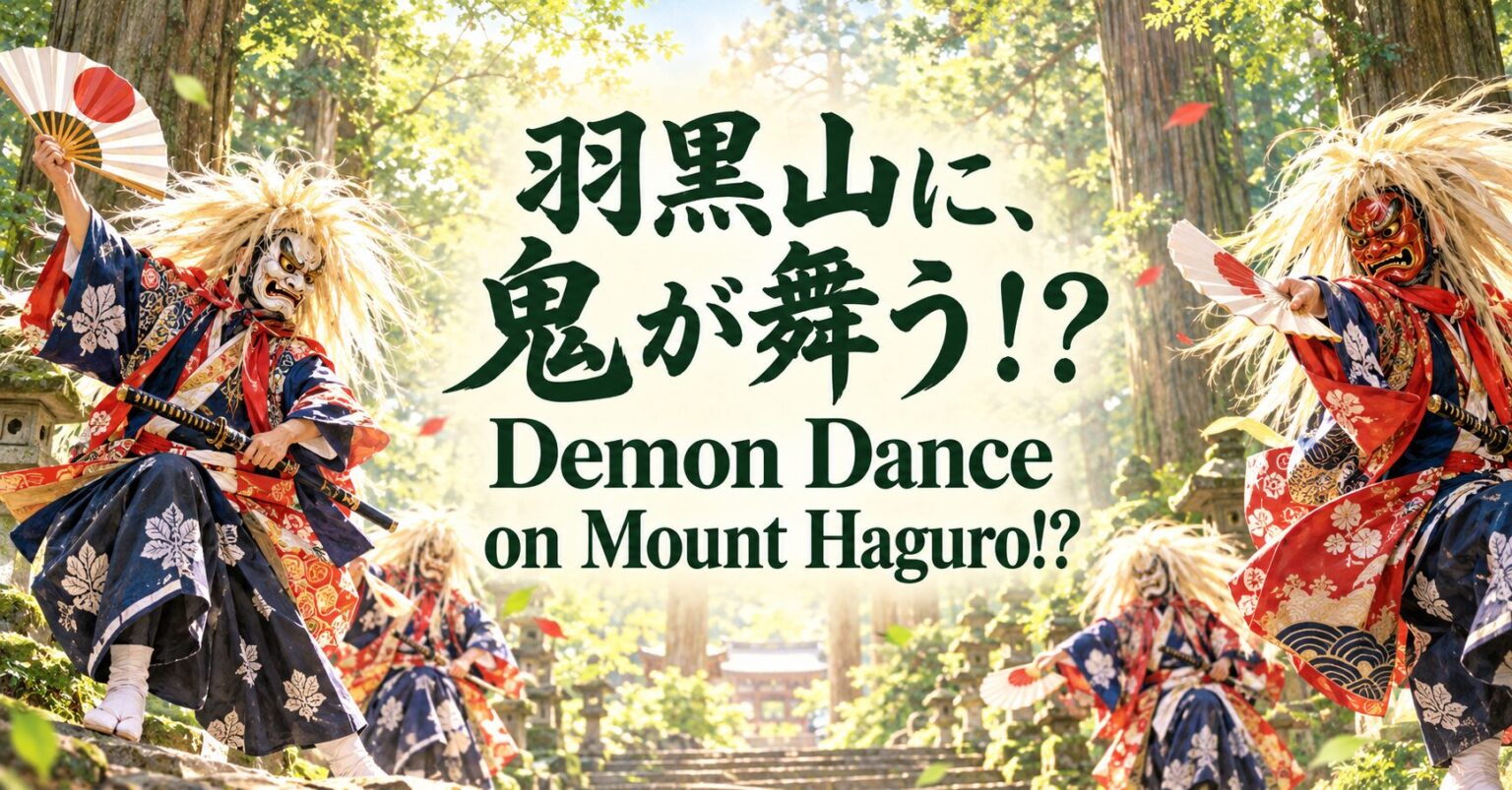
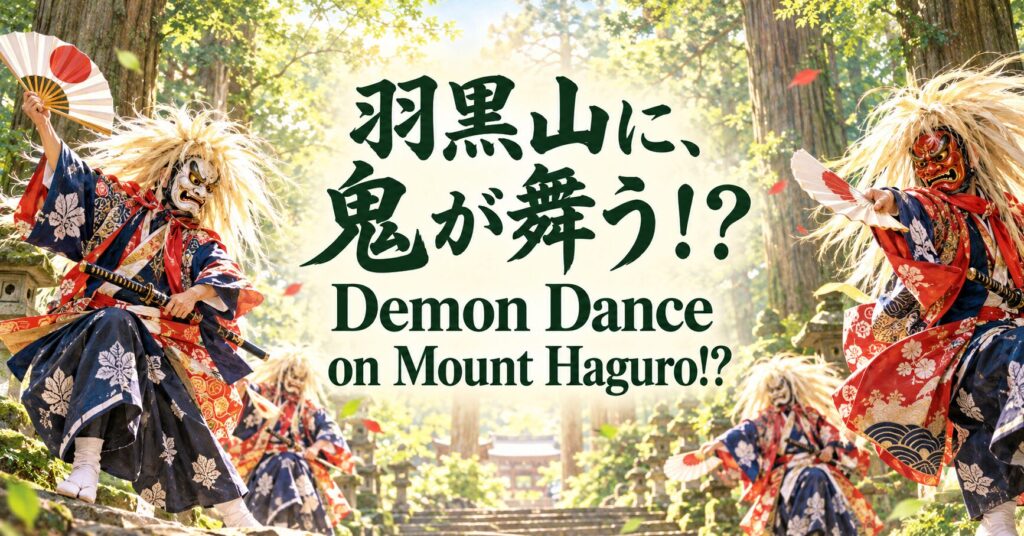
Fierce masks and eye-catching costumes. Holding swords or fans, the dancers move to drums, flutes and tebiragane, small hand cymbals. The basic form uses eight dancers, though there also seem to be solo pieces and pieces for small groups.
Even in photographs, it is quite something.
But right away, I learned something unexpected.
The masks do not actually represent demons.
They may look like demons, but they depict Myōō, the Wisdom Kings: incarnations of the Buddha who save people and drive away misfortune. That is why the masks have no horns.
With "demon" right there in the name, I had assumed it was a demon dance. You really can't judge by looks alone.
What's more, in 2022 Onikenbai, a nationally designated Important Intangible Folk Cultural Property, was inscribed on UNESCO's Intangible Cultural Heritage list as one of the Furyu-odori, Japan's ritual folk dances.
The designation is held by four preservation societies: Iwasaki and Nameshida in Kitakami, and Honokizawa and Kawanishi in neighbouring Oshu. It does not mean that every Onikenbai group in the region is individually inscribed.
With so many preservation groups in existence, it is the way this dance is rooted in the area and carried on as part of daily life that is itself the heritage.
And still, I kept reading.
Roots on Mount Haguro?
Now for the part that surprised me most: the connection between Onikenbai and Mount Haguro.
The Kitakami Tourism and Convention Association introduces several traditions about how Onikenbai began.
One says that En no Ozunu, regarded as the founder of Shugendō, Japan's tradition of mountain asceticism, danced it to spread the nenbutsu prayer.
Another says it began in the Daidō era (806 to 810) as a nenbutsu dance associated with Zengyōin, a high-ranking priest of Mount Haguro, performed to drive away evil spirits and bring salvation to all living beings.
"Salvation of all living beings," or shujō saido, is a Buddhist idea: freeing people from confusion and suffering.
So the dance carried a meaning that went far beyond entertainment.
The Haguro Tourist Association, too, notes that Onikenbai is said to have originated at Kōtakuji Temple on Mount Haguro. It also announced an offering performance at Kōtakuji by Yachi Onikenbai of Kitakami on 10 October 2026.
Haguro's name doesn't just survive in the origin story; people still travel from Kitakami to offer the dance here today. Doesn't that lend the story real weight?
Why did it spread so widely?
Why has it been passed down for so long?
We can only imagine, but there's no doubt it is a dance that moves people's hearts.
It is not a performance put on to make money.
It carries wishes: to ward off misfortune, for people to live in safety, to protect those they love.
That is what this dance expresses.
Knowing that background, the footage of the offering feels all the more precious.
Here is the offering performance by Yachi Onikenbai at Kōtakuji on Mount Haguro, 10 October 2026. You can watch the piece called "Ichiban-niwa" in the video.
Offering at Kōtakuji, Mount Haguro: "Ichiban-niwa"

Of course, a story handed down over the centuries and history confirmed in records are not the same thing.
I can't claim that Mount Haguro is the one and only origin. Still, the name of our local mountain appears in the origins of a dance carried on in Kitakami.
That alone was enough to amaze me, and I can't help hoping it's true.
Why Kitakami?
But that raised my next question.
If the dance comes from Mount Haguro, why is it in Kitakami?
And why is it carried on by so many different groups?
Looking into it, I found that parts of how it first arrived are still unknown.
Even for Iwasaki Onikenbai, regarded as the ancestor of Onikenbai in the Waga area, how it was transmitted remains unclear. On the other hand, a transmission book from 1732, the Nenbutsu Kenbai Den Zen, survives.
So there is evidence of a long tradition. But the full path from the beginning to the present is not known.
I'd rather accept that as it is than turn it into a tidy story.
What we can trace in detail, though, is how the dance was passed from one community to another.
For example, Nameshida Onikenbai received the dance from Iwasaki Onikenbai in 1901, and later taught the groups in Iide, Yachi, Murasakino and Futago. Yachi received it from Nameshida in 1912.
Each community didn't start the same dance on its own. They learned from people who already carried it, and then passed it on again.
Behind the many groups in Kitakami lies this long chain of teaching.
And children are still learning today.
The introduction to Iwasaki Onikenbai shows practice scenes with an elementary school youth club, junior high students and adults. Yachi Onikenbai's introduction also shows elementary school children hard at practice.
It's not just that old records survive. There are still people trying to learn, and people teaching them.
When I think about why Onikenbai lives on in Kitakami, I sense a great and beautiful love in that scene.
That Family, Right There in the Dance!
After our guests left, I also looked up the offerings on Instagram and elsewhere.
It was far more accomplished than I had imagined. Surprised all over again.
Our guests belong to Yachi Onikenbai, a group in Kitakami.
You can see their activities on Yachi Onikenbai's Instagram. If you're curious, do take a look.
In this video, you can watch "Tōkenbai no Kurui: Sannin Kago," offered at Dewa Sanzan Shrine on the same day, 10 October.
Offering at Dewa Sanzan Shrine: "Tōkenbai no Kurui: Sannin Kago"

Among the dancers and musicians, I was told, the daughter dances and her mother plays the flute.
So the family I'd chatted with at Watausagi were among the people who keep this dance going.
From children to adults, everyone takes part in their own role.
There are people who dance, people who make the music, people who teach. Together, they create one performance.
"UNESCO Intangible Cultural Heritage" can suddenly sound like something belonging to important people in a faraway world. Yet the people who carry it are also ordinary neighbours, living everyday lives in their own town.
Perhaps that is exactly why it has been handed down, generation after generation.
This encounter brought traditional performing arts much closer to me.
A Little Like Kurokawa Noh?
As I listened, what came to mind was Kurokawa Noh, here in Tsuruoka.
Kurokawa Noh is a sacred Noh tradition that the parishioners of Kasuga Shrine in the Kurokawa district have carried on for more than 500 years.
Of course, Onikenbai and Kurokawa Noh are different arts. Their forms and histories can't simply be laid side by side.
But in the way local residents carry them and hand them to the next generation, I sense something they share.
One face for everyday life, another for the stage.
A level of seriousness you'd never guess from a casual chat.
Each place has its own dance, and people who treasure it.
Once you know the background, I'm sure you'll see the same dance differently.
A Side of Home I Didn't Know
When it comes to your own area, surely the locals know best.
That's what we tend to think. But running a guesthouse, I learn so much from travellers.
This time, guests from Kitakami showed me a side of Mount Haguro I had never known.
The mountain I see every day turned out to be linked to a dance carried on in a faraway place.
Just knowing that makes Mount Haguro look a little different to me.
Next, I'd love to see Onikenbai in person.
And now I want to visit Kitakami, too.
And when you come to Tsuruoka, please tell me what you saw on your travels and what caught your interest.
I might set out to be your guide and end up being the one learning again (ha!).
On your way around Mount Haguro and the Shonai region, take a break at Guesthouse Watausagi.
I'm looking forward to chatting about your journey.
Sources (Japanese-Language Websites)
- Kitakami Tourism and Convention Association: About Onikenbai
- Haguro-san Kōtakuji Shōzen-in: Kōtakuji Temple
- Agency for Cultural Affairs, Cultural Heritage Online: Onikenbai
- Haguro Tourist Association: Yachi Onikenbai Offering Performance at Kōtakuji
- Kitakami Tourism and Convention Association: Iwasaki Onikenbai
- Kitakami Tourism and Convention Association: Nameshida Onikenbai
- Kitakami Tourism and Convention Association: Yachi Onikenbai
- Tsuruoka City: Kasuga Shrine
Sources checked: 12 October 2026
📖 やまがたいいとこ の関連記事
 Why a dragon god at a Buddhist temple? The mystery of Zenpoji (Tsuruoka) and its sea-guarding dragon faith
 Michelin-Starred Sakata: A Two-Star Tour Built on the Wealth of the Kitamae Ships
 Michelin-Starred Tsuruoka: From a Three-Star Cedar Avenue to a Two-Star Living Buddha
- STAY WITH US -
Your Base for Exploring Tsuruoka
A small guesthouse in central Tsuruoka, Yamagata. The perfect base for your trip to Dewa Sanzan and Shonai.
Book Now →