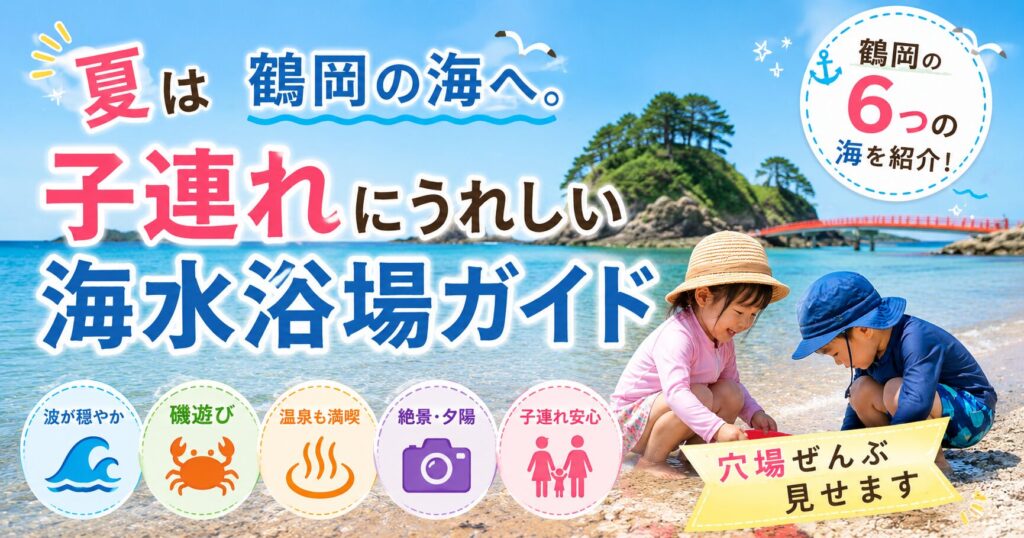
Every summer, plenty of travelers come to Tsuruoka with one thing in mind: the beach. Wide stretches of sand, calm sheltered coves, rocky pools for exploring — for a single town, Tsuruoka’s coast is remarkably varied.
The question we hear most from families is this: “Where’s the calm water where even a small child can play safely?” As it happens, Tsuruoka has several family-friendly hidden gems that most visitors never hear about.
Today, as your hosts, we’d like to share the six beaches we actually recommend to our guests — from calm, sheltered shores made for little ones to a coast famous for its sunsets. We hope it helps you plan your summer.
The Six Beaches of Tsuruoka at a Glance
Tsuruoka’s coastline is lined with six beaches, each with its own personality. Here they are at a glance.
| Beaches | 2026 season | Best for | Waves | parking |
|---|---|---|---|---|
| Yunohama | Jul 11–Aug 16 | Classic + onsen | Shallow | 800 |
| Kamo Rainbow Beach | Jul 18–Aug 16 | Tide pools + aquarium | Calm | 60 free |
| Yura | Jul 18–Aug 16 | Scenery + photos | Moderate | 300 |
| Sanze | Jul 18–Aug 16 | Quiet cove | Calm | 120 |
| Kobato | Jul 18–Aug 16 | Crab hunting + access | Calm | 200 |
| Marine Park Nezugaseki | Jul 11–Aug 16 | Little kids | Very calm | 150 |
Note: the seasons, parking counts, and facilities here are taken from the 2026 listings on Yamagata’s official tourism site (“Yamagata e no Tabi”) and should be treated as a guide. Beach-hut operation and parking capacity can change from year to year, so always confirm the firm details with each local tourism association before you go. Parking is generally a 1,000-yen cooperation fee per car (Kamo Rainbow Beach alone is free, about 60 spaces).
Our honest advice as innkeepers: choose by your children’s ages and the day’s weather. Let’s walk through them one by one.
For Families with Little Ones|Marine Park Nezugaseki
If you have a small child who’s wary of waves, this is the very first place we point families to. Marine Park Nezugaseki sits at the southern edge of the city, in Nezugaseki.
Above all, the water here is calm. Ringed by Bentenjima and a scatter of little islands, it’s sheltered from the open sea. The pebbled, man-made beach keeps the water clear, and it’s one of Japan’s “100 Best Bathing Beaches” chosen by the Ministry of the Environment.
Best of all for parents: the changing room has a baby bed. There are both warm showers (100 yen for 2 minutes) and free cold ones, plus a man-made tide-pool area and a grassy lawn to keep kids happy out of the water. There’s no beach hut here — but that quiet is exactly the treat.
The 2026 season runs July 11 to August 16. Parking holds 150 cars (1,000 yen). It’s about a 10-minute walk from JR Nezugaseki Station.
For Crab-Hunting Adventures|Kobato
For the child who’d rather hunt for creatures than swim, head straight to Kobato Beach.
Its charm is the rocky tide pools right inside the swimming area. Once kids start chasing crabs, hermit crabs, and little fish along the water’s edge, they’re unstoppable. The rocks keep the waves gentle, so it’s reassuring even for small children. Don’t forget a net and bucket.
It’s easy to reach — right along National Route 7 and just steps from JR Kobato Station. Toilets, changing rooms, and showers are all on hand. The 2026 season runs July 18 to August 16, with parking for 200 cars (1,000 yen).
For an Uncertain-Weather Day|Kamo Rainbow Beach
The Japan Sea’s summer skies can change fast. The savior for a rainy day is Kamo Rainbow Beach, in the Kamo district.
Right next door — just across the parking lot — is the world-famous Kamo Aquarium (Kurage Dream Hall), known for its jellyfish. Play at the sea, and if rain rolls in, duck into the aquarium. With its man-made sand and rock zones you can both swim and observe sea life, and you can drive almost right up to the shore.
The 2026 season runs July 18 to August 16 (swimming roughly 8:30–17:00). Parking holds 60 cars — and, happily, it’s free. Toilets, changing rooms, and showers are all on hand.
For Hot Springs to Match|Yunohama
It’s no hidden gem, but for a first beach outing, or a big group with grandparents along, the dependable choice is Yunohama — the largest beach in the prefecture.
A long, wide, clean sandy shore with shallow water, a floating pier offshore, and everything you need: toilets, changing rooms, showers, even beach huts. The Yunohama hot-spring town rises right behind it, so you can soak in an onsen after your swim — a luxury that’s very Shonai.
It’s known for sunsets ranked among “Japan’s 100 Best” and for the night fishing-fires offshore — and it’s said to be the birthplace of the oldest surfing in Japan. The 2026 season runs July 11 to August 16, with parking for 800 cars (1,000 yen).
For the Photographs|Yura
If you simply want the most beautiful view, go to Yura Beach — doubly honored as one of Japan’s “100 Best Bathing Beaches” and “100 Best Shores.”
Its symbol is Hakusan Island, joined to the shore by a vermilion bridge. The island floating beyond the sand, set against the sun sinking into the Japan Sea, draws a sigh every time. A walking path circles the island, and even children can try the fishing pond there.
One thing to note: Yura has no changing room (it does have toilets, showers, a beach hut, and lifeguards). Come already in your swimsuit, or use a rash guard. The 2026 season runs July 18 to August 16, with parking for 300 cars (1,000 yen).
For a Quiet Escape|Sanze
One last spot. Sanze Beach, a cove framed by dramatic rock formations, has gentle waves and suits anyone who’d rather skip the crowds. There’s rock-pool play, a natural rock diving platform, and a sunset from atop “Tate-iwa” rock that draws photographers. Since it sits right beside Kobato, you can always slide over when Kobato gets busy. (The 2026 season runs July 18 to August 16; parking 120 cars at 1,000 yen, with toilets, changing rooms, and showers.)
Toilets, Showers, Changing Rooms — A Quick Comparison
With kids along, whether there’s a toilet and shower matters a lot. Here’s how the six compare. Every beach has a first-aid station and lifeguards on duty, so you can relax.
| Beaches | Toilet | Changing | shower | Beach hut |
|---|---|---|---|---|
| Yunohama | ✓ | ✓ | ✓ | ✓ |
| Kamo Rainbow Beach | ✓ | ✓ | ✓ | ✕ |
| Yura | ✓ | ✕ | ✓ | ✓ |
| Sanze | ✓ | ✓ | ✓ | ✕ |
| Kobato | ✓ | ✓ | ✓ | ✕ |
| Marine Park Nezugaseki | ✓ | ✓ | ✓ | ✕ |
At Nezugaseki the showers are both warm (100 yen for 2 minutes) and cold (free). Yura has no changing room, so come in your swimsuit or bring a rash guard. If you’re counting on food or a shop on site, the beach huts at Yunohama and Yura are your safe bets — though beach-hut operation varies year to year, so check with the local tourism association before the season.
A Few Tips From Your Hosts
Here are a few “glad-we-brought-it” notes we share with our guests.
- Water shoes are essential for the tide-pool beaches — they save little feet from sharp rocks.
- A net, bucket, and small bug box earn their keep at Kobato, Kamo, and Sanze.
- A pop-up tent gives you shade and peace of mind (beaches can be windy).
- Bring plenty to drink, and don’t forget salt for hydration — Shonai summers are hotter than you’d expect.
- Carry cash: the parking fee (1,000 yen) and warm showers (100 yen) usually require it.
- Swim only within the posted season and hours, in the lifeguarded area — and please keep an eye on the children.
In closing
Swim off a wide sandy beach, or chase crabs in the rock pools — Tsuruoka gives you a sea to suit the day’s mood. Calm water at Nezugaseki, tide pools at Kobato, a rainy-day backup at Kamo, the classic at Yunohama, the view at Yura, the quiet at Sanze.
Watausagi is here as your base for days like these. Swim to your heart’s content, eat well, and sleep deeply. We hope this summer becomes a day you’ll never forget — we’d love to welcome you.
📖 やまがたいいとこ の関連記事
 Demons Dancing on Mount Haguro!?
 Why a dragon god at a Buddhist temple? The mystery of Zenpoji (Tsuruoka) and its sea-guarding dragon faith
 Michelin-Starred Sakata: A Two-Star Tour Built on the Wealth of the Kitamae Ships
- STAY WITH US -
Your Base for Exploring Tsuruoka
A small guesthouse in central Tsuruoka, Yamagata. The perfect base for your trip to Dewa Sanzan and Shonai.
Book Now →