
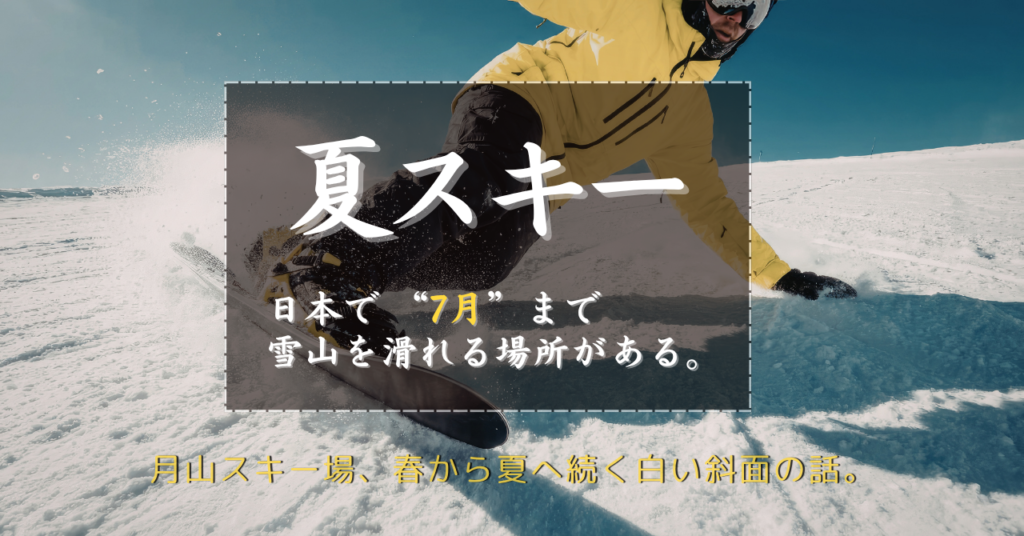
The lifts stop, the slopes turn into grass and mud, and ski wear is tucked away in the back of the closet. But in Yamagata, it’s different.
In late April—just as other ski resorts are closing, Gassan opens.
At an elevation of 1,600 meters. The majestic ridgelines of Bandai-Asahi National Park. A spring landscape found nowhere else, where lingering snow and fresh beech greenery spread out before your eyes at the same time.
And Gassan Ski Resort is open for skiing until around July. Skiers, snowboarders, and backcountry ski mountaineers—all are drawn to the same white slopes for a reason.
Gassan Ski Resort—one of the slopes in Japan where snow remains the longest.
Gassan Ski Resort is located in Nishikawa Town, Yamagata Prefecture. It typically opens in late April and operates until around July, making it one of Japan’s premier spring and summer ski resorts. The slopes stretch across high elevations of about 1,600 meters, and its greatest appeal lies in the abundant lingering snow and the panoramic courses of Bandai-Asahi National Park.
Why does the snow remain until this time of year?
Although Mount Gassan stands at 1,984 meters—just under 2,000 meters—it is strongly affected by seasonal winds blowing directly from the Sea of Japan, resulting in extremely heavy snowfall during winter. Even in spring, much of that snow remains unmelted, leaving patches of white across slopes where fresh greenery has begun to emerge. This creates the unique landscape that only Gassan can offer.
From mid-June onward, in addition to skiing and snowboarding, you can also access Mount Gassan for hiking using the pair lift. Beyond the lift, an alpine world unfolds where flowers and snow coexist.
Gassan Ski Resort – Basic Information
Location: Nishikawa Town, Yamagata Prefecture (within Bandai-Asahi National Park)
Elevation: حوالي 1,600 m (ski area)
Opening: Typically late April (pair lift begins operation)
Closing: Typically around July
Lifts: Gassan pair lift, T-bar lift
Hiking access: From mid-June (access to Mount Gassan via lift)
Payment: PayPay and au PAY accepted
Parking: Environmental maintenance fee 1,000 yen per vehicle
Climb the mountain on skis—Gassan offers a truly unique experience.
At Gassan, it’s not just about skiing the slopes—seasoned snow mountain enthusiasts gather from all over the country.
This style is known as ski mountaineering, or alpine touring.
You climb the slope on skis, aim for the summit, and then descend steep snowy terrain, tracing your own tracks. It’s a completely different experience from groomed resort runs—one that feels like a direct dialogue with the mountain itself.
Mount Gassan is a sacred mountain.
As one of the Dewa Sanzan (Mount Gassan, Mount Haguro, and Mount Yudono), it has long been revered as a sacred mountain of Shugendo.
You walk through this sacred realm on skis. You glide across it. From the summit, you can look out over Mount Chokai and the Sea of Japan. This is not just a sport—it’s an experience where you can even feel a deep reverence for the mountain.
However, Gassan has its own unique “Gassan skiing and mountaineering rules.”
These rules, established by the Gassan Environmental Maintenance and Management Council, are designed to protect both nature and its visitors. First-time visitors should be sure to check them in advance.
What you should know before ski mountaineering at Gassan
* Checking the “Gassan Skiing & Mountaineering Rules” in advance is essential (see official website)
* Submitting a climbing plan is recommended
* Areas outside the ski resort are backcountry and at your own risk
* Weather conditions change rapidly, so proper equipment is essential
* From mid-June, Mount Gassan can also be accessed for hiking via lift
Flowers bloom beside the snow—Gassan flower trekking
In late June, a mysterious scene appears on the slopes of Mount Gassan. Right beside slopes where snow still remains, alpine flowers begin to bloom.
Although Mount Gassan is under 2,000 meters in elevation, it is directly exposed to seasonal winds from the Sea of Japan, allowing alpine plants—typically found at elevations above 3,000 meters—to thrive here. The sight of these flowers blooming beside lingering snow is known as “snowbed vegetation,” and it is considered a highly valuable phenomenon from a scientific perspective.
The route from the summit of Mount Ubagatake to Kanauba, Saitomori, Ushikubi, and the summit of Mount Gassan is filled with continuous highlights. On clear days, you can see all the way to the Sea of Japan from the top of Mount Ubagatake.
With skis in hand, you walk carefully so as not to step on the flowers. On Mount Gassan, there is a season like this—quietly luxurious.
What’s interesting is that not only winter sports enthusiasts gather here during this season.
A traditional lift called a T-bar lift
At Gassan Ski Resort, there is also a “T-bar lift” installed in addition to the pair lift.
You place a T-shaped bar against your hips or between your legs and are pulled up the slope. It’s a traditional lift that has become quite rare in Japan.
First-time riders may find it a bit tricky, but once you get the hang of it, the feeling is exceptional. T-bar lifts are still in use at some ski resorts overseas, and many international guests feel nostalgic when they see them. Personally, I’m one of those people too. When I was a child, this was the only type of lift I knew, and I still remember how excited I was when I first managed to ride it.
This lift may feel a bit old-fashioned, but it also adds to Gassan’s unique atmosphere—think of it as a small attraction to enjoy.
Gassan × Tsuruoka makes the journey even richer.
Gassan Ski Resort is located in Nishikawa Town, but it is also easily accessible when using Tsuruoka as your base.
The day before, you experience the spiritual culture of the Dewa Sanzan in Tsuruoka. The next morning, you head to the slopes of Mount Gassan. After skiing, you return to Tsuruoka and fully enjoy its status as a UNESCO Creative City of Gastronomy—mugikiri noodles, local Shonai sake, and traditional cuisine. Then, you soak in an onsen and stay the night.
Guesthouse Watausagi serves as a base for this kind of journey through Yamagata. We aim to be a place that makes Tsuruoka—home to the Dewa Sanzan—not just a stop along the way, but a destination in itself.
▶ Click here for details and reservations at Watausagi
【URL】https://wata-usagi.com/reservation/
Related Article ①There was a mecca for snowboarders in Yamagata.
Related Article ②Someone you can meet at Yudonosan Ski Resort: the ski world’s legend, Saburo Watanabe.
Winter in Yamagata isn’t over yet.
Just as the season at Mount Yudono comes to an end, Mount Gassan finally awakens.
On the spring slopes, lingering snow glistens, flowers bloom, and a blue sky stretches above. You ride the T-bar lift up the slope in silence, then carve down an empty run. In that stillness, you can feel the mountain’s true power.
For those who want to experience skiing or mountaineering not just as a sport, but as a dialogue with the mountain, Gassan will surely become a special place.
Wouldn’t you like to experience summer skiing?
That’s all for today’s article. The latest updates are shared on Instagram Stories. Please follow and stay tuned! ❣️
📖 やまがたいいとこ の関連記事
 Why a dragon god at a Buddhist temple? The mystery of Zenpoji (Tsuruoka) and its sea-guarding dragon faith
 Michelin-Starred Sakata: A Two-Star Tour Built on the Wealth of the Kitamae Ships
 Michelin-Starred Tsuruoka: From a Three-Star Cedar Avenue to a Two-Star Living Buddha
- STAY WITH US -
Your Base for Exploring Tsuruoka
A small guesthouse in central Tsuruoka, Yamagata. The perfect base for your trip to Dewa Sanzan and Shonai.
Book Now →