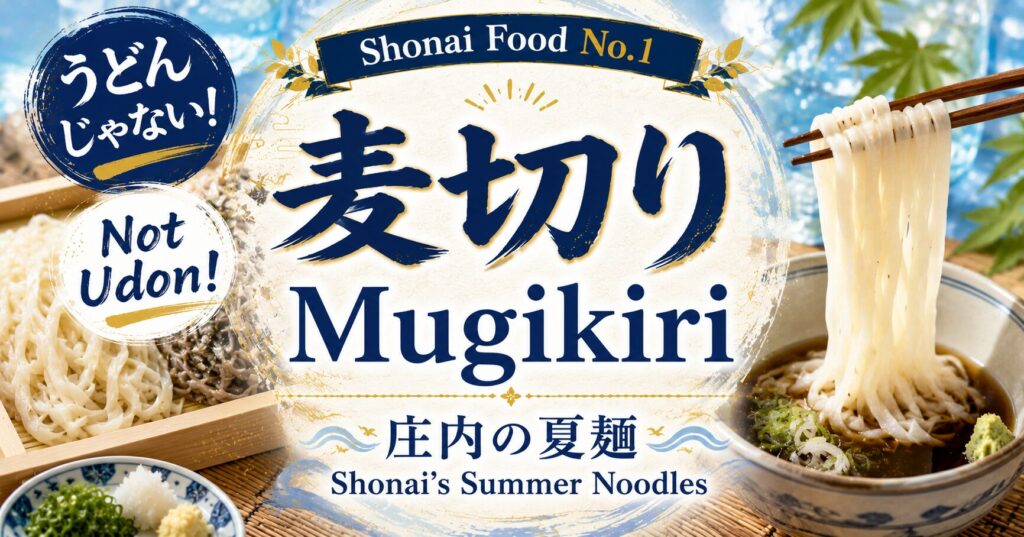
In summer, I don't eat udon. I eat mugikiri instead.
Thin, flat noodles, chilled in cold water. You dip them in a little sauce and let them slip down your throat. That alone tells me summer has come to Shonai.
Say "mugikiri" to most people in Japan and you get a blank look. "You mean udon?" they ask. No. But it's close. A little. So let me tell you about this confusing, lovable noodle.
What is mugikiri?
Mugikiri (麦切り) is a local noodle from Shonai, the coastal part of Yamagata on the Sea of Japan side. Wheat flour, kneaded with salted water, then cut thin. The ingredients are the same as udon: flour, salt, water.
What differs is the shape, and the way you eat it. Mugikiri is thinner than udon, with a flat cross-section. And you eat it cold.
In Shonai, the classic order is aimori (合盛り) — soba and mugikiri side by side on one board. Condiments: wasabi, green onion, ginger. Some shops add karashi mustard.
Where the name comes from
The name is literal. You cut (kiri) wheat (mugi) dough with a knife. Mugi-kiri.
And it has a sibling: soba. The noodle we usually just call "soba" was originally soba-kiri — "cut buckwheat." Cut buckwheat, soba-kiri. Cut wheat, mugi-kiri.
Soba wasn't always a noodle, either. For centuries, buckwheat was eaten as whole grains or as sobagaki, a soft dough. The oldest record of buckwheat served as cut noodles comes from Josho-ji, a temple in Kiso, Nagano: a 1574 donation note that lists "sohakiri." The very idea of "noodles you cut" carries centuries behind it.
The history is murky
Honestly, the origin of mugikiri itself isn't clearly documented. The common story is that it was born in Shonai in the Meiji era (late 1800s), with the Oyama district of Tsuruoka often named as its birthplace. But all of this is "one theory among several."
The word "mugikiri" is older. A 1643 cookbook, Ryori Monogatari, lists both "kirimugi" and "mugikiri." In that era, though, mugikiri may have meant a noodle made from barley flour — a different lineage from today's wheat-based Shonai mugikiri. Same name, different thing, depending on time and place. That gap is exactly what I find fascinating.
The biggest difference from udon
In Shonai, a thick noodle with a round cross-section is called "udon." A thin, flat one is mugikiri.
But the real dividing line is temperature. Mugikiri is meant to be chilled. Serve the same noodle hot, and many shops will call it udon instead. To people here, mugikiri is a cold noodle for summer.
Mugikiri vs. Inaniwa udon (Akita)
Next door in Akita, there's Inaniwa udon. It looks a little similar. But it's made in a completely different way.
Mugikiri is cut. Inaniwa udon is stretched. Inaniwa is hand-pulled: the dough is twisted and drawn out thin by hand, dusted with starch rather than oil. That's why its surface is smooth and slightly translucent. And it's sold dried.
If mugikiri is a knife noodle, Inaniwa is a palm noodle. By lineage, Inaniwa is a cousin of somen.
Mugikiri vs. Sanuki udon (Kagawa)
Sanuki udon, from Kagawa, is famous for being thick, chewy, and powerfully springy. By method, though, Sanuki belongs to the same "cut" family as mugikiri. You roll it, then cut it.
The difference is the thickness, and the kind of "koshi." In Sanuki, koshi means elasticity, not hardness — old-timers said you "swallow" it. Plenty of water, plenty of salt, a long rest: that's where the bounce comes from.
The ways to eat it are endless: kake, bukkake, kamaage, kamatama, plain with soy sauce. You can even match noodle and broth by temperature — hot noodle with cold broth, and so on. The broth is built on iriko, dried sardines. Mugikiri, by comparison, is simple. Chill it, dip it. One clean bowl of summer.
The differences, at a glance
Mugikiri sits right between the bounce of Sanuki and the delicacy of Inaniwa. At least, that's how I think of it.
Where to eat mugikiri in Tsuruoka
I make it at home, but a shop's hand-cut noodles are something else. Three places I'd choose in Tsuruoka:
Nezameya Hanbee (Umamachi)
Ask a local "where do I go for mugikiri?" and this name comes up first. Cars line up before opening, many with out-of-prefecture plates. The mugikiri here is on the thicker side, with real chew, and the soba-and-mugikiri aimori is the signature plate. Many people pair a visit with the Kamo Aquarium, famous for its jellyfish. Closed Wednesdays; lunch only. (Current hours & closures → Tabelog)
Mendokoro Hosho (Hiyoridamachi)
A short walk from Tsuruoka Station, tucked into a residential block — look for the water wheel out front. Soba, mugikiri, and ramen are all house-made, and the "three-color" plate lets you try all three at once. The broth is seafood-based. A large bowl of soba runs 500 g for 950 yen, so arrive hungry. Closed Mondays. (Current hours & closures → Tabelog)
Menkobo Muryoan (Haguromachi Kawashiro)
At the foot of Mt. Haguro — an easy stop on the way back from the shrine. The shop mills its own buckwheat for stone-ground soba and cuts mugikiri from Shonai wheat, both made with Haguro’s clear spring water, which is part of why the soba is so fragrant. There are private tatami rooms with sunken hearths, relaxed enough for families. Closed Wednesdays. (Menu & hours → Muryoan official site)
None of these sit in a convenient spot in town. And that's fine. Mugikiri is a noodle you go out of your way for.
Take one slurp, and you'll probably understand. This isn't udon. This is summer in Shonai.
(Opening hours and closing days can change — check before you go.)
📖 つるおかグルメ の関連記事
 Why Shonai Melon Tastes Like Nowhere Else: Japan’s Sand-Dune “Miracle Fruit” of Summer
 🍑 Shonai Persimmon Tales (3): A “Persimmon Curtain” Hanging Under the Eaves
 🍊 *Shonai Persimmon Story, Part 2 — Persimmons: Nature’s Edible Beauty Serum*
- STAY WITH US -
Your Base for Exploring Tsuruoka
A small guesthouse in central Tsuruoka, Yamagata. The perfect base for your trip to Dewa Sanzan and Shonai.
Book Now →