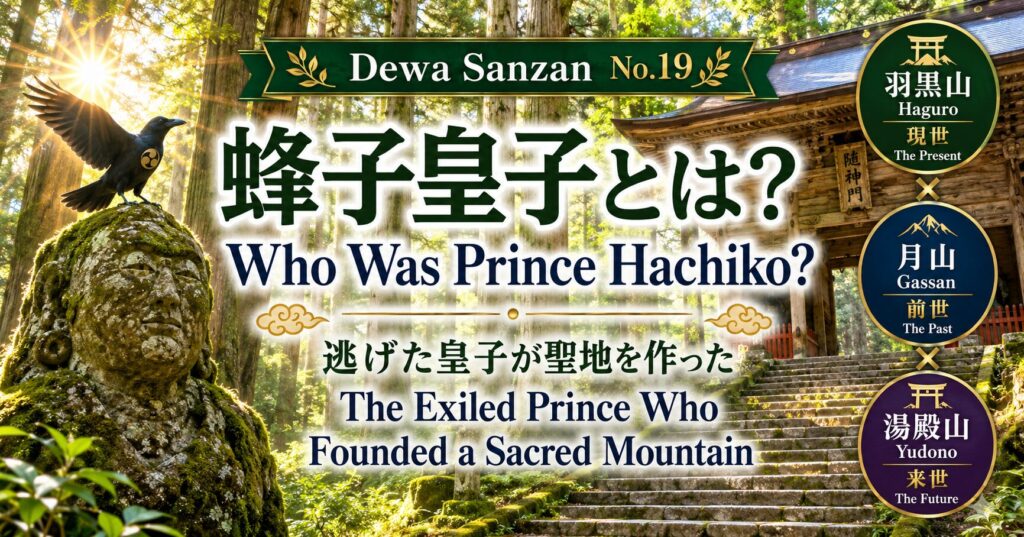
At the summit of Mt. Haguro, close to the Sanjin Gosaiden, stands a small mausoleum, quiet and apart.
This is the Mausoleum of Prince Hachiko — dedicated to the man revered as the founder of Dewa Sanzan.
He was a son of Emperor Sushun and a cousin of Prince Shotoku (traditionally he is often called Shotoku's "nephew," though by the family tree they were cousins). He fled political strife, entered the mountains of Tohoku, and spent his whole life there. His name was Prince Hachiko (Hachiko no Ouji).
Without this story, which began more than 1,400 years ago, neither today's Mt. Haguro nor Dewa Sanzan would exist.
This time, we tell the story of Prince Hachiko, the very starting point of Dewa Sanzan.
→ Dewa Sanzan overview [Article No.1]
→ Read about the history of Shugendo here (Article No.15)
Prince Hachiko: Key Facts
| Item | Details |
|---|---|
| Name | Prince Hachiko (Hachiko no Ouji) |
| Other name / Buddhist name | Nojo Taishi |
| Dates | Birth date unknown – died approximately 643 CE |
| Family | Third son of Emperor Sushun; cousin of Prince Shotoku (traditionally sometimes called his "nephew") |
| Connection to Dewa Sanzan | Credited with founding Mt. Haguro as a sacred site (around the reign of Empress Suiko, 6th–7th century) |
| Mausoleum | Summit precinct of Mt. Haguro (Mausoleum of Prince Hachiko) |
The Life of Prince Hachiko: From Court to Mountain
A Young Man Born Into the Aristocracy
Prince Hachiko was born the third son of Emperor Sushun.
Emperor Sushun reigned in the late 6th century, just before Empress Suiko. Because Sushun and Emperor Yomei (Prince Shotoku's father) were brothers, Hachiko and Shotoku were, by the family tree, cousins. The label "Shotoku's nephew" has long been widely used, but the strict blood relationship is that of cousins.
From birth, he stood at the very top of the aristocracy.
The Assassination of His Father, Emperor Sushun
What changed Prince Hachiko's life completely was the assassination of his father, Emperor Sushun.
Emperor Sushun came into conflict with Soga no Umako, a powerful clan leader, and in 592 CE he was assassinated on Umako's orders.
Having lost his father, Prince Hachiko is said to have felt that his own life was now in danger. Survive in a court seething with power struggles, or escape — he chose to flee.
Flight to Tohoku and the Encounter with Mt. Haguro
Guided, it is said, by a three-legged crow (yatagarasu), Prince Hachiko reached a distant mountain in the north — present-day Mt. Haguro.
The three-legged crow (yatagarasu) is a mysterious being known in Japanese mythology as a messenger of the gods. The legend that he "came to Mt. Haguro guided by the divine" means his founding of the mountain was no mere accident, but the will of the gods.
A young prince fleeing the power struggles of the court, arriving deep in the mountains of Tohoku — we can only imagine how harsh that journey must have been.
Ascetic Training and the Founding of the Sacred Mountain
Having reached Mt. Haguro, Prince Hachiko undertook severe ascetic training in the mountains.
Tradition holds that, through repeated practice in the mountains, he gained genriki (supernatural power), healed the illnesses of the people around him, and prayed for the prosperity of farming and fishing.
In this way he opened Mt. Haguro as a reijo — a sacred place of training — and is said to have laid the foundation of the Dewa Sanzan faith that followed.
He never returned to the court, and is said to have spent the rest of his life in the mountains of Tohoku.
What Came After
Little detailed record survives of the latter half of Prince Hachiko's life.
Tradition holds that the faith he founded at Mt. Haguro was carried on by his disciples and eventually spread as the worship of "Dewa Sanzan," incorporating Mt. Gassan and Mt. Yudono as well.
Prince Hachiko himself is said to have died around 643 CE, and his mausoleum still stands today in the summit precinct of Mt. Haguro.
His Appearance: The Legend of an Ugly Face
There is a fascinating anecdote in the traditions about Prince Hachiko.
He is said to have had an extraordinarily ugly appearance.
Legend tells of "a face covered with countless lumps, an extremely ugly form." And yet — or perhaps precisely because of it — he is remembered as a figure deeply loved by the common people and widely revered.
The statue of Prince Hachiko in the summit precinct of Mt. Haguro is rendered with this distinctive appearance, following the tradition. It is a face you will not forget once you have seen it.
The paradoxical tradition that "true greatness lies within outward ugliness" may suggest that Prince Hachiko was handed down not as a mere relic of the aristocracy, but as "a different person" reborn in the mountains.
The Hachiko Statue: Summit precinct of Mt. Haguro, seated near the Sanjin Gosaiden. Look for its distinctive form.
Prince Hachiko and the Dewa Sanzan "Pilgrimage of Rebirth"
When you look back on Prince Hachiko's life, you notice how deeply it resonates with the Dewa Sanzan "pilgrimage of rebirth."
He came from the "present world" — a prince at court, a man at the centre of the only world he knew.
Then he passed through a kind of "death" — his father killed, his world ended, his identity as a courtier erased. Not a metaphor, but a real fall into danger.
And from there he was reborn as a "new self" — not a prince but a mountain ascetic, not a courtier but a healer of the sick and a founder of faith. This rebirth was no parable; it was the very shape of his life.
This is why Prince Hachiko did not merely found Dewa Sanzan. He lived out the "pilgrimage of rebirth" himself — as its very first traveler, 1,400 years before the tradition even had a name.
→ The philosophy of the Dewa Sanzan pilgrimage [Article No.16]
The Hachiko Mausoleum: Touching History at the Summit
In the summit precinct of Mt. Haguro stands a mausoleum dedicated to Prince Hachiko.
Compared with the great hall of the Sanjin Gosaiden, it is far smaller and quieter. Yet standing before it, you cannot help thinking of "the first person who came here."
A young prince who fled political strife and came to this mountain 1,400 years ago. Without him, Mt. Haguro might have been an entirely different place — or might not exist at all.
After paying your respects at the Sanjin Gosaiden, take a little time to stop by this mausoleum too. The 2,446 stone steps and 1,400 years of history come together as one before this small mausoleum.
The Hachiko Mausoleum: Summit precinct of Mt. Haguro, near the Sanjin Gosaiden. Free to visit.
A Historical Note: Legend and History
Here I want to draw a clear line between what we know as historical fact and what has come down to us as tradition.
Most records of Prince Hachiko were written centuries after his death. The specific anecdotes — the three-legged crow, the unusual appearance, the many miracles — are tradition rather than documented history.
What seems historically likely is this: in the late 6th to early 7th century, a person of high status came to Mt. Haguro, began ascetic practice in the mountains, and was deeply revered — and around that person a tradition of faith and pilgrimage was born here. Whether that person was precisely Prince Hachiko, third son of Emperor Sushun, cannot be confirmed.
But one thing is certain. For 1,400 years, sacred practice at Dewa Sanzan has continued without a break — this is undeniable historical fact. This mountain was a place of pilgrimage before Europe had universities. The tradition that began here, whoever began it and whenever, has survived through that long age and remains unbroken today.
Standing before the mausoleum and feeling the weight of that history, what presses on the heart far more than the founder's exact name is the simple fact of what he began.
Wrap-up
Prince Hachiko was the figure who stood at the very beginning of Dewa Sanzan.
A single human being who was caught up in political strife, lost his father, fled the court, and entered the deep mountains of Tohoku — his actions became the starting point of 1,400 years of religious history.
"Why does Mt. Haguro hold such deep history?" — the answer began with the decision of a single "prince who fled."
When you stand at the summit of Mt. Haguro, please remember Prince Hachiko. Beyond the 2,446 stone steps you have climbed lie his footsteps from 1,400 years ago.
→ The stone staircase guide [Article No.12]
→ Read about the history of Shugendo here (Article No.15)
→ About the Sanjin Gosaiden here (Article No.17)
📖 やまがたいいとこ の関連記事
 Demons Dancing on Mount Haguro!?
 Why a dragon god at a Buddhist temple? The mystery of Zenpoji (Tsuruoka) and its sea-guarding dragon faith
 Michelin-Starred Sakata: A Two-Star Tour Built on the Wealth of the Kitamae Ships
- STAY WITH US -
Your Base for Exploring Tsuruoka
A small guesthouse in central Tsuruoka, Yamagata. The perfect base for your trip to Dewa Sanzan and Shonai.
Book Now →