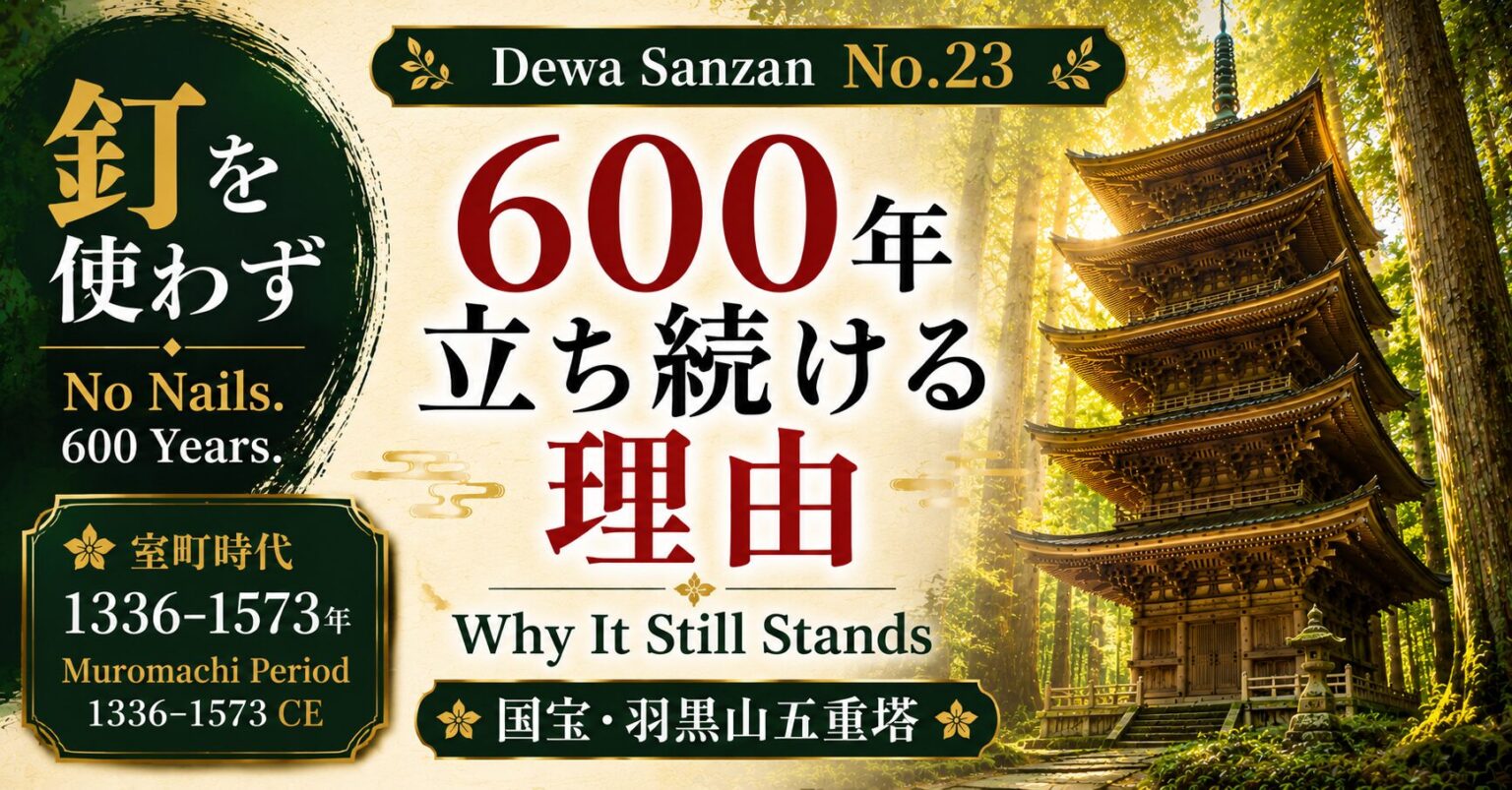
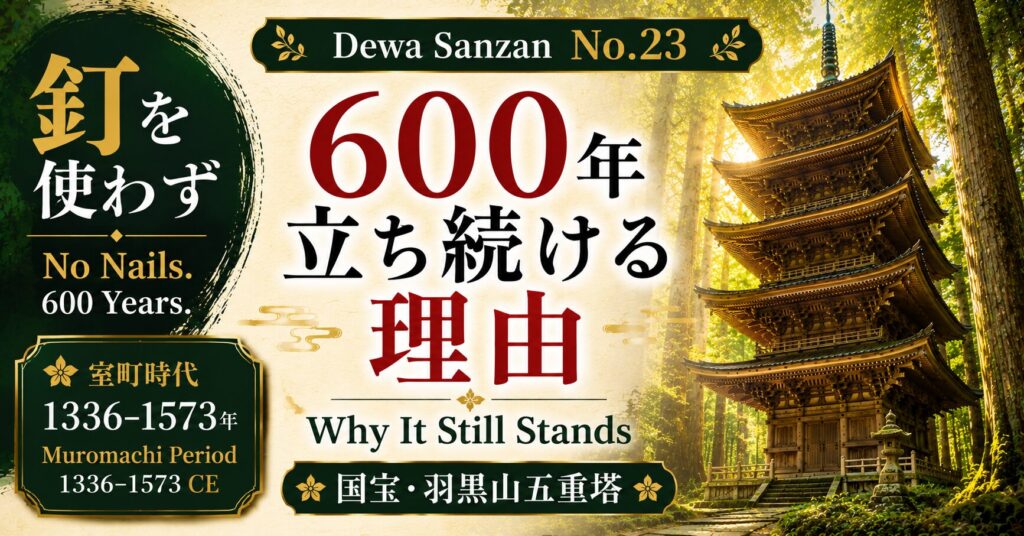
A wooden structure, standing approximately 29 metres tall, built in the Muromachi period (14th–15th century CE), still standing in its original location more than 600 years later, surrounded by cedar trees older than itself. Classified as a National Treasure of Japan. (Written independently for international visitors — not a direct translation of the Japanese article.)
The Five-Storied Pagoda of Mt. Haguro is not merely a historically significant object. It is an active demonstration of what Japanese timber construction can achieve — and of the care that has been applied over centuries to ensure that this particular achievement continues to exist.
This article examines the pagoda as a piece of architecture: what it is made of, how it was built, what keeps it standing, and where it fits in the broader history of Japanese pagoda construction.
→ Why is a Buddhist pagoda in a Shinto shrine? [Article No.21]
→ Photography guide for the pagoda [Article No.13]
Essential Facts
Official name:Hagurosan Gojunoto (Mt. Haguro Five-Storied Pagoda)
Height:Approximately 29.0 metres (95 ft), including the finial (sorin)
Architectural style:Wayō (和様) — the Japanese style derived from Tang Chinese architecture, adapted over centuries into a distinct Japanese form
Current structure:Muromachi period (14th–15th century CE) — exact dating varies by source
Cultural designation:National Treasure of Japan (designated 1966)
Location:On the stone staircase, approximately 10 minutes from the Zuishinmon Gate
Administration:Dewa Sanzan Jinja (Shrine)
Note on dating: Sources vary in their specific dating of the current structure within the Muromachi period. The broad attribution to the 14th–15th century is consistent across sources; precise dates within that range are less certain.
The Architectural History
The Original Pagoda: Heian Period Origins
The current structure is the Muromachi-period pagoda — but it is not the first pagoda to stand on this site. Historical and religious records indicate that a pagoda was built here significantly earlier, likely in the Heian period (9th–10th century CE), as the Dewa Sanzan sacred site developed.
Given that Mt. Haguro's Shugendo tradition is said to have been founded in the 7th century (the era of Prince Hachiko), it would have been a natural step for a pagoda to be raised as the site grew into a place of worship.
The precise form, height, or history of that earlier structure is not well documented. What the historical record indicates is that a pagoda — as an expression of Buddhist practice at this syncretic sacred site — has been part of Mt. Haguro's sacred landscape for well over a millennium.
Heian Period (794–1185 CE)
An earlier pagoda is believed to have stood at this site, constructed as part of the development of Dewa Sanzan as a syncretic Buddhist-Shinto sacred complex. No detailed records of this structure survive.
Muromachi Period (1336–1573 CE)
The current surviving structure was built. Exact dating within this period varies between sources. The building's stylistic characteristics and timber analysis are consistent with this era.
Edo Period (1603–1868 CE)
The height of Dewa Sanzan's sacred tradition. The pagoda stood as part of one of Japan's foremost pilgrimage sites. Repair and maintenance work was carried out, though detailed records are limited.
Meiji Period onward (1868–present)
The pagoda survived the Haibutsu Kishaku destruction campaign targeting Buddhist structures at Shinto sites. Designated National Treasure in 1966. Ongoing conservation work continues under government-supported programmes.
The Architecture: How It Was Built and Why It Stands
Wayō Style: Japan's Own Architectural Language
The architectural style of the Haguro pagoda is formally known as sangen goju toba — a three-bay, five-storey pagoda.
The Haguro pagoda is built in the Wayō (和様) style — a form of Japanese architecture that developed from Tang Chinese architectural models introduced to Japan along with Buddhism, and evolved over centuries into something distinctly Japanese.
Wayō architecture is characterised by a certain structural elegance and restraint: the forms are not heavy or overpowering, but achieve their effect through proportion, the relationship between elements, and the careful handling of wood. The Haguro pagoda, with its moderate height (29m is not Japan's tallest pagoda) and its setting within a dense cedar forest, exemplifies this: it impresses not through scale alone but through how perfectly it inhabits its environment.
The Shinbashira: Japan's Earthquake Solution in Wood
Running through the centre of the pagoda is a single timber column called the shinbashira (心柱, 'heart pillar'). At Mt. Haguro it is surrounded by four inner pillars (shitenbashira) and stands on a foundation stone, while the outer pillars and the roofs and bracket complexes of each storey work together to hold the building up. The shinbashira is not a rigid pillar that locks the structure in place.
What makes these pagodas resilient in an earthquake is not the shinbashira alone. The five storeys are stacked so that each can move somewhat independently, swaying out of step with one another — a 'snake-dance' motion that disperses and absorbs seismic energy. The shinbashira works like a central crossbar (kannuki), restraining and balancing the sway of the separate storeys rather than carrying the building's load.
Exactly how much each factor contributes — the independent movement of the storeys, the damping effect of the heavy roofs, and the role of the shinbashira — is debated by architectural historians. What is clear is that this flexible timber system has helped Japanese pagodas survive centuries of seismic activity, including the Haguro pagoda itself, which has stood through numerous significant earthquakes in the Tohoku region.
Note: The earthquake resistance of five-storied pagodas is an active area of architectural research, and scholars have proposed several models — the independent sway of the storeys, the inertia of the heavy roofs, and the action of the shinbashira among them. That these structures are remarkably earthquake-resistant is well established; the precise mechanism is still being studied.
The Bracket Complex: Structural Elegance Made Visible
At each level of the pagoda, beneath each set of roof eaves, is a complex system of interlocking timber brackets called kumimono (組物). This bracket system is one of the most visually distinctive elements of Japanese traditional architecture — and also one of its most structurally significant.
The kumimono distributes the weight of the roof outward along the eaves, allowing the roof to project significantly beyond the wall line while remaining structurally stable. It does this without nails — purely through the fit of shaped timber against shaped timber, each piece holding the others in place through geometry and gravity.
When you stand close to the Haguro pagoda and look up at the eaves, the kumimono is what you see: a dense, three-dimensional arrangement of timber elements that manages to look both enormously complex and completely inevitable. This is craft at the highest level.
The Roof: Kokerafuki and Timber Shingles
The roofs of the pagoda's five levels are covered in kokerafuki (こけら葺き) — a method of roofing using very thin, overlapping timber shingles. This is one of Japan's traditional roofing techniques, well-suited to the wet climate of the Tohoku region.
Kokerafuki shingles are thin enough to expand slightly in wet weather, which improves their seal against rain — and contract in dry conditions, which prevents warping. The skill of the kokerafuki craftsman lies in the preparation and laying of the shingles so that this natural movement works in the building's favour rather than against it.
The roofs visible on the pagoda today are the product of past restoration work rather than the original materials — timber shingles require periodic replacement. The method, however, has continued unchanged from the original construction.
Comparing with Other Famous Japanese Pagodas
| Pagoda | Height | Period | Style | Designation |
|---|---|---|---|---|
| Hagurosan (Yamagata) | ~29m | Muromachi (14th–15th c.) | Wayō | National Treasure |
| Horyuji (Nara) | ~32m | 7th century | Asuka style | National Treasure |
| Toji (Kyoto) | ~55m | 1644 (Edo period) | Wayō | National Treasure |
| Kofukuji (Nara) | ~50m | 1426 (Muromachi) | Wayō | National Treasure |
The Haguro pagoda is not Japan's largest or oldest surviving pagoda. But it holds distinctions that are unique: it is said to be the oldest surviving pagoda in the Tohoku region, and it stands in an environment — surrounded by ancient cedar trees, in an active sacred precinct — that no other Japanese National Treasure pagoda can match. The other pagodas on this list stand in temple gardens or urban settings. The Haguro pagoda stands in a forest, on a mountainside, as part of a living pilgrimage route. That is not a minor distinction.
National Treasure Designation and Conservation
The pagoda was designated a National Treasure (国宝, Kokuhō) in 1966 — the highest level of cultural heritage protection in Japan, reserved for objects and structures of 'especially high historical, artistic, or scholarly value from the perspective of Japan's unique culture.'
National Treasure designation comes with government-supported conservation obligations. The pagoda undergoes regular inspection and maintenance, and has been subject to major restoration projects that have addressed structural issues while preserving the original materials wherever possible.
The challenge of conserving a 600-year-old timber structure in an active outdoor environment — exposed to rain, humidity, snow, insects, and seismic activity — is significant. The fact that the pagoda continues to stand in good condition is the result of sustained, skilled effort over many generations.
Standing Before the Pagoda: What to Look For
Armed with architectural knowledge, the pagoda becomes a more rewarding object to look at. Here are the specific features worth seeking out on your visit:
The five roof levels and their proportions — notice how each successive roof is slightly smaller than the one below, creating the tapered silhouette
The kumimono bracket systems visible under each set of eaves — the dense, three-dimensional timber structure that supports the projecting roofs
The kokerafuki shingle surfaces on each roof — the fine, overlapping texture of the timber shingles
The sorin finial at the top — the bronze spire that crowns the building, catching light through the cedar canopy
The relationship between the pagoda and the cedar trees — the building has been standing here for 600 years while the forest has grown around it
Take a full 15–20 minutes. Walk around the pagoda perimeter. Look from different distances. Look up at the eaves from directly below. The more carefully you look, the more you find.
Final Thoughts
The Five-Storied Pagoda of Mt. Haguro is a working document of 600 years of Japanese craft, material knowledge, and sacred intention. It was built by people who are not remembered individually — we don't know the names of the carpenters or the sponsors or the monks who decided it should be built here. What they left is the building itself.
It has survived earthquakes, storms, the attempted destruction of the Meiji period, and the slow attrition of six centuries of weather. It stands in an ancient cedar forest at the edge of one of Japan's most significant sacred mountains, doing exactly what it was built to do.
If you walk the stone staircase, you will find it. Stop. Look carefully. This building has been here for 600 years — it can afford to give you 20 minutes.
→ The mystery of the pagoda: why is it here? [Article No.21]
→ The stone staircase complete guide [Article No.12]
→ Photography guide for the pagoda [Article No.13]
Guesthouse Watausagi sits right in the heart of Dewa Sanzan territory — perfectly positioned between Hagurosan, Gassan, and Yudonosan. Guests come from across Japan and around the world to explore these sacred mountains. Make Watausagi your base and discover the spiritual world of Dewa Sanzan! 😊
We also share the charms of our home region — Yamagata, Tsuruoka, and the Shonai area.
I'm always sharing updates and local tips on Instagram Stories. Follow us on Instagram and stay in the loop! 😊
Likes and shares make my day 💕
📖 やまがたいいとこ の関連記事
 Summer at the Sea in Tsuruoka|A Family-Friendly Guide to the Best Beaches
 【NO.22】Sokushinbutsu: The Self-Mummified Buddhist Monks of Tohoku
 【NO.21】The Mystery of Haguro’s Five-Storied Pagoda: Why Is a Buddhist Tower Inside a Shinto Shrine?
- STAY WITH US -
Your Base for Exploring Tsuruoka
A small guesthouse in central Tsuruoka, Yamagata. The perfect base for your trip to Dewa Sanzan and Shonai.
Book Now →