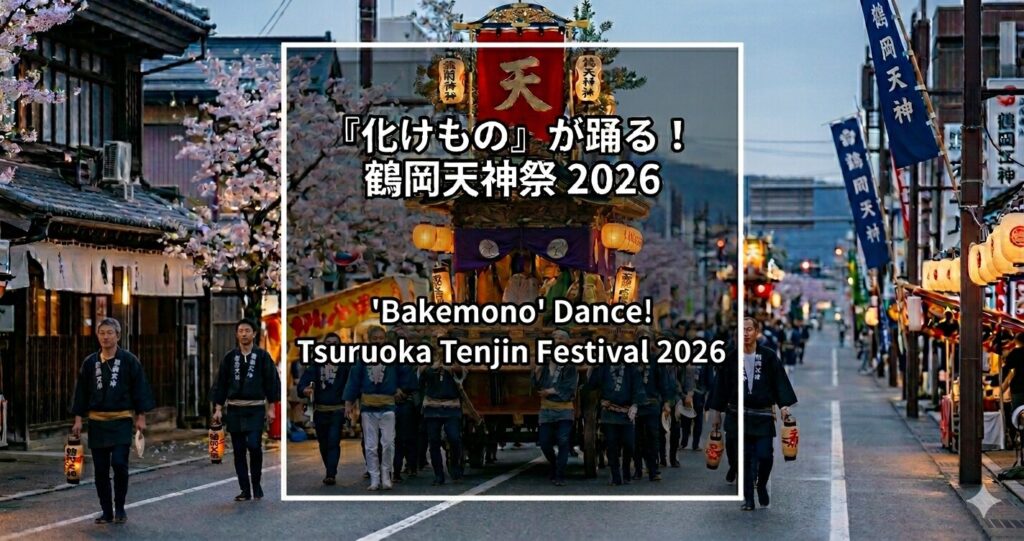
Every year on May 25th, in the small castle town of Tsuruoka on Japan's northwest coast, a strange scene unfolds in the streets of the city center.
Adults dressed in bright floral kimono undergarments. Faces hidden completely under woven straw hats and tenugui cloth. A sake flask in one hand, a small cup in the other. They walk along the street, quietly approach you — a complete stranger — and pour you a cup of sake without saying a word. Then they walk away, just as silently.
This is the Bakemono Matsuri — literally, the "Festival of Things in Disguise."
Of the more than 10,000 shrines in Japan dedicated to the deified scholar Sugawara no Michizane ("Tenjin-sama"), this is the only one in the country where worshippers attend in full disguise.
Why do they hide their faces? Why the silence?
To find the answer, we have to go back over 1,100 years — to a single political conflict in Heian-period Kyoto.
Who was Sugawara no Michizane?
Sugawara no Michizane (845–903) is enshrined as "Tenjin-sama" — the god of learning — at over 10,000 Tenmangu shrines across Japan.
Today, most Japanese people know him as the deity that students pray to before entrance exams.
But Michizane was not originally a god.
He was a flesh-and-blood human being.
He was a Heian-period aristocrat — a scholar, poet, and statesman. Exceptionally talented in Chinese poetry and Japanese waka, born into the Sugawara family that produced generations of scholars. Around the age of 30 he was appointed Monjō Hakase — the equivalent today of being the top professor at a national university. He was one of the leading intellectuals of his age.
He earned the trust of Emperor Uda and rose through the political ranks, eventually becoming Minister of the Right — the number-two position in the imperial court. In a Heian Japan dominated by the Fujiwara clan, for a non-Fujiwara aristocrat to rise this high was almost without precedent.
But that very success would unravel his life.
From Kyoto to Dazaifu — and from "vengeful spirit" to "god of learning"
In 901 (Shōtai 4), Michizane was suddenly removed from office through the false accusations of the Minister of the Left, Fujiwara no Tokihira (zangen — groundless slander made to a superior). He was demoted and exiled to Dazaifu, in Kyushu.
Dazaifu had been used since the Nara period as a remote outpost to keep fallen officials at a safe distance from the capital. Just two years later, in 903, Michizane died there in despair.
What happened next is one of the most extraordinary chapters in Japanese history.
After Michizane's death, Kyoto was struck by a series of disasters — lightning strikes, great fires, plagues — and one by one, the people involved in his demotion began to die. In the famous 930 lightning strike on the Seiryōden palace, Major Counselor Fujiwara no Kiyotsura was killed.
The people of the time reached one conclusion: "This is the curse of Michizane's vengeful spirit."
Terrified, the court restored Michizane's honor and ultimately decided to enshrine him as a god. The vengeful spirit was reborn as the god of learning.
Centered on Dazaifu Tenmangu and Kitano Tenmangu in Kyoto, shrines to Michizane began spreading throughout Japan.
The founding of Tsuruoka Tenmangu — how Michizane's spirit reached the Sea of Japan coast
Dazaifu to Tsuruoka: roughly 1,000 kilometers in a straight line.
That Michizane's spirit traveled this far north to the Shōnai region was the work of samurai patrons and local faith.
Tsuruoka Tenmangu is believed to have been founded around 1469–1486, in the late Muromachi period (source: Tsuruoka City official website). Later, under the patronage of the Sakai clan who governed the Shōnai domain, it became a place where people prayed for safe sea voyages for the rice transport ships, for rain, and for bountiful harvests.
Michizane's spirit was transferred here from Kitano Tenmangu in Kyoto through bunrei — the ritual of inviting a deity to be enshrined in a new location.
For the people of Shōnai, Michizane was at once the god of learning and a protector of a life lived between the sea and the rice fields.
Born in the Edo period, shaped into its current form in the Meiji era
Here is where the "Bakemono Matsuri" finally enters the story.
The Tsuruoka Tenjin Festival itself is said to have begun in the Edo period, but the form it takes today — what people call the "Bakemono Matsuri" — was established in the Meiji era. Of the more than 10,000 shrines enshrining Michizane across Japan, the Tsuruoka Tenjin Festival is the only one with the unique custom of worshipping in disguise. It is sometimes called "the strangest festival in northern Japan" (source: Tsuruoka Ginza Shopping Street website).
In other words: the festival itself is more than 200 years old, but its current form — masked people silently offering sake — was crystallized about 150 years ago.
There are no clear records explaining exactly why this happened in the Meiji era.
But during the rapid modernization and Westernization of that period, there are many examples across Japan of regional customs being consciously preserved and refined, partly in response to that change. The Tsuruoka bakemono tradition likely took its current form within that same movement.
Why people disguise themselves — reading the legend
Why did the practice of disguise become attached to a festival honoring Michizane, the god of learning?
The story told locally goes like this:
When Michizane was being exiled to Dazaifu, there were many people in Kyoto who deeply admired him.
But with the eyes of the ruling Fujiwara clan everywhere, no one could openly say farewell.
So, the story goes, they changed their appearance, hid their faces, gathered in secret, exchanged silent cups of sake with him, and saw him off.
It is a tradition that is hard to verify historically, but it carries a feeling that crosses centuries and cultures: "We refuse to bow to power — and still, we want to see the person we love off properly."
The bakemono disguise is the symbol of that feeling.
And the silence is, in itself, a quiet form of resistance — a way of communicating what one cannot say out loud, in a situation where speaking is not allowed.
Worshipping for three years without being recognized — a way of having your wish granted
And there is one more piece of folklore that gives this festival its strange power:
"If you can attend the festival in bakemono disguise for three years without anyone recognizing you, your wish will come true."
This is not just a costumed event. It tells us the festival also carries the character of a pilgrimage.
Three years of attending the shrine — without your family or friends ever noticing it is you —
means paying careful attention to your costume, controlling every movement, and never letting your voice slip.
A practice that could almost be called spiritual training, compressed into a single day each year, May 25th.
European readers may find this slightly closer to home if they think of the "silent route" on the Camino de Santiago pilgrimage. The walking distances are completely different, but the structure — "shedding speech, hiding one's appearance, and facing oneself" — is strikingly similar. In Tsuruoka, the walk is only a few hundred meters. In exchange, the weight of three years and the secrecy of being unrecognized take the place of the long pilgrimage road.
2026 main festival overview
For reference, here is a summary of this year's main festival.
| Item | Details |
|---|---|
| Date & Time | Monday, May 25, 2026. Parade from 14:00. |
| Parade route | Tsuruoka City Hall → Tsuruoka Central Children's Hall (a single consolidated route this year, and the direction reversed from previous years) |
| Tengu Mai & Shishi Mai sacred dances | At Tsuruoka Tenmangu shrine: 11:00 / 13:00 / 15:00 / 17:00 (about 300 years of history) |
| Food & craft stalls | Inside Tsuruoka Park (until Tuesday, May 26) |
| Bake-Ben (festival lunch box) | Sold at Hayasaka Foods, Cook Meat Maruyama, Shufu no Mise, and Kakoben |
| How to participate | Bakemono costumes are loaned free of charge with prior application (via Tsuruoka City Hall) |
*In 2026, the usual two-route parade is consolidated into a single route. Please always check the Tsuruoka City official site for the latest details.
A day at the festival, from Watausagi
Watausagi is about a 15-minute walk from Tsuruoka Station, which means our small guesthouse is within walking distance of the festival's main venues — Tsuruoka Park and Tsuruoka Tenmangu shrine.
What matters to us at Watausagi, though, is not to view local festivals like this one "from the outside, as a tourist," but to let our guests "stay here and experience them inside the flow of the town's own time."
Morning: pick up local ingredients at the neighborhood supermarket and cook them in our kitchen.
Lunch: take a Bake-Ben to a bench in Tsuruoka Park and eat there.
Afternoon: a person in bakemono disguise quietly appears, pours you a silent cup of sake, and walks away just as quietly.
Evening: walk back to the guesthouse with the sound of taiko drums from the shrine grounds following you home.
That is not sightseeing. That is one day of "ordinary life" lived in Tsuruoka.
Next May 25th, the festival will be here again.
Why not come and experience this strange festival — slowly, on your own time — staying at Watausagi, where four-night or longer stays come with a 10% discount?
Book direct with Watausagi here →
👉 https://wata-usagi.com/reservation/
📖 やまがたいいとこ の関連記事
 Demons Dancing on Mount Haguro!?
 Why a dragon god at a Buddhist temple? The mystery of Zenpoji (Tsuruoka) and its sea-guarding dragon faith
 Michelin-Starred Sakata: A Two-Star Tour Built on the Wealth of the Kitamae Ships
- STAY WITH US -
Your Base for Exploring Tsuruoka
A small guesthouse in central Tsuruoka, Yamagata. The perfect base for your trip to Dewa Sanzan and Shonai.
Book Now →