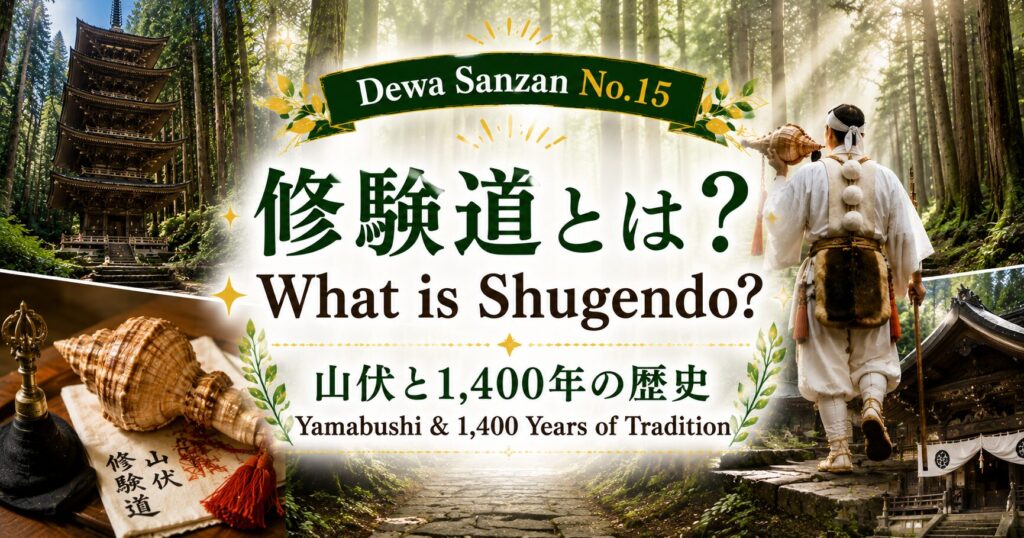
If you walk the stone staircase of Mt. Haguro long enough, you may encounter them: figures in white robes, blowing conch shells, moving through the ancient cedar forest with a quiet sense of purpose.
These are yamabushi — mountain priests — and they are the human thread connecting Dewa Sanzan to over 1,400 years of sacred practice.
The tradition they represent is called Shugendo (修験道). It has no real equivalent in Western religion or Eastern religion as generally understood. It is uniquely Japanese — and understanding it changes how you experience Dewa Sanzan completely.
This article explains what Shugendo is, where it came from, what yamabushi actually do, and how this practice shaped everything you see at Dewa Sanzan today. 😊
→ Dewa Sanzan overview [Article No.1]
→ Mt. Haguro highlights [Article No.5]
What Is Shugendo? The One-Paragraph Answer
Shugendo (修験道) is a uniquely Japanese spiritual practice in which practitioners enter mountains to undergo extreme physical and mental hardship — with the goal of acquiring supernatural powers (called genriki, 験力) that can then be used to heal the sick, pray for rain, protect communities, and perform rituals.
It emerged from the fusion of three distinct traditions: Japan's ancient indigenous mountain worship (the belief that mountains are inhabited by deities), Buddhism (particularly the concept of acquiring spiritual power through ascetic practice), and Taoist and shamanistic elements.
The result is something that doesn't fit cleanly into any standard religious category. Shugendo is not really a 'religion' in the Western sense — it has no fixed creed, no founding text, no single deity. It is better understood as a practice: a set of things that are done, in specific places, in specific ways, that have been done the same way for over a millennium.
Shugendo (修験道)
Shu (修) = to train, to cultivate / Ken (験) = genriki, supernatural power / Do (道) = the Way, the path. Literally: 'The Way of training to acquire supernatural power.' The term captures the essential activity: going into mountains, enduring physical extremity, and emerging with spiritual capability.
Where Does Shugendo Come From?
To understand Shugendo's origins, you need to understand Japan's relationship with mountains.
For as long as Japan has been inhabited, mountains have been understood as inhabited by kami — divine presences. This is not a metaphorical statement in the traditional Japanese worldview. Mountains are literally the home of the gods: unapproachable, dangerous, powerful. Entering a sacred mountain is not hiking. It is an act of spiritual trespass — dangerous and potentially transformative.
When Buddhism arrived in Japan from continental Asia in the 6th century, it encountered this pre-existing mountain worship and, over time, merged with it. Buddhist concepts — of suffering as a path to enlightenment, of ascetic practice as a way of purifying the self, of the practitioner acquiring spiritual power through voluntary hardship — proved deeply compatible with the existing mountain cult.
By the 7th–8th century, a distinctive practice had emerged: entering mountains specifically to undergo the kind of hardship that would strip away the ordinary self and leave behind someone with direct access to spiritual power. This is Shugendo.
En no Gyoja — The Legendary Founder
Shugendo's origin is traditionally attributed to a figure called En no Gyoja (役行者), who lived in the 7th century during Japan's Asuka period. His formal name was En no Ozuno.
According to tradition, En no Gyoja retreated into the mountains of the Kinki region (modern-day Nara and Osaka), underwent extreme ascetic practice, and emerged with extraordinary spiritual powers — the ability to command demons, summon rain, heal sickness, and fly through the air.
He was eventually exiled by the imperial court, reportedly because his powers frightened people in authority — a fate that, in the Shugendo tradition, only confirms his spiritual potency.
He remains the patron saint of Shugendo to this day, and his image appears at sacred sites across Japan.
Who Are the Yamabushi?
The practitioners of Shugendo are called yamabushi (山伏) — a compound meaning 'those who lie down in the mountains.'
The name captures something essential: the yamabushi doesn't visit the mountain. They live in it, sleep in it, suffer in it, until the mountain has done what the mountain does to those who stay long enough.
What Do Yamabushi Actually Do?
The core practice of Shugendo is the peak entry (mine-iri, 峰入り) — a structured retreat into a specific mountain range, lasting days or weeks, during which yamabushi undergo a sequence of prescribed practices:
Waterfall immersion (takigyo, 滝行): Standing under cold mountain waterfalls to purify the body and mind. The cold water is understood as the force that removes the ordinary self.
Goma fire rituals (護摩): Building sacred fires and reciting sutras and mantras over them. The fire is understood to burn away delusion and purify the intention of the practitioner.
Fasting (danjiki, 断食): Abstaining from food for extended periods to sharpen spiritual awareness and demonstrate the transcendence of physical needs.
Sutra chanting and mantra recitation: Reciting Buddhist texts and Shinto prayers continuously during the retreat, often for hours at a time.
Physical endurance: Walking through rough mountain terrain regardless of weather, sleeping on cold ground, and enduring exposure as part of the practice's physical dimension.
The cumulative effect of these practices — the physical depletion, the sleep deprivation, the cold, the sustained chanting, the removal from ordinary life — is understood to dissolve the ego and open the practitioner to direct experience of spiritual reality. Whether understood literally or psychologically, the practice has maintained its form for over 1,300 years.
The Yamabushi's Distinctive Appearance
Yamabushi are immediately recognisable by their distinctive equipment and robes. Every element carries specific symbolic meaning:
Suzukake (篠懸): White or natural-coloured hemp robe — white symbolising purity and the shedding of ordinary identity
Tokin (兜巾): A small black cap tied to the forehead — representing the Buddha's wish-fulfilling jewel
Shakujo (錫杖): A metal staff with rings that jangle with each step — a traditional Buddhist walking implement signifying the dharma
Hora-gai (法螺貝): A large conch shell blown as a horn — the defining Shugendo instrument, used as a signal in the mountains and in rituals
Kyahan (脚絆): White leg wrappings, again for purity
The conch shell in particular has become synonymous with Shugendo. Its low, penetrating resonance carries through cedar forests and mountain valleys in a way that no other instrument can match. When you hear it at Haguro, you are hearing a sound that has echoed through these forests for over a thousand years.
→ Yamabushi costume explained in detail [Article No.25]
Shugendo and Dewa Sanzan — 1,400 Years of Sacred Practice
Nowhere has Shugendo shaped a place more completely than at Dewa Sanzan — and that bond reaches all the way back to Prince Hachiko, the figure traditionally credited with opening Mt. Haguro.
The Foundation: Prince Hachiko
The connection between Shugendo and Dewa Sanzan is traced to the legendary figure of Prince Hachiko (蜂子皇子), a nephew of Prince Shotoku, who fled political persecution at the imperial court and retreated to what is now Mt. Haguro in the early 7th century.
According to tradition, he underwent severe ascetic practice in the mountain, established the sacred site, and attracted disciples who perpetuated the tradition. For 1,400 years, an unbroken line of mountain priests has maintained that original commitment.
→ Prince Hachiko: Who founded Dewa Sanzan? [Article No.19]
The Height of Influence: The Edo Period
Shugendo at Dewa Sanzan reached its peak influence during the Edo period (17th–19th centuries). Mt. Haguro became one of the most significant pilgrimage sites in all of Japan, drawing tens of thousands of visitors annually from across the country.
The yamabushi of Dewa Sanzan were not recluses — they were actively engaged with surrounding communities, travelling throughout the Tohoku region to perform healing rituals, agricultural prayers, exorcisms, and community festivals.
At their peak, there were estimated to be over 2,000 yamabushi based at Haguro alone.
The Meiji Crisis and the Suppression of Shugendo
The Meiji Restoration of 1868 brought Japan's new government into direct conflict with Shugendo. The government's policy of separating Buddhism and Shinto (Shinbutsu bunri) — designed to elevate Shinto as the state religion — targeted the Buddhist-Shinto fusion that was the essence of Shugendo.
In 1872, the Meiji government issued an edict banning Shugendo practice outright. Yamabushi were required to either become Shinto priests or Buddhist monks — they could not remain yamabushi. Almost overnight, a 1,200-year tradition was officially abolished.
At Dewa Sanzan, many Buddhist elements were forcibly removed. Temples were converted or demolished. The physical evidence of syncretism was systematically erased — with the significant exception of the Five-Storied Pagoda, which survived through a combination of circumstance and advocacy.
→ The separation of Buddhism and Shinto at Dewa Sanzan [Article No.20]
The Cultural Legacy of Shugendo
Even setting aside its religious significance, Shugendo produced cultural artefacts that define the Dewa Sanzan landscape.
Architecture
The Five-Storied Pagoda, the Sanjin Gosaiden, the shukubo lodges, the entire physical infrastructure of Dewa Sanzan — all of this was built to serve the Shugendo practice and the pilgrimage tradition it generated.
The thatched roof of the Sanjin Gosaiden, which unifies the three mountains' deities under one structure, directly reflects the syncretic worldview of Shugendo.
Performing Arts
Yamabushi-kagura (山伏神楽) and other ritual performance traditions that emerged from Shugendo practice survive throughout the Tohoku region.
These are not reconstructed heritage performances — many continue as living traditions, performed by communities that have maintained them for centuries.
Agriculture and Community Life
For most of Japanese history, yamabushi were the primary interface between ordinary communities and the spiritual world. They prayed for good harvests, performed healing rituals for the sick, managed the community's relationship with the mountain deities. Their role was practical as well as spiritual.
This practical dimension is sometimes forgotten. Shugendo was not an abstract spiritual pursuit. It was a service — the yamabushi went into the mountain so that the rest of the community didn't have to, and came back with whatever the mountain had to give.
Wrap-up
Understanding Shugendo doesn't require religious belief. It requires only the recognition that for over a thousand years, people found something in these mountains that was worth extraordinary effort to access — and that they organised a sophisticated, durable practice around the act of accessing it.
Dewa Sanzan stands among the most important centres of this tradition anywhere in Japan, having kept the practice of Shugendo alive for more than 1,400 years.
When you walk the stone staircase at Haguro, you are walking a route that yamabushi have walked for 1,400 years. When you hear a conch shell in the forest, you are hearing an instrument that has shaped the acoustic memory of this place across more than a millennium. When you stand before the Sanjin Gosaiden at the summit, you stand at the end of a pilgrimage that has transformed thousands of people before you.
That history doesn't require explanation to be felt. But knowing it helps. 😊
What Shugendo looks like today — and how you can experience it for yourself — is covered in separate articles.
→ Modern yamabushi — how to meet them today [Article No.26]
→ Peak entry training: can I participate? [Article No.27]
→ Shinbutsu bunri: the forced separation of Buddhism and Shinto [Article No.20]
Guesthouse Watausagi sits right in the heart of Dewa Sanzan territory — perfectly positioned between Hagurosan, Gassan, and Yudonosan. Guests come from across Japan and around the world to explore these sacred mountains. Make Watausagi your base and discover the spiritual world of Dewa Sanzan! 😊
We also share the charms of our home region — Yamagata, Tsuruoka, and the Shonai area.
I'm always sharing updates and local tips on Instagram Stories. Follow us on Instagram and stay in the loop! 😊
And a like or a share is always, always appreciated 💕
📖 やまがたいいとこ の関連記事
 Demons Dancing on Mount Haguro!?
 Why a dragon god at a Buddhist temple? The mystery of Zenpoji (Tsuruoka) and its sea-guarding dragon faith
 Michelin-Starred Sakata: A Two-Star Tour Built on the Wealth of the Kitamae Ships
- STAY WITH US -
Your Base for Exploring Tsuruoka
A small guesthouse in central Tsuruoka, Yamagata. The perfect base for your trip to Dewa Sanzan and Shonai.
Book Now →